


EN 1127-1:2007
(Main)Explosive atmospheres - Explosion prevention and protection - Part 1: Basic concepts and methodology
General Information
- Abstract
This European Standard specifies methods for the identification and assessment of hazardous situations leading to explosion and the design and construction measures appropriate for the required safety. This is achieved by:
hazard identification;
risk assessment;
reduction of risk;
information for use.
The safety of equipment, protective systems and components can be achieved by eliminating of hazards and/or limiting the risk, i.e. by:
a) design without using safeguarding;
b) safeguarding;
c) communication links if necessary to convey information to the user;
d) any other precautions.
Measures in accordance with a) (prevention) and b) (protection) against explosions are dealt with in Clause 6, measures according to c) against explosions are dealt with in Clause 7. Measures in accordance with d) are not specified in this European Standard. They are dealt with in EN ISO 12100-1:2003, Clause 5.
The preventive and protective measures described in this European Standard will not provide the required level of safety unless the equipment, protective systems and components are operated within their intended use and are installed and maintained according to the relevant codes of practice or requirements.
This standard specifies general design and construction methods to help designers and manufacturers in achieving explosion safety in the design of equipment, protective systems and components.
This European Standard is applicable to any equipment, protective systems and components intended to be used in potentially explosive atmospheres, under atmospheric conditions. These atmospheres can arise from flammable materials processed, used or released by the equipment, protective systems and components or from materials in the vicinity of the equipment, protective systems and components and/or from the materials of construction of the equipment, protective systems and components.
This European Standard is applicable to equipment, protective systems and compon
- Status
- Withdrawn
- Publication Date
- 27-Nov-2007
- Withdrawal Date
- 19-Jul-2011
- Technical Committee
- CEN/TC 305 - Potentially explosive atmospheres - Explosion prevention and protection
- Drafting Committee
- CEN/TC 305/WG 4 - Terminology and Methodology
- Current Stage
- 9960 - Withdrawal effective - Withdrawal
- Start Date
- 20-Jul-2011
- Completion Date
- 20-Jul-2011
- Directive
- Harmonized Standard2006/42/EC - Directive 2006/42/EC of the European Parliament and of the Council of 17 May 2006 on machinery, and amending Directive 95/16/EC (recast)OJ Ref: C, C 309 OJ Date: 18-Dec-2009
Not Harmonized94/9/EC - Equipment and protective systems intended for use in potentially explosive atmospheres (ATEX)OJ Ref: C, C 90 OJ Date: 11-Apr-2008
Not Harmonized98/37/EC - Machinery

Relations
- Effective Date
- 22-Dec-2008
- Effective Date
- 08-Jun-2022
- Effective Date
- 28-Jan-2026
- Effective Date
- 28-Jan-2026
- Effective Date
- 28-Jan-2026
- Effective Date
- 28-Jan-2026
- Effective Date
- 28-Jan-2026
- Effective Date
- 28-Jan-2026
- Effective Date
- 28-Jan-2026
- Effective Date
- 28-Jan-2026
Get Certified
Connect with accredited certification bodies for this standard

IMQ S.p.A. (Certification)
Italian electrical product certification.

SLG Prüf- und Zertifizierungs GmbH
German testing and certification body.

UL Solutions
Global safety science company with testing, inspection and certification.
Sponsored listings
Frequently Asked Questions
EN 1127-1:2007 is a standard published by the European Committee for Standardization (CEN). Its full title is "Explosive atmospheres - Explosion prevention and protection - Part 1: Basic concepts and methodology". This standard covers: This European Standard specifies methods for the identification and assessment of hazardous situations leading to explosion and the design and construction measures appropriate for the required safety. This is achieved by: hazard identification; risk assessment; reduction of risk; information for use. The safety of equipment, protective systems and components can be achieved by eliminating of hazards and/or limiting the risk, i.e. by: a) design without using safeguarding; b) safeguarding; c) communication links if necessary to convey information to the user; d) any other precautions. Measures in accordance with a) (prevention) and b) (protection) against explosions are dealt with in Clause 6, measures according to c) against explosions are dealt with in Clause 7. Measures in accordance with d) are not specified in this European Standard. They are dealt with in EN ISO 12100-1:2003, Clause 5. The preventive and protective measures described in this European Standard will not provide the required level of safety unless the equipment, protective systems and components are operated within their intended use and are installed and maintained according to the relevant codes of practice or requirements. This standard specifies general design and construction methods to help designers and manufacturers in achieving explosion safety in the design of equipment, protective systems and components. This European Standard is applicable to any equipment, protective systems and components intended to be used in potentially explosive atmospheres, under atmospheric conditions. These atmospheres can arise from flammable materials processed, used or released by the equipment, protective systems and components or from materials in the vicinity of the equipment, protective systems and components and/or from the materials of construction of the equipment, protective systems and components. This European Standard is applicable to equipment, protective systems and compon
This European Standard specifies methods for the identification and assessment of hazardous situations leading to explosion and the design and construction measures appropriate for the required safety. This is achieved by: hazard identification; risk assessment; reduction of risk; information for use. The safety of equipment, protective systems and components can be achieved by eliminating of hazards and/or limiting the risk, i.e. by: a) design without using safeguarding; b) safeguarding; c) communication links if necessary to convey information to the user; d) any other precautions. Measures in accordance with a) (prevention) and b) (protection) against explosions are dealt with in Clause 6, measures according to c) against explosions are dealt with in Clause 7. Measures in accordance with d) are not specified in this European Standard. They are dealt with in EN ISO 12100-1:2003, Clause 5. The preventive and protective measures described in this European Standard will not provide the required level of safety unless the equipment, protective systems and components are operated within their intended use and are installed and maintained according to the relevant codes of practice or requirements. This standard specifies general design and construction methods to help designers and manufacturers in achieving explosion safety in the design of equipment, protective systems and components. This European Standard is applicable to any equipment, protective systems and components intended to be used in potentially explosive atmospheres, under atmospheric conditions. These atmospheres can arise from flammable materials processed, used or released by the equipment, protective systems and components or from materials in the vicinity of the equipment, protective systems and components and/or from the materials of construction of the equipment, protective systems and components. This European Standard is applicable to equipment, protective systems and compon
EN 1127-1:2007 is classified under the following ICS (International Classification for Standards) categories: 29.260.20 - Electrical apparatus for explosive atmospheres. The ICS classification helps identify the subject area and facilitates finding related standards.
EN 1127-1:2007 has the following relationships with other standards: It is inter standard links to EN 1127-1:1997, EN 1127-1:2011, EN 13463-1:2009, EN 1010-2:2006+A1:2010, EN 12757-1:2005+A1:2010, EN 930:1997+A2:2009, EN 12621:2006+A1:2010, EN 1010-1:2004+A1:2010, EN 13457:2004+A1:2010, EN 12779:2004+A1:2009. Understanding these relationships helps ensure you are using the most current and applicable version of the standard.
EN 1127-1:2007 is associated with the following European legislation: EU Directives/Regulations: 2006/42/EC, 94/9/EC, 98/37/EC; Standardization Mandates: M/396, M/BC/CEN/88/13, M/BC/CEN/92/46. When a standard is cited in the Official Journal of the European Union, products manufactured in conformity with it benefit from a presumption of conformity with the essential requirements of the corresponding EU directive or regulation.
EN 1127-1:2007 is available in PDF format for immediate download after purchase. The document can be added to your cart and obtained through the secure checkout process. Digital delivery ensures instant access to the complete standard document.
Standards Content (Sample)
2003-01.Slovenski inštitut za standardizacijo. Razmnoževanje celote ali delov tega standarda ni dovoljeno.Explosive atmospheres - Explosion prevention and protection - Part 1: Basic concepts and methodologyAtmospheres explosives - Prévention de l'explosion et protection contre l'explosion - Partie 1 : Notions fondamentales et méthodologieExplosionsfähige Atmosphären - Explosionsschutz - Teil 1: Grundlagen und MethodikTa slovenski standard je istoveten z:EN 1127-1:2007SIST EN 1127-1:2008en,fr,de13.230Varstvo pred eksplozijoExplosion protectionICS:SLOVENSKI
STANDARDSIST EN 1127-1:200801-februar-2008
EUROPEAN STANDARDNORME EUROPÉENNEEUROPÄISCHE NORMEN 1127-1November 2007ICS 29.260.20Supersedes EN 1127-1:1997
English VersionExplosive atmospheres - Explosion prevention and protection -Part 1: Basic concepts and methodologyAtmosphères explosives - Prévention de l'explosion etprotection contre l'explosion - Partie 1: Notionsfondamentales et méthodologieExplosionsfähige Atmosphären - Explosionsschutz - Teil 1:Grundlagen und MethodikThis European Standard was approved by CEN on 21 October 2007.CEN members are bound to comply with the CEN/CENELEC Internal Regulations which stipulate the conditions for giving this EuropeanStandard the status of a national standard without any alteration. Up-to-date lists and bibliographical references concerning such nationalstandards may be obtained on application to the CEN Management Centre or to any CEN member.This European Standard exists in three official versions (English, French, German). A version in any other language made by translationunder the responsibility of a CEN member into its own language and notified to the CEN Management Centre has the same status as theofficial versions.CEN members are the national standards bodies of Austria, Belgium, Bulgaria, Cyprus, Czech Republic, Denmark, Estonia, Finland,France, Germany, Greece, Hungary, Iceland, Ireland, Italy, Latvia, Lithuania, Luxembourg, Malta, Netherlands, Norway, Poland, Portugal,Romania, Slovakia, Slovenia, Spain, Sweden, Switzerland and United Kingdom.EUROPEAN COMMITTEE FOR STANDARDIZATIONCOMITÉ EUROPÉEN DE NORMALISATIONEUROPÄISCHES KOMITEE FÜR NORMUNGManagement Centre: rue de Stassart, 36
B-1050 Brussels© 2007 CENAll rights of exploitation in any form and by any means reservedworldwide for CEN national Members.Ref. No. EN 1127-1:2007: E
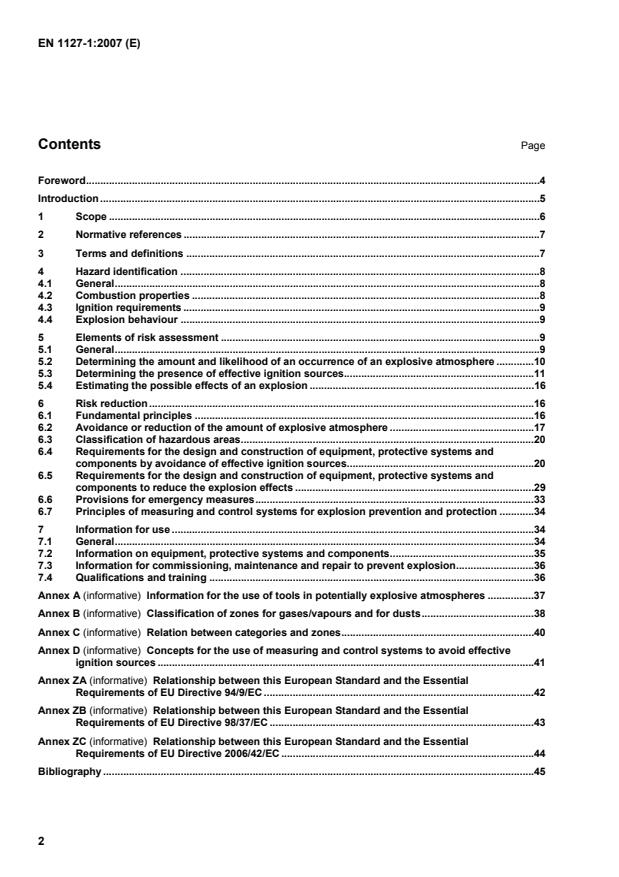
Information for the use of tools in potentially explosive atmospheres.37 Annex B (informative)
Classification of zones for gases/vapours and for dusts.38 Annex C (informative)
Relation between categories and zones.40 Annex D (informative)
Concepts for the use of measuring and control systems to avoid effective ignition sources.41 Annex ZA (informative)
Relationship between this European Standard and the Essential Requirements of EU Directive 94/9/EC.42 Annex ZB (informative)
Relationship between this European Standard and the Essential Requirements of EU Directive 98/37/EC.43 Annex ZC (informative)
Relationship between this European Standard and the Essential Requirements of EU Directive 2006/42/EC.44 Bibliography.45
Tables Table C.1 — Relation between categories and zones.40 Table C.2 — Applicable equipment in the different zones.40 Table D.1 — Additional measuring and control systems necessary to avoid effective ignition sources.41 Table ZA — Correspondence between this European Standard and Directive 94/9/EC.42
Flammable and/or combustible substances shall be considered as materials which can form an explosive atmosphere unless an investigation of their properties has shown that in mixtures with air they are incapable of self-sustained propagation of an explosion.
This potential hazard associated with explosive atmosphere is released when ignited by an effective ignition source. The safety data listed in 4.2, 4.3 and 4.4 describe safety relevant properties of substances. They can be obtained by laboratory experiments and in a few cases also by calculation methods1). The safety data obtained are used for the identification of the hazard. It is necessary to bear in mind that such safety data are not physical constants but depend for instance on the techniques used for their measurement. Also, for dusts, tabulated safety data are for guidance only because the values depend on particle size and shape, moisture content and the presence of additives even in trace concentrations. For a specific application, samples of the dust to be present in the equipment should be tested and the data obtained used in the identification of the hazard.
4.2 Combustion properties Since in this context it is not the material itself that represents the potential hazard but its contact or mixing with the air, the properties of the mixture of the flammable substance with air shall be determined. These properties give information about a substance's burning behaviour and whether it could give rise to fire or explosions. Relevant data are e.g. a) flash point; b) explosion limits (LEL, UEL); c) limiting oxygen concentration (LOC).
1) Appropriate standards have been or are being developed by CEN and CENELEC, see also Bibliography.
Shock waves are generated, for example, during the sudden relief of high-pressure gases into pipelines. In this process the shock waves are propagated into regions of lower pressure faster than the speed of sound. When they are diffracted or reflected by pipe bends, constrictions, connection flanges, closed valves etc., very high temperatures can occur. NOTE 2 Equipment, protective systems and components containing highly oxidizing gases, e.g. pure oxygen or gas atmospheres with a high oxygen concentration, can become an effective ignition source under the action of adiabatic compression, shock waves or even pure flow because lubricants, gaskets and even construction materials can be ignited. If this leads to destruction of the equipment, protective systems and components, parts of it will ignite a surrounding explosive atmosphere. For protective measures against ignition hazards due to adiabatic compression and shock waves, see 6.4.13. 5.3.14 Exothermic reactions, including self-ignition of dusts Exothermic reactions can act as an ignition source when the rate of heat generation exceeds the rate of heat loss to the surroundings. Many chemical reactions are exothermic. Whether a reaction can reach a high temperature is dependent, among other parameters, on the volume/surface ratio of the reacting system, the ambient temperature and the residence time. These high temperatures can lead to ignition of explosive atmospheres and also the initiation of smouldering and/or burning. Such reactions include those of pyrophoric substances with air, alkali metals with water, self-ignition of combustible dusts2), self-heating of feed-stuffs, induced by biological processes, the decomposition of organic peroxides, or polymerization reactions. Catalysts can also induce energy-producing reactions (e.g. hydrogen/air atmospheres and platinum).
2) For determination of the spontaneous ignition behaviour of dust accumulations see EN 15188.
...