


EN ISO 17262:2012/AC:2013
(Corrigendum)Intelligent transport systems - Automatic vehicle and equipment identification - Numbering and data structures - Technical Corrigendum 1 (ISO 17262:2012/Cor 1:2013)
General Information
- Abstract
This International Standard defines generic numbering and data structures for unambiguous identification of equipment used for Intermodal goods transport. These data are known as ‘Intermodal Goods Transport Numbering and Data Structures’. This International Standard defines data independently of the data carrier. The modelling of data is based on ‘Abstract Syntax Notation One’ (ASN.1) as defined in ISO/IEC 8824.this International Standard excludes any physical aspects such as interfaces, dimensions etc. Data that form part of transmission or storage protocols (headers, frame markers and checksums) are excluded. Data defined in this International Standard require a system for control and distribution of number series independent of the different AVI/AEI systems. This is required in order to avoid ambiguity and to provide the necessary level of security where appropriate. For this reason the registration authority defined in ENV ISO 14816 applies for this International Standard. This International Standard enables the use of optimised encoding schemes such as ASN.1 Packed Encoding Rules’ (PER). This International Standard provides interoperability, not only between simple AVI/AEI and more complex ITS/RTTT functions, but also with pre-existing standards such as container (ISO 10374). Specifications for protecting against changes, classifying and qualifying security aspects of the data are out of scope of this International Standard. This International Standard relates to AVI/AEI units, but not to smaller containers and units being transported. For smaller units (pallet loads, trays, parcels etc.) please refer to ISO 26683 and ISO/IEC SC31 standards, ISO 18000 series, etc.. However, CS10 defined herein, provides a means to provide land conveyance content data using such standards. The numbering structure defined in this International Standard is designed to enable combinations with the data definitions from ISO18000 series. This combination is covered in CEN ISO/TS 17264. This International Standard provides the capability to carry application data, associated with the identification, to be carried as part of the AVI/AEI message. Within this International Standard this is provided as a “black box” facility. The definition of the structure and contents of such messages are outside the scope of this International Standard (examples are shown in CEN ISO/TS 17264).
- Status
- Published
- Publication Date
- 17-Dec-2013
- Technical Committee
- CEN/TC 278 - Road transport and traffic telematics
- Current Stage
- 6060 - Definitive text made available (DAV) - Publishing
- Start Date
- 18-Dec-2013
- Completion Date
- 18-Dec-2013


Relations
- Effective Date
- 18-Dec-2013
Get Certified
Connect with accredited certification bodies for this standard

BSI Group
BSI (British Standards Institution) is the business standards company that helps organizations make excellence a habit.

Great Wall Tianjin Quality Assurance Center
Established 1993, first batch to receive national accreditation with IAF recognition.
Hong Kong Quality Assurance Agency (HKQAA)
Hong Kong's leading certification body.
Sponsored listings
Frequently Asked Questions
EN ISO 17262:2012/AC:2013 is a corrigendum published by the European Committee for Standardization (CEN). Its full title is "Intelligent transport systems - Automatic vehicle and equipment identification - Numbering and data structures - Technical Corrigendum 1 (ISO 17262:2012/Cor 1:2013)". This standard covers: This International Standard defines generic numbering and data structures for unambiguous identification of equipment used for Intermodal goods transport. These data are known as ‘Intermodal Goods Transport Numbering and Data Structures’. This International Standard defines data independently of the data carrier. The modelling of data is based on ‘Abstract Syntax Notation One’ (ASN.1) as defined in ISO/IEC 8824.this International Standard excludes any physical aspects such as interfaces, dimensions etc. Data that form part of transmission or storage protocols (headers, frame markers and checksums) are excluded. Data defined in this International Standard require a system for control and distribution of number series independent of the different AVI/AEI systems. This is required in order to avoid ambiguity and to provide the necessary level of security where appropriate. For this reason the registration authority defined in ENV ISO 14816 applies for this International Standard. This International Standard enables the use of optimised encoding schemes such as ASN.1 Packed Encoding Rules’ (PER). This International Standard provides interoperability, not only between simple AVI/AEI and more complex ITS/RTTT functions, but also with pre-existing standards such as container (ISO 10374). Specifications for protecting against changes, classifying and qualifying security aspects of the data are out of scope of this International Standard. This International Standard relates to AVI/AEI units, but not to smaller containers and units being transported. For smaller units (pallet loads, trays, parcels etc.) please refer to ISO 26683 and ISO/IEC SC31 standards, ISO 18000 series, etc.. However, CS10 defined herein, provides a means to provide land conveyance content data using such standards. The numbering structure defined in this International Standard is designed to enable combinations with the data definitions from ISO18000 series. This combination is covered in CEN ISO/TS 17264. This International Standard provides the capability to carry application data, associated with the identification, to be carried as part of the AVI/AEI message. Within this International Standard this is provided as a “black box” facility. The definition of the structure and contents of such messages are outside the scope of this International Standard (examples are shown in CEN ISO/TS 17264).
This International Standard defines generic numbering and data structures for unambiguous identification of equipment used for Intermodal goods transport. These data are known as ‘Intermodal Goods Transport Numbering and Data Structures’. This International Standard defines data independently of the data carrier. The modelling of data is based on ‘Abstract Syntax Notation One’ (ASN.1) as defined in ISO/IEC 8824.this International Standard excludes any physical aspects such as interfaces, dimensions etc. Data that form part of transmission or storage protocols (headers, frame markers and checksums) are excluded. Data defined in this International Standard require a system for control and distribution of number series independent of the different AVI/AEI systems. This is required in order to avoid ambiguity and to provide the necessary level of security where appropriate. For this reason the registration authority defined in ENV ISO 14816 applies for this International Standard. This International Standard enables the use of optimised encoding schemes such as ASN.1 Packed Encoding Rules’ (PER). This International Standard provides interoperability, not only between simple AVI/AEI and more complex ITS/RTTT functions, but also with pre-existing standards such as container (ISO 10374). Specifications for protecting against changes, classifying and qualifying security aspects of the data are out of scope of this International Standard. This International Standard relates to AVI/AEI units, but not to smaller containers and units being transported. For smaller units (pallet loads, trays, parcels etc.) please refer to ISO 26683 and ISO/IEC SC31 standards, ISO 18000 series, etc.. However, CS10 defined herein, provides a means to provide land conveyance content data using such standards. The numbering structure defined in this International Standard is designed to enable combinations with the data definitions from ISO18000 series. This combination is covered in CEN ISO/TS 17264. This International Standard provides the capability to carry application data, associated with the identification, to be carried as part of the AVI/AEI message. Within this International Standard this is provided as a “black box” facility. The definition of the structure and contents of such messages are outside the scope of this International Standard (examples are shown in CEN ISO/TS 17264).
EN ISO 17262:2012/AC:2013 is classified under the following ICS (International Classification for Standards) categories: 03.220.20 - Road transport; 35.240.60 - IT applications in transport. The ICS classification helps identify the subject area and facilitates finding related standards.
EN ISO 17262:2012/AC:2013 has the following relationships with other standards: It is inter standard links to EN ISO 17262:2012. Understanding these relationships helps ensure you are using the most current and applicable version of the standard.
EN ISO 17262:2012/AC:2013 is available in PDF format for immediate download after purchase. The document can be added to your cart and obtained through the secure checkout process. Digital delivery ensures instant access to the complete standard document.
Standards Content (Sample)
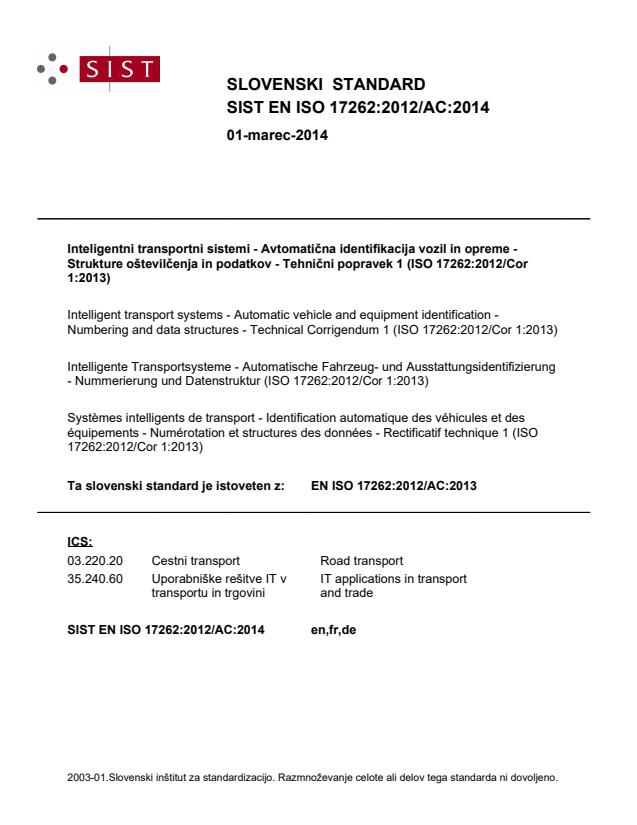
2003-01.Slovenski inštitut za standardizacijo. Razmnoževanje celote ali delov tega standarda ni dovoljeno.&RUIntelligente Transportsysteme - Automatische Fahrzeug- und Ausstattungsidentifizierung - Nummerierung und Datenstruktur (ISO 17262:2012/Cor 1:2013)Systèmes intelligents de transport - Identification automatique des véhicules et des équipements - Numérotation et structures des données - Rectificatif technique 1 (ISO 17262:2012/Cor 1:2013)Intelligent transport systems - Automatic vehicle and equipment identification - Numbering and data structures - Technical Corrigendum 1 (ISO 17262:2012/Cor 1:2013)35.240.60Uporabniške rešitve IT v transportu in trgoviniIT applications in transport and trade03.220.20Cestni transportRoad transportICS:Ta slovenski standard je istoveten z:EN ISO 17262:2012/AC:2013SIST EN ISO 17262:2012/AC:2014en,fr,de01-marec-2014SIST EN ISO 17262:2012/AC:2014SLOVENSKI
STANDARD
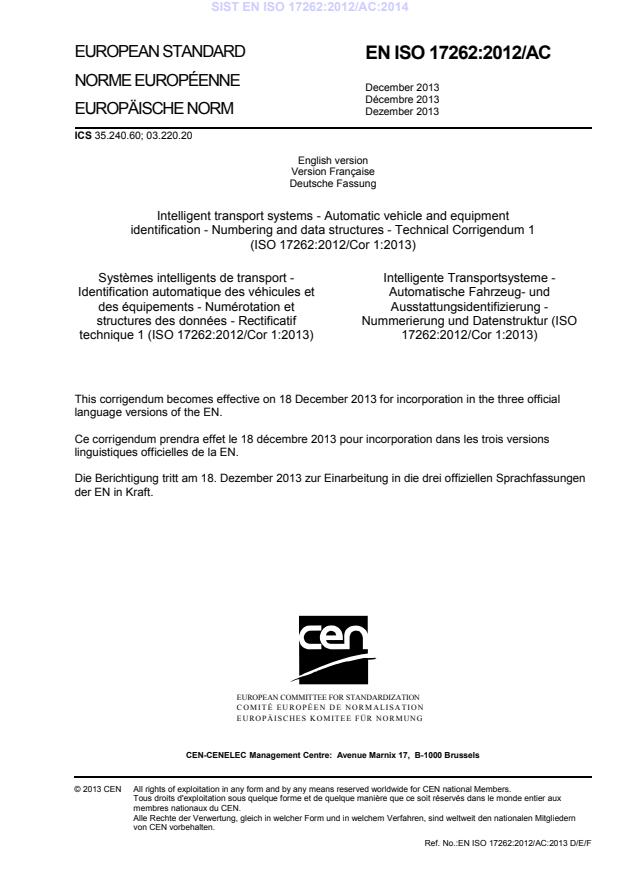
EUROPEAN STANDARD NORME EUROPÉENNE EUROPÄISCHE NORM
EN ISO 17262:2012/AC
December 2013
Décembre 2013
Dezember 2013 ICS 35.240.60; 03.220.20 English version Version Française Deutsche Fassung
Intelligent transport systems - Automatic vehicle and equipment identification - Numbering and data structures - Technical Corrigendum 1 (ISO 17262:2012/Cor 1:2013)
Systèmes intelligents de transport - Identification automatique des véhicules et des équipements - Numérotation et structures des données - Rectificatif technique 1 (ISO 17262:2012/Cor 1:2013) Intelligente Transportsysteme - Automatische Fahrzeug- und Ausstattungsidentifizierung - Nummerierung und Datenstruktur (ISO 17262:2012/Cor 1:2013) This corrigendum becomes effective on 18 December 2013 for incorporation in the three official language versions of the EN.
Ce corrigendum prendra effet le 18 décembre 2013 pour incorporation dans les trois versions linguistiques officielles de la EN.
Die Berichtigung tritt am 18. Dezember 2013 zur Einarbeitung in die drei offiziellen Sprachfassungen der EN in Kraft.
EUROPEAN COMMITTEE FOR STANDARDIZATION
COMITÉ EUROPÉEN DE NORMALISATION EUROPÄISCHES KOMITEE FÜR NORMUNG
CEN-CENELEC Management Centre:
Avenue Marnix 17,
B-1000 Brussels © 2013 CEN All rights of exploitation in any form and by any means reserved worldwide fo
...