


EN 12500:2000
(Main)Protection of metallic materials against corrosion - Corrosion likelihood in atmospheric environment - Classification, determination and estimation of corrosivity of atmospheric environments
General Information
- Abstract
This EN establishes a classification system for the corrosivity of atmospheric environments. It: - defines corrosivity categories of the atmospheric environments taking into account ISO 9223; - describes the determination of corrosivity based on assessment of mass loss of standard specimens after the first year of exposure; - can be used to estimate the corrosivity of an environment based on knowledge of local conditions or of specific data that characterize the local conditions, where it is not possible to make an experimental determination.
- Status
- Withdrawn
- Publication Date
- 20-Jun-2000
- Withdrawal Date
- 31-Jan-2012
- Technical Committee
- CEN/TC 262 - Metallic and other inorganic coatings
- Drafting Committee
- CEN/TC 262/WG 10 - Corrosion likelihood
- Current Stage
- 9960 - Withdrawal effective - Withdrawal
- Start Date
- 01-Feb-2012
- Completion Date
- 01-Feb-2012

Relations
- Effective Date
- 08-Jun-2022
- Effective Date
- 08-Jun-2022
- Effective Date
- 08-Jun-2022
- Effective Date
- 08-Jun-2022
Get Certified
Connect with accredited certification bodies for this standard

Element Materials Technology
Materials testing and product certification.

Inštitut za kovinske materiale in tehnologije
Institute of Metals and Technology. Materials testing, metallurgical analysis, NDT.
Sponsored listings
Frequently Asked Questions
EN 12500:2000 is a standard published by the European Committee for Standardization (CEN). Its full title is "Protection of metallic materials against corrosion - Corrosion likelihood in atmospheric environment - Classification, determination and estimation of corrosivity of atmospheric environments". This standard covers: This EN establishes a classification system for the corrosivity of atmospheric environments. It: - defines corrosivity categories of the atmospheric environments taking into account ISO 9223; - describes the determination of corrosivity based on assessment of mass loss of standard specimens after the first year of exposure; - can be used to estimate the corrosivity of an environment based on knowledge of local conditions or of specific data that characterize the local conditions, where it is not possible to make an experimental determination.
This EN establishes a classification system for the corrosivity of atmospheric environments. It: - defines corrosivity categories of the atmospheric environments taking into account ISO 9223; - describes the determination of corrosivity based on assessment of mass loss of standard specimens after the first year of exposure; - can be used to estimate the corrosivity of an environment based on knowledge of local conditions or of specific data that characterize the local conditions, where it is not possible to make an experimental determination.
EN 12500:2000 is classified under the following ICS (International Classification for Standards) categories: 77.060 - Corrosion of metals. The ICS classification helps identify the subject area and facilitates finding related standards.
EN 12500:2000 has the following relationships with other standards: It is inter standard links to EN ISO 9223:2012, EN ISO 9225:2012, EN ISO 9224:2012, EN ISO 9226:2012. Understanding these relationships helps ensure you are using the most current and applicable version of the standard.
EN 12500:2000 is available in PDF format for immediate download after purchase. The document can be added to your cart and obtained through the secure checkout process. Digital delivery ensures instant access to the complete standard document.
Standards Content (Sample)
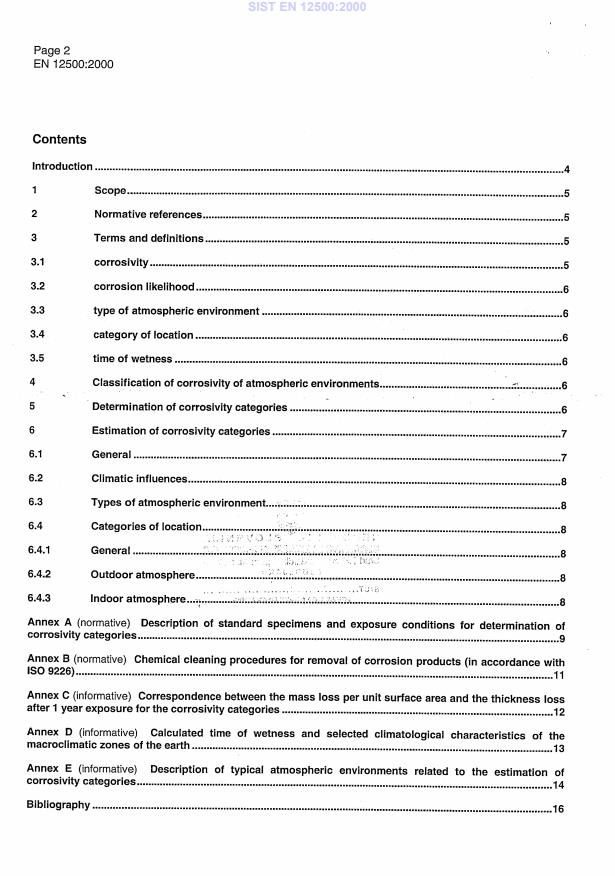
2003-01.Slovenski inštitut za standardizacijo. Razmnoževanje celote ali delov tega standarda ni dovoljeno.ROMLKKorrosionsschutz metallischer Werkstoffe - Korrosionswahrscheinlichkeit in einer atmosphärischen Umgebung - Einteilung, Bestimmung und Abschätzung der Korrosivität von atmosphärischen UmgebungenProtection des matériaux métalliques contre la corrosion - Risque de corrosion dans un environnement atmosphérique - Classification, détermination et appréciation de la corrosité des environnements atmosphériquesProtection of metallic materials against corrosion - Corrosion likelihood in atmospheric environment - Cl
...