


EN 15333-2:2009
(Main)Respiratory equipment - Open-circuit umbilical supplied compressed gas diving apparatus - Part 2: Free flow apparatus
Respiratory equipment - Open-circuit umbilical supplied compressed gas diving apparatus - Part 2: Free flow apparatus
This European Standard specifies minimum requirements for free flow surface supplied and free flow surface oriented diving apparatus to ensure a minimum level of safe operation of the apparatus. It applies to the following:
a maximum depth of 50 m for apparatus using:
1) air or;
2) oxygen or;
3) oxygen in nitrogen mixtures (Nitrox) or;
4) oxygen in helium mixtures (Heliox) or;
5) oxygen, nitrogen and helium mixtures (Trimix);
water temperatures between 4 °C and 34 °C or outside these temperatures as specified by the manufacturer;
environmental temperatures between -20 °C and 50 °C or outside these temperatures as specified by the manufacturer.
The requirements of this European Standard are intended to take account of the interaction between the wearer, the apparatus, and where possible the environment in which the apparatus is likely to be used.
This European Standard does not cover saturation diving systems, mini bell systems or apparatus used for oxygen decompression only.
Atemgeräte - Schlauchversorgte Leichttauchgeräte mit Druckgas - Teil 2: Geräte mit konstantem Volumenstrom
Diese Europäische Norm legt Mindestanforderungen für schlauchversorgte Leichttauchgeräte mit konstantem
Volumenstrom fest, um ein Mindestmaß an Sicherheit für den Betrieb des Gerätes sicherzustellen. Sie gilt für
Folgendes:
- eine maximale Tiefe von 50 m für Geräte mit
a) Luft oder;
b) Sauerstoff oder;
c) Sauerstoff/Stickstoff-Gemischen (Nitrox) oder;
d) Sauerstoff/Helium-Gemischen (Heliox) oder;
e) Sauerstoff/Stickstoff/Helium-Gemischen (Trimix);
- Wassertemperaturen zwischen 4 °C und 34 °C oder außerhalb dieser Temperaturen, wie vom Hersteller
festgelegt;
- Umgebungstemperaturen zwischen –20 °C und 50 °C oder außerhalb dieser Temperaturen, wie vom
Hersteller festgelegt.
Die Anforderungen dieser Europäischen Norm sind dafür vorgesehen, die Interaktion zwischen Gerätträger,
Gerät und, wo möglich, der Umgebung, in der das Gerät wahrscheinlich benutzt werden soll, zu berücksichtigen.
Diese Europäische Norm gilt nicht für Sättigungstauchsysteme, Taucherglockensysteme und Geräte, die nur
zur Sauerstoffdekompression benutzt werden.
Equipements respiratoires - Appareils de plongée narguilé à gaz comprimé et à circuit ouvert - Partie 2: Appareils à débit continu
La présente Norme européenne spécifie les exigences minimales qui s’appliquent aux appareils de plongée à écoulement libre avec alimentation en surface et aux appareils de plongée à écoulement libre orientés vers la surface, dans le but de garantir un niveau minimal de sécurité en fonctionnement de l’appareil. Elle s’applique :
à une profondeur maximale de 50 m pour les appareils utilisant de l’air, de l’oxygène ou de l’oxygène dans les mélanges à base d’azote ;
à une profondeur maximale de 60 m pour les appareils utilisant de l’oxygène, de l’oxygène et de l’hélium ou des mélanges d’oxygène, d’azote et d’hélium ;
à des températures d’eau comprises entre 4 °C et 34 °C ou en dehors de cette plage de températures comme spécifié par le fabricant.
Les exigences de la présente norme européenne sont conçues pour tenir compte de l’interaction entre l’utilisateur, l’appareil, et, dans la mesure du possible, l’environnement dans lequel l’appareil est susceptible d’être utilisé.
La présente norme européenne ne couvre pas les systèmes de plongée en saturation, ni les systèmes de mini-ceinture, ni les appareils utilisés uniquement pour la décompression à l’oxygène.
Oprema za dihanje - Potapljaški dihalni aparat z odprtim krogom in sredinskim dovodom stisnjenega plina - 2. del: Aparat s konstantnim volumenskim pretokom
General Information
Standards Content (Sample)
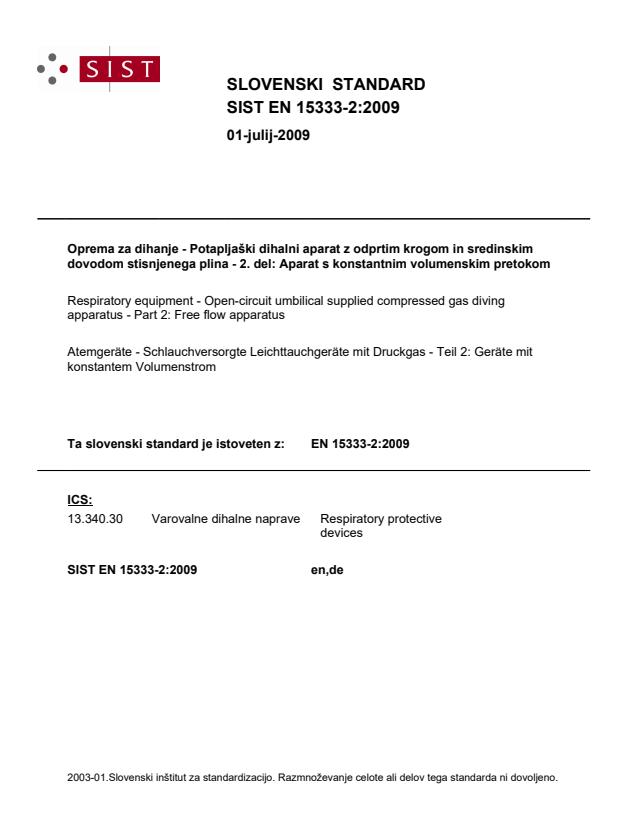
2003-01.Slovenski inštitut za standardizacijo. Razmnoževanje celote ali delov tega standarda ni dovoljeno.Oprema za dihanje - Potapljaški dihalni aparat z odprtim krogom in sredinskim dovodom stisnjenega plina - 2. del: Aparat s konstantnim volumenskim pretokomAtemgeräte - Schlauchversorgte Leichttauchgeräte mit Druckgas - Teil 2: Geräte mit konstantem VolumenstromRespiratory equipment - Open-circuit umbilical supplied compressed gas diving apparatus - Part 2: Free flow apparatus13.340.30Varovalne dihalne napraveRespiratory protective devicesICS:Ta slovenski standard je istoveten z:EN 15333-2:2009SIST EN 15333-2:2009en,de01-julij-2009SIST EN 15333-2:2009SLOVENSKI
STANDARD
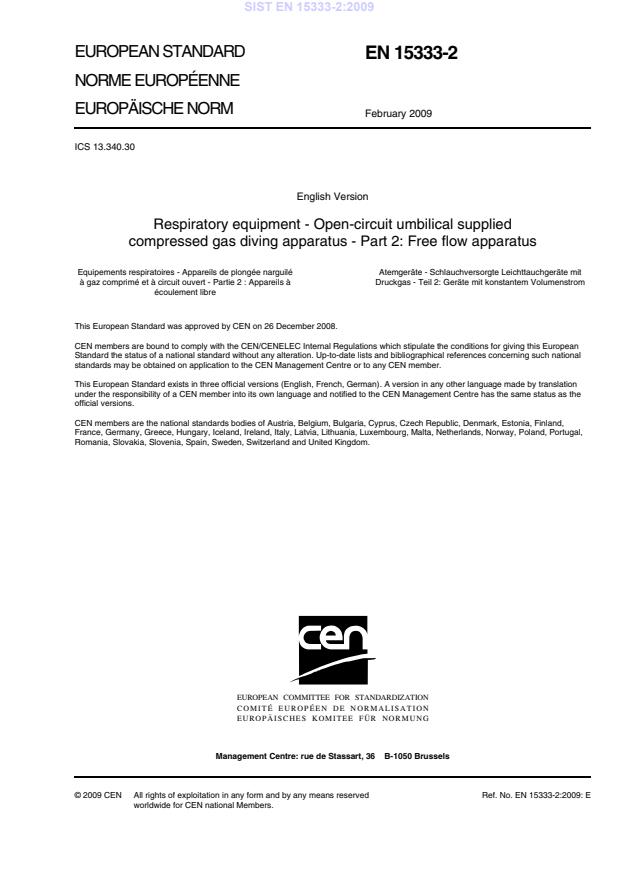
EUROPEAN STANDARDNORME EUROPÉENNEEUROPÄISCHE NORMEN 15333-2February 2009ICS 13.340.30 English VersionRespiratory equipment - Open-circuit umbilical suppliedcompressed gas diving apparatus - Part 2: Free flow apparatusEquipements respiratoires - Appareils de plongée narguiléà gaz comprimé et à circuit ouvert - Partie 2 : Appareils àécoulement libreAtemgeräte - Schlauchversorgte Leichttauchgeräte mitDruckgas - Teil 2: Geräte mit konstantem VolumenstromThis European Standard was approved by CEN on 26 December 2008.CEN members are bound to comply with the CEN/CENELEC Internal Regulations which stipulate the conditions for giving this EuropeanStandard the status of a national standard without any alteration. Up-to-date lists and bibliographical references concerning such nationalstandards may be obtained on application to the CEN Management Centre or to any CEN member.This European Standard exists in three official versions (English, French, German). A version in any other language made by translationunder the responsibility of a CEN member into its own language and notified to the CEN Management Centre has the same status as theofficial versions.CEN members are the national standards bodies of Austria, Belgium, Bulgaria, Cyprus, Czech Republic, Denmark, Estonia, Finland,France, Germany, Greece, Hungary, Iceland, Ireland, Italy, Latvia, Lithuania, Luxembourg, Malta, Netherlands, Norway, Poland, Portugal,Romania, Slovakia, Slovenia, Spain, Sweden, Switzerland and United Kingdom.EUROPEAN COMMITTEE FOR STANDARDIZATIONCOMITÉ EUROPÉEN DE NORMALISATIONEUROPÄISCHES KOMITEE FÜR NORMUNGManagement Centre: rue de Stassart, 36
B-1050 Brussels© 2009 CENAll rights of exploitation in any form and by any means reservedworldwide for CEN national Members.Ref. No. EN 15333-2:2009: ESIST EN 15333-2:2009
Artificial sea water . 51 Annex B (informative)
A typical Modified Rhyme Test word list . 52 Annex ZA (informative)
Relationship between this European Standard and the Essential Requirements of EU Directive 89/686/EEC (PPE) . 53 Bibliography . 54
bail out auxiliary and independent gas supply or breathing apparatus for use in case of a failure of the umbilical supply 3.2 body harness component to attach the breathing apparatus, umbilical and any pressure vessels to the body of the diver 3.3 breathing frequency number of breathing cycles per minute 3.4 displaced volume tidal volume volume of respirable gas displaced by a breathing simulator during one half cycle (inhalation or exhalation)
NOTE Measured in litres. 3.5 exhaust device device for releasing excess gas from the facepiece 3.6 full face mask facepiece covering mouth, nose, eyes and chin which may be fitted with either a mouthpiece or an inner mask 3.7 helmet facepiece covering the whole head, which may be fitted with either a mouthpiece or an inner mask 3.8 high pressure pressure greater than medium pressure 3.9 hydrostatic imbalance difference at both end exhalation no flow and end inhalation no flow between the pressure within the facepiece (see Figure 1) and that at the reference point, which could be either the suprasternal notch or the lung centroid of the diver (see Figure 2) 3.10 life line component of the apparatus which connects the diver to the surface and may be used to help a diver in distress SIST EN 15333-2:2009
NOTE It is normally worn with some form of retaining device that prevents the helmet from floating off the wearers head. 3.15 neckdam device that connects to the helmet and seals at the wearers neck
NOTE It is normally worn with some form of retaining device that prevents the helmet from floating off the wearers head. 3.16 pressure volume diagram diagram generated during one breathing cycle by plotting the respiratory pressure against the displaced volume (see Figure 1) 3.17 rated working pressure maximum allowable pressure for which the apparatus is designed 3.18 respiratory minute volume
RMV product of the tidal volume and breathing frequency
NOTE Measured in litres per minute. 3.19 respiratory pressure differential pressure at the mouth relative to the no flow pressures at the mouth at the end of inhalation and exhalation (see Figure 1) 3.20 surface control system system that controls the supply from (a) gas source(s) to the diver(s) via the umbilical
NOTE It may also have a separate independent controlled supply for a stand by diver. 3.21 free flow surface supplied diving apparatus
diving apparatus that has gas supplied from the surface through a surface control system or system via an umbilical, allowing the diver to breathe under water from a facepiece
NOTE It may consist of a single hose or multiple lines, comprising life line, gas supply and if fitted voice communication and depth measuring system together with other services such as heating or cooling for suits, power for lighting and camera video signals. 3.23 work of breathing work expended during one breathing cycle
NOTE 1 Measured in Joule per litre. NOTE 2 This work is proportional to the area bounded by the pressure volume diagram (see Figure 1). 4 Minimum equipment The apparatus may consist of subassemblies. The apparatus shall comprise, at least the following components: surface gas supply: gas supply; surface control system; gas monitoring; breathing system: facepiece; flow control devices; body harness; umbilical; safety device(s). It shall also be delivered with information supplied by the manufacturer. The apparatus may also include the following components: auxiliary gas supply; lifting harness; depth measuring device; voice communication system. SIST EN 15333-2:2009
for pressure vessels intended for compressed air; EN 144-3
for pressure vessels intended for compressed nitrox and
compressed oxygen. If no specific standards for other respirable gases are available, connections according to EN 144-3 shall be used. SIST EN 15333-2:2009
[J×l-1]
(1) NOTE The WOB specified is considered to be a physiological maximum level and the manufacturers should endeavour to keep the WOB as low as possible. b) inspired and expired respiratory pressures shall be determined as shown in Figure 1. The inspired and expired respiratory pressures shall not exceed 25 mbar each; c) the positive work of breathing during inhalation shall not exceed 0,3 J×l-1; d) pressure spikes with no measurable positive work of breathing shall not exceed 25 mbar; e) pressure peaks with measurable positive work of breathing shall not exceed 5 mbar. Testing shall be done in accordance with 6.5.1, 6.5.2 and 6.5.3. SIST EN 15333-2:2009
[J×l-1]
(2) NOTE The WOB specified is considered to be a physiological maximum level and the manufacturers should endeavour to keep the WOB as low as possible. b) inspired and expired respiratory pressures shall be determined as shown in Figure 1. The inspired and expired respiratory pressures shall not exceed 35 mbar each; c) the positive work of breathing during inhalation shall not exceed 0,5 J×l-1; d) pressure spikes with no measurable positive work of breathing shall not exceed 25 mbar; e) pressure peaks with measurable positive work of breathing shall not exceed 12 mbar. Testing shall be done in accordance with 6.5.1, 6.5.2 and 6.5.3. 5.7.1.3 Cold water performance The breathing performance shall be measured using a sinusoidal waveform from a breathing simulator with simulated RMV of 62,5 l min-1. The air exhaled by the breathing simulator shall be heated and humidified. The air temperature shall be (28 ± 2) °C and the relative humidity greater than 90 % when measured at the mouth (see Table 6). The performance of the apparatus shall be determined using air at an ambient pressure of 6 bar. The breathing system shall meet the following requirements related to an RMV (BTPS; body temperature at pressure saturated) of 62,5 l min-1: a) the work of breathing (WOB) shall not exceed a value of: WOB = 0,5 + 0,03 × RMV
[J×l-1]
(3) b) inspired and expired respiratory pressures shall be determined as shown in Figure 1. The inspired and expired respiratory pressures shall not exceed 25 mbar each; c) the positive work of breathing during inhalation shall not exceed 0,3 J×l-1; d) pressure spikes with no measurable positive work of breathing shall not exceed 25 mbar; e) pressure peaks with measurable positive work of breathing shall not exceed 5 mbar. Testing shall be done in accordance with 6.10.3. SIST EN 15333-2:2009
...
Questions, Comments and Discussion
Ask us and Technical Secretary will try to provide an answer. You can facilitate discussion about the standard in here.