


EN 16215:2012
(Main)Animal feeding stuffs - Determination of dioxins and dioxin-like PCBs by GC/HRMS and of indicator PCBs by GC/HRMS
General Information
- Abstract
This European Standard is applicable to the determination of polychlorinated dibenzo-p-dioxins (PCDDs), polychlorinated dibenzofurans (PCDFs), (together termed ‘dioxins’ (PCDD/Fs)) and dioxin-like PCBs and non dioxin-like PCBs (dl-PCBs and ndl-PCBs) in animal feeding stuffs. Collaborative studies have been carried out. The method is suitable for the determination of dioxins, dl-PCBs and ndl-PCBs at the appropriate MRL in compound feed and ingredients e.g. oil, mineral clay. The method is applicable to samples containing residues of one or more of the following dioxins, dioxin-like PCBs and indicator PCBs. The limit of quantification (LOQ) for the relevant individual congeners of dioxins/furans is 0,05 pg/g (OCDD/F = 0,1 pg/g), of non-ortho PCBs 0,05 pg/g, of mono-ortho PCBs 10 pg/g and of indicator PCBs 100 pg/g.
For determination of dioxins and dioxin-like PCBs, the procedure can be used as confirmatory method as defined by Commission Regulation (EC) No 152/2009 for dioxins and dl-PCB in feed [1]. Confirmatory methods are high-resolution gas chromatography/high resolution mass spectrometry (HRGC/HRMS) methods. If only the analysis of indicator PCBs is required, a GC-LRMS method can be used (e.g. EN 15741 Animal feeding stuffs - Determination of OC-pesticides and PCBs by GC/MS [7] and EN 15742 Animal feeding stuffs - Determination of OC-pesticides and PCBs by GC/ECD [8]) provided that appropriate analytical performance criteria are met in the relevant range for the matrix of interest.
This European Standard is split into four modules each describing a part of the whole procedure (see Figure 1 and Figure 2) to be followed:
a) Module A: Description of standards which might be used;
b) Module B: Description of extraction procedures;
c) Module C: Description of clean up procedures;
d) Module D: GC/HRMS determination.
Each module describes a part of the whole method as well as, when applicable, alternatives which should be equivalent. Each module has to be regarded as an example. Combining modules and/or alternatives gives a highly flexible procedure which is "performance based". It is permitted to modify the method if all performance criteria laid down in Commission Regulation (EC) No 152/2009 [1] are met.
Any deviation of the described method, combination of modules needs to be recorded as part of the QA/QC procedures of accredited laboratories and should be available on request.
- Status
- Withdrawn
- Publication Date
- 24-Apr-2012
- Withdrawal Date
- 22-Sep-2026
- Technical Committee
- CEN/TC 327 - Animal feeding stuffs - Methods of sampling and analysis
- Drafting Committee
- CEN/TC 327/WG 1 - Minerals and Contaminants
- Current Stage
- 9960 - Withdrawal effective - Withdrawal
- Start Date
- 08-Jan-2020
- Completion Date
- 23-Sep-2026

Relations
- Effective Date
- 12-Jul-2017
- Effective Date
- 28-Jan-2026
Get Certified
Connect with accredited certification bodies for this standard

Control Union Certifications
Global certification for agriculture and sustainability.

ECOCERT
Organic and sustainability certification.

FSC International
Forest Stewardship Council certification.
Sponsored listings
Frequently Asked Questions
EN 16215:2012 is a standard published by the European Committee for Standardization (CEN). Its full title is "Animal feeding stuffs - Determination of dioxins and dioxin-like PCBs by GC/HRMS and of indicator PCBs by GC/HRMS". This standard covers: This European Standard is applicable to the determination of polychlorinated dibenzo-p-dioxins (PCDDs), polychlorinated dibenzofurans (PCDFs), (together termed ‘dioxins’ (PCDD/Fs)) and dioxin-like PCBs and non dioxin-like PCBs (dl-PCBs and ndl-PCBs) in animal feeding stuffs. Collaborative studies have been carried out. The method is suitable for the determination of dioxins, dl-PCBs and ndl-PCBs at the appropriate MRL in compound feed and ingredients e.g. oil, mineral clay. The method is applicable to samples containing residues of one or more of the following dioxins, dioxin-like PCBs and indicator PCBs. The limit of quantification (LOQ) for the relevant individual congeners of dioxins/furans is 0,05 pg/g (OCDD/F = 0,1 pg/g), of non-ortho PCBs 0,05 pg/g, of mono-ortho PCBs 10 pg/g and of indicator PCBs 100 pg/g. For determination of dioxins and dioxin-like PCBs, the procedure can be used as confirmatory method as defined by Commission Regulation (EC) No 152/2009 for dioxins and dl-PCB in feed [1]. Confirmatory methods are high-resolution gas chromatography/high resolution mass spectrometry (HRGC/HRMS) methods. If only the analysis of indicator PCBs is required, a GC-LRMS method can be used (e.g. EN 15741 Animal feeding stuffs - Determination of OC-pesticides and PCBs by GC/MS [7] and EN 15742 Animal feeding stuffs - Determination of OC-pesticides and PCBs by GC/ECD [8]) provided that appropriate analytical performance criteria are met in the relevant range for the matrix of interest. This European Standard is split into four modules each describing a part of the whole procedure (see Figure 1 and Figure 2) to be followed: a) Module A: Description of standards which might be used; b) Module B: Description of extraction procedures; c) Module C: Description of clean up procedures; d) Module D: GC/HRMS determination. Each module describes a part of the whole method as well as, when applicable, alternatives which should be equivalent. Each module has to be regarded as an example. Combining modules and/or alternatives gives a highly flexible procedure which is "performance based". It is permitted to modify the method if all performance criteria laid down in Commission Regulation (EC) No 152/2009 [1] are met. Any deviation of the described method, combination of modules needs to be recorded as part of the QA/QC procedures of accredited laboratories and should be available on request.
This European Standard is applicable to the determination of polychlorinated dibenzo-p-dioxins (PCDDs), polychlorinated dibenzofurans (PCDFs), (together termed ‘dioxins’ (PCDD/Fs)) and dioxin-like PCBs and non dioxin-like PCBs (dl-PCBs and ndl-PCBs) in animal feeding stuffs. Collaborative studies have been carried out. The method is suitable for the determination of dioxins, dl-PCBs and ndl-PCBs at the appropriate MRL in compound feed and ingredients e.g. oil, mineral clay. The method is applicable to samples containing residues of one or more of the following dioxins, dioxin-like PCBs and indicator PCBs. The limit of quantification (LOQ) for the relevant individual congeners of dioxins/furans is 0,05 pg/g (OCDD/F = 0,1 pg/g), of non-ortho PCBs 0,05 pg/g, of mono-ortho PCBs 10 pg/g and of indicator PCBs 100 pg/g. For determination of dioxins and dioxin-like PCBs, the procedure can be used as confirmatory method as defined by Commission Regulation (EC) No 152/2009 for dioxins and dl-PCB in feed [1]. Confirmatory methods are high-resolution gas chromatography/high resolution mass spectrometry (HRGC/HRMS) methods. If only the analysis of indicator PCBs is required, a GC-LRMS method can be used (e.g. EN 15741 Animal feeding stuffs - Determination of OC-pesticides and PCBs by GC/MS [7] and EN 15742 Animal feeding stuffs - Determination of OC-pesticides and PCBs by GC/ECD [8]) provided that appropriate analytical performance criteria are met in the relevant range for the matrix of interest. This European Standard is split into four modules each describing a part of the whole procedure (see Figure 1 and Figure 2) to be followed: a) Module A: Description of standards which might be used; b) Module B: Description of extraction procedures; c) Module C: Description of clean up procedures; d) Module D: GC/HRMS determination. Each module describes a part of the whole method as well as, when applicable, alternatives which should be equivalent. Each module has to be regarded as an example. Combining modules and/or alternatives gives a highly flexible procedure which is "performance based". It is permitted to modify the method if all performance criteria laid down in Commission Regulation (EC) No 152/2009 [1] are met. Any deviation of the described method, combination of modules needs to be recorded as part of the QA/QC procedures of accredited laboratories and should be available on request.
EN 16215:2012 is classified under the following ICS (International Classification for Standards) categories: 65.120 - Animal feeding stuffs. The ICS classification helps identify the subject area and facilitates finding related standards.
EN 16215:2012 has the following relationships with other standards: It is inter standard links to EN 16215:2020, EN ISO 6498:2012. Understanding these relationships helps ensure you are using the most current and applicable version of the standard.
EN 16215:2012 is associated with the following European legislation: EU Directives/Regulations: 70/373/EC; Standardization Mandates: M/382. When a standard is cited in the Official Journal of the European Union, products manufactured in conformity with it benefit from a presumption of conformity with the essential requirements of the corresponding EU directive or regulation.
EN 16215:2012 is available in PDF format for immediate download after purchase. The document can be added to your cart and obtained through the secure checkout process. Digital delivery ensures instant access to the complete standard document.
Standards Content (Sample)
2003-01.Slovenski inštitut za standardizacijo. Razmnoževanje celote ali delov tega standarda ni dovoljeno.QFuttermittel - Bestimmung von Dioxinen und dioxin-ähnlichen PCBs mittels GC/HRMS und von Indikator-PCBs mittels GC/HRMSAnimal feed - Determination of dioxins and dioxin-like PCBs by GC/HRMS and of indicator PCBs by GC/HRMS65.120KrmilaAnimal feeding stuffsICS:Ta slovenski standard je istoveten z:EN 16215:2012SIST EN 16215:2012en,fr,de01-september-2012SIST EN 16215:2012SLOVENSKI
STANDARD
EUROPEAN STANDARD NORME EUROPÉENNE EUROPÄISCHE NORM
EN 16215
April 2012 ICS 65.120 English Version
Animal feeding stuffs - Determination of dioxins and dioxin-like PCBs by GC/HRMS and of indicator PCBs by GC/HRMS
Aliments des animaux - Dosage des dioxines, des PCB de type dioxine et des PCB indicateurs par GC/HRMS
Futtermittel - Bestimmung von Dioxinen und dioxin-ähnlichen PCBs mittels GC/HRMS und von Indikator-PCBs mittels GC/HRMS This European Standard was approved by CEN on 9 March 2012.
CEN members are bound to comply with the CEN/CENELEC Internal Regulations which stipulate the conditions for giving this European Standard the status of a national standard without any alteration. Up-to-date lists and bibliographical references concerning such national standards may be obtained on application to the CEN-CENELEC Management Centre or to any CEN member.
This European Standard exists in three official versions (English, French, German). A version in any other language made by translation under the responsibility of a CEN member into its own language and notified to the CEN-CENELEC Management Centre has the same status as the official versions.
CEN members are the national standards bodies of Austria, Belgium, Bulgaria, Croatia, Cyprus, Czech Republic, Denmark, Estonia, Finland, France, Germany, Greece, Hungary, Iceland, Ireland, Italy, Latvia, Lithuania, Luxembourg, Malta, Netherlands, Norway, Poland, Portugal, Romania, Slovakia, Slovenia, Spain, Sweden, Switzerland, Turkey and United Kingdom.
EUROPEAN COMMITTEE FOR STANDARDIZATION
COMITÉ EUROPÉEN DE NORMALISATION EUROPÄISCHES KOMITEE FÜR NORMUNG
Management Centre:
Avenue Marnix 17,
B-1000 Brussels © 2012 CEN All rights of exploitation in any form and by any means reserved worldwide for CEN national Members. Ref. No. EN 16215:2012: ESIST EN 16215:2012
Description of PTV injection system .37Annex B (informative)
Description of standards and concentration of the standard solutions .39Annex C (informative)
Example of automated procedure .46Annex D (informative)
Mass spectrometer (MS) .48Annex E (informative)
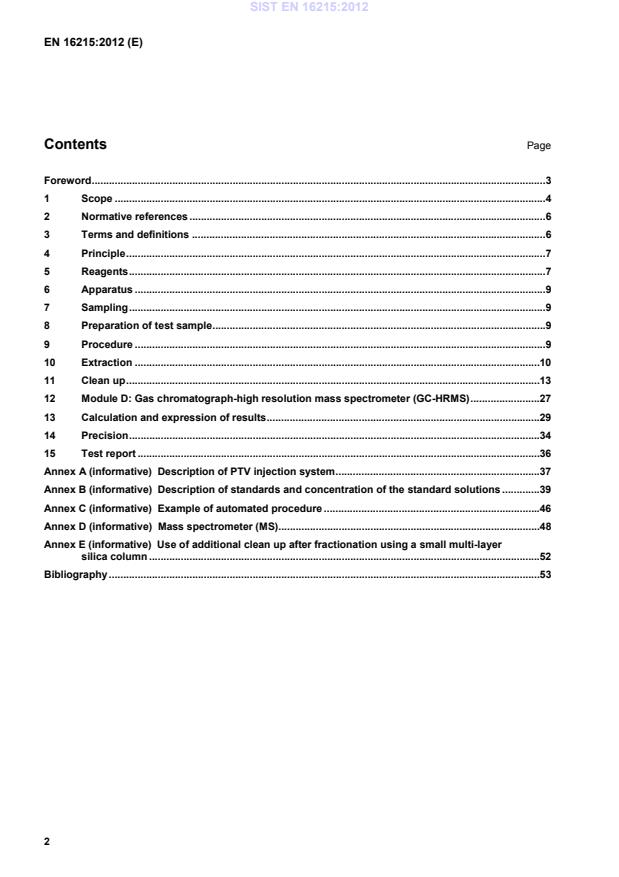
Use of additional clean up after fractionation using a small multi-layer silica column .52Bibliography .53 SIST EN 16215:2012
GC/HRMS determination. Each module describes a part of the whole method as well as, when applicable, alternatives which should be equivalent. Each module has to be regarded as an example. Combining modules and/or alternatives gives a highly flexible procedure which is "performance based". It is permitted to modify the method if all performance criteria laid down in Commission Regulation (EC) No 152/2009 [6] are met. Any deviation of the described method, combination of modules needs to be recorded as part of the QA/QC procedures of accredited laboratories and should be available on request.
= optional Figure 1 — Flow scheme for the determination of Dioxins, dl-PCBs and Indicator PCBs in feed SIST EN 16215:2012
= optional Figure 2 — Flow scheme for the determination of Dioxins, dl-PCBs and Indicator PCBs in oil / fat 2 Normative references The following documents, in whole or in part, are normatively referenced in this document and are indispensable for its application. For dated references, only the edition cited applies. For undated references, the latest edition of the referenced document (including any amendments) applies. prEN ISO 6498, Animal feeding stuffs
Guidelines for sample preparation (ISO/DIS 6498) 3 Terms and definitions For the purposes of this document, the following terms and definitions apply. 3.1 limit of detection smallest measured content, from which it is possible to deduce the presence of the analyte with reasonable statistical certainty Note 1 to entry: The limit of detection is numerically equal to three times the standard deviation of the mean of blank determinations (n > 10). SIST EN 16215:2012
Quantification is based on isotope dilution. If only indicator PCBs are required, they can be determined with GC-LRMS (e.g. according to EN 15741 Animal feeding stuffs - Determination of OC-pesticides and PCBs by GC/MS [1] and EN 15742 Animal feeding stuffs - Determination of OC-pesticides and PCBs by GC/ECD [2])
Preconditions of combining modules for extraction and clean-up are: a) for each extraction module an equal sample intake of 10 g for feed or feed ingredients with a fat content ≤ 25 % or 2,5 g fat or oil is required; b) in order to achieve the required LOQ for dioxins a final volume of 10 µl in combination with an injection volume of 2 µl is required. If a different injection volume is applied, the final volume has to be adjusted directly proportional. NOTE In case more sensitivity is necessary or less volume reduction is wanted, injection of a larger volume by PTV (an example is described in Annex A) or higher sample intake is possible (see also 9.2.2 NOTE). 5 Reagents Use only reagents of recognized analytical grade and with purity suitable for dioxin and PCB residue analysis. Check the purity of the reagents and reference materials (e.g. standard solutions) by performing a blank test under the same conditions as used in the method. The chromatogram should not show any interfering impurity at the retention time of compounds of interest. SIST EN 16215:2012
6.1 Evaporator, suitable for volumes up to 200 ml and inlet for nitrogen gas. 6.2 Evaporator tubes, endpoint about 0,5 ml. 6.3 Homogeniser 6.4 Pasteur pipette, borosilicate glass, 150 mm. 6.5 Vortexmixer 6.6 Measuring cylinder, borosilicate glass, 100 ml, 2 ml graduations with a precision of ± 0,5 ml. 6.7 Measuring cylinder, borosilicate glass, glass-stoppered, 25 ml, 1 ml graduation with a precision of ± 0,5 ml graduation and 50 ml, 2 ml graduation
with a precision of ± 0,5 ml graduation. 7 Sampling The sample should be truly representative and not damaged or changed during transport or storage. Sampling is not part of the method specified in this European Standard. A recommended sampling method is given in EN ISO 6497 [3]. 8 Preparation of test sample Prepare the test sample in accordance with prEN ISO 6498. Dry or low moisture products such as cereals and cereal products, mixed feeds, and hay should be ground carefully so that it passes completely through a sieve with 1 mm apertures. Mix thoroughly. High moisture products such as grasses and silages and liquid feed should be (freeze-)dried and after that ground carefully so that it passes completely through a sieve with 1 mm apertures. Mix thoroughly. Oil / fat are directly dissolved in n-hexane. 9 Procedure 9.1 General Analyse the following samples in each series: procedure blank (n = 1); (certified) reference material at appropriate level or a home made reference sample; all samples (maximum 20). The procedure blank should be free of contaminants at or above the limits of quantification. SIST EN 16215:2012
≤ 25 % and 2,5 g for fat and oil. Deviations of sample intake should be taken into account in the formula’s in 13.4 (M = sample intake in gram). The internal standard consisting of 13C-labelled congeners listed in Annex B, Table B.1 shall be added directly onto the sample before extraction, or onto the oil sample before clean up. The extraction procedure is carried out using Pressurized Fluid Extraction (PFE) with consecutively toluene and a mixture of toluene/ethanol (module BI) or Soxhlet extraction (module BII). Duration of extraction should be adjusted according to kind and amount of sample used. The minimum requirement for Soxhlet extraction is 50 extraction cycles. Other extraction techniques like microwave assisted extraction can also be used but shall be of proven equal performance. 10.2 Module BI: Extraction using automated Pressurized Fluid Extraction (PFE) system 10.2.1 Reagents and materials 10.2.1.1 Diatomaceous earth 10.2.1.2 n-Hexane, for dioxin and PCB analysis. 10.2.1.3 Toluene, for dioxin and PCB analysis. 10.2.1.4 Ethanol, for dioxin and PCB analysis. SIST EN 16215:2012
100 °C; pressure
10 MPa; preheat
0 min; heat
5 min; static
15 min; flush
40 vol. % of extraction cell, e.g. for a 33 ml extraction cell = 13,2 ml; purge
300 s; cycles
3; solvent cycle 1
toluene (10.2.1.3); solvent cycle 2 and 3
toluene/ethanol in volume portions of 9/1 (10.2.1.5). Combine solvent obtained with each cycle and filter over a funnel (10.2.2.4) equipped with a glass wool plug (10.2.1.8) and 5 g pre-dried sodium sulphate (10.2.1.6). Evaporate the filtrate using an evaporator (10.2.2.5) SIST EN 16215:2012
Activated carbon column Column adsorption chromatography using activated carbon may be used to separate planar PCDD/PCDF and coplanar PCB molecules from mono-ortho PCB and other interfering non-planar molecules. Additionally activated carbon can also be used to clean the PCDD/PCDDF fraction or separate non-ortho PCBs, mono-ortho PCBs and indicator PCBs. Alumina column Column fluid chromatography on alumina of different activity grade and acidity/basicity. Interfering compounds with small differences in polarity or structure compared to PCDDs/PCDFs and dioxin-like PCBs can be removed. Additionally, alumina columns can be used to separate PCDDs/PCDFs from dioxin-like PCBs. Florisil column Column fluid chromatography on Florisil of different activity grade can be used to separate PCDDs/PCDFs from PCBs, also dioxin-like PCBs and other interfering compounds with small differences in polarity or structure compared to PCDDs/PCDFs. Procedure sample clean up Proven clean up procedures shall be used containing normally two or more of the above discribed techniques which can be combined in different orders. A detailed description of the automated clean up procedure is given in Module CI (automated method). In module CII and module CIII manual methods are described, where module CII describes the clean up over a mixed silica column followed by a activated naoh carbon column where non-ortho PCB, PCDDs/PCDFs are separated from mono-ortho PCBs and indicator PCBs. Module CIII describes the clean up procedure using mixed silica followed by GPC or Florisil. Other methods can also be used but shall be of proven equal performance as the methods described in modules C. 11.2 Module CI: Automated clean up 11.2.1 General The purification method consists of a comprehensive automated system. Extracts are transferred by a pump to the system and purified consecutively on an acid silica column, a neutral silica column, a basic alumina column and an activated carbon/Celite column. For the elution of the columns, custom made solvents and mixtures are used: n-hexane, n-hexane/dichloromethane in volume portions of 1/1, ethylacetate/toluene in volume portions of 1/1 and toluene. The program can be downloaded from:
http://www.rikilt.wur.nl/UK/services/Analyses/Dioxine+analysis/ [11]. After the automated procedure two fractions are obtained: mono-ortho substituted PCBs and indicator PCBs (Fraction A) and planar PCDD/Fs and non-ortho substitute PCBs (Fraction B). For additional clean up especially in case of dirty complex samples (oxidized fat/oil) a small multi layer silica column might be used. 11.2.2 Reagents and materials 11.2.2.1 Toluene, for dioxin and PCB analysis. 11.2.2.2 n-Hexane, for dioxin and PCB analysis. 11.2.2.3 Dichloromethane, for dioxin and PCB analysis. SIST EN 16215:2012
Step 18 and step 19 are for SIST EN 16215:2012
Fluid Management System, Watertown, USA e.g. is a company producing hardware for and disposable columns for automated clean-up. This information is given for the convenience of the users of this European Standard and does not constitute an endorsement by CEN of this product. NOTE 2 Comparable techniques in combination with appropriate parameters can be used provided that Commison Regulation (EC) No 152/2009 [6] is obeyed. The program given in Annex D has to be regarded as an example, different programs and solvents can be used, provided that the procedure (method + program) is validated. 11.3 Module CII: Manual sample clean up, removal of fat and group separation 11.3.1 General This module details a manual procedure for the isolation, fractionation and purification of PCDD/F and PCB analytes prior to concentration and analysis by GC-HRMS. The analytes are isolated from the matrix using cold solvent extraction simultaneously with acid and base hydrolysis on multi-layer, mixed silica columns. The procedure allows for in-tandem fractionation of planar PCDD/Fs and non-ortho substitute PCBs from ortho substituted PCBs, by connecting the outflow of the multi-layer column directly to an activated carbon column, alternatively, the concentrated outflow of the multi-layer column may be fractionated separately by a carbon column method. The fractions – mono-ortho substituted PCBs and indicator PCBs (Fraction A) and planar PCDD/Fs and non-ortho substitute PCBs (Fraction B) – are purified on activated basic alumina. SIST EN 16215:2012
11.3.2.11 Methanol, glass distilled. 11.3.2.12 Nitrogen 11.3.2.13 Toluene/dichloromethane, in volume portions of 3/7. Mix 600 ml toluene (11.3.2.1) with 1 400 ml dichloromethane (11.3.2.3) thoroughly.
Store at room temperature in a tightly closed bottle. 11.3.2.14 Anhydrous sodium sulphate, heated at 160 °C for at least 24 h. 11.3.2.15 Methanol, for dioxin and PCB analysis. 11.3.3 Apparatus All technical descriptions are examples of possible system setups and parameters and have to be scaled or adopted to the user’s equipment. 11.3.3.1 Large glass column, 650 mm x 55 mm ID 11.3.3.2 Medium glass column, 400 mm x 25 mm ID 11.3.3.3 Silanised glass wool SIST EN 16215:2012
11.3.3.18 1 l glass bottle Duran /Amber. 11.3.4 Procedure 11.3.4.1 Preparation of mixed silica column Take a large glass column (11.3.3.1) and wash with dichloromethane (11.3.2.3). Plug the column at the lower end (#11 fitting) with a #11 plug (11.3.3.7). Add two glass fibre discs (11.3.3.5) and a plug of silanised glass wool (11.3.3.3). Place on to this, in ascending order, anhydrous sodium sulphate (11.3.2.14, 10 g ± 1 g), basic silica (11.3.2.8, 50 g ± 5 g), sulphuric acidic silica (11.3.2.9, 10 g + 2,5 g), 47 mm glass fibre disc (11.3.3.16) and anhydrous sodium sulphate (11.3.2.14, 30 g ± 3 g). Tap the column firmly to arrange the layers of powdered reagents evenly. Place a 1 l glass bottle (11.3.3.18) at the outfall of each silica column.
NOTE If the carbon column is to be used in tandem, it can be directly coupled at this stage to the bottom of the mixed silica column followed by the use of the procedure described below (11.3.4.2) to give Fraction A and the procedure described in (11.3.4.5) to give Fraction B. Condition the carbon columns using the solvents in reverse direction as described in (11.3.4.3). and ensure that the carbon column is marked indicating flow direction prior to use. Connect the top of the carbon column directly to the outflow of the mixed silica column and the bottom to a 1 l reservoir using 1/8 connectors and tubing. 11.3.4.2 Sample clean up using mixed silica column Transfer the sample (9.2.2) or extract (10.2) or extract (10.3) into a 1 l bottle (11.3.3.18). Add 200 ml ± 10 ml n-hexane (11.3.2.2) using a measuring cylinder (11.3.3.11) and mix. Add sulphuric acidic silica (11.3.2.9)
75 g to the bottle using small funnel and swirling during addition. Quantitatively transfer the slurry to the large SIST EN 16215:2012
...