

EN ISO 10519:2026
(Main)Rapeseed - Determination of chlorophyll content - Spectrometric method (ISO 10519:2026)
- Abstract
This document specifies a spectrometric method for the determination of the chlorophyll content of rapeseed. It is not applicable to the determination of chlorophyll in oils.
- Status
- Published
- Publication Date
- 13-Oct-2026
- Current Stage
- 6060 - Definitive text made available (DAV) - Publishing
- Start Date
- 14-Oct-2026
- Completion Date
- 14-Oct-2026
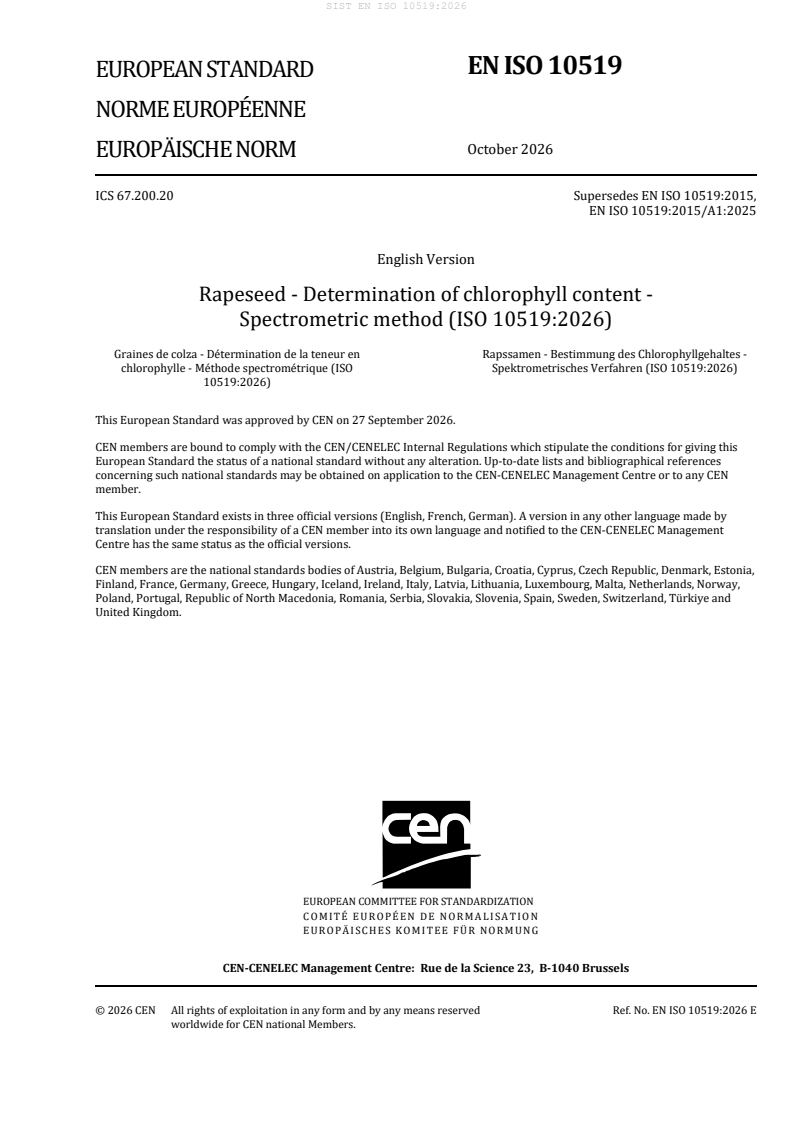


EN ISO 10519:2026 is a CEN and ISO standard for measuring the chlorophyll content of rapeseed by spectrometric analysis. It tells laboratories how to prepare the seed, extract the pigments, measure absorbance, and calculate chlorophyll content for results reported in milligrams per kilogram. The method applies to rapeseed seed and is not for chlorophyll in oils.
What does EN ISO 10519:2026 specify?
EN ISO 10519:2026 specifies a spectrometric method for determining chlorophyll content in rapeseed. In practice, it gives a complete laboratory procedure from sample preparation through to reporting, so users can generate comparable results from seed samples.
The document is organized into clauses on scope, normative references, terms and definitions, principle, reagent, apparatus, sampling, preparation of the test sample, procedure, expression of results, precision, and the test report. It also includes two informative annexes that support method validation and instrument calibration.
| Annex | What it covers |
|---|---|
| Annex A | Results of an interlaboratory test, including precision data |
| Annex B | Preparation of the calibration curve to determine the k factor |
What are the key requirements of EN ISO 10519:2026?
EN ISO 10519:2026 sets out a simple but controlled laboratory method. The important points are the sample condition, the extraction conditions, the measurement wavelengths, and the way results are corrected and reported.
Sample preparation and extraction
Clause 8 requires the laboratory sample to be prepared in accordance with ISO 664 after impurities are removed. Seeds with more than 10 % moisture are dried at 45 °C for 12 h to reduce the risk of chlorophyll loss, then ground to a uniform test sample. This matters because uneven grinding or excess moisture can change the result before testing even starts.
Clause 9 then specifies a 2 g test portion and an extraction with 30 ml of the specified solvent mixture from Clause 5. The method uses a shaking or ball-mill extraction, followed by settling and filtration into a tube for measurement. In practice, this means the operator must keep the extraction conditions consistent if results are to be comparable.
Spectrometric measurement and calculation
Clause 9.3 requires absorbance measurements at 665 nm, 705 nm and 625 nm with a spectrometer suitable for the 600 nm to 700 nm range and a 2 nm spectral bandwidth. The readings at 705 nm and 625 nm are used for baseline correction. This helps reduce the effect of background absorption and improves the usefulness of the 665 nm reading for chlorophyll determination.
Clause 10 gives the calculation of chlorophyll content from corrected absorbance, optical path length, test portion mass and solvent volume. The result is expressed as milligrams per kilogram of product as received, and the moisture content may also be used if the user wants a dry-product basis. The document also notes that the k factor depends on the instrument bandwidth, so some instruments may need calibration rather than use of the default value.
Precision and reporting
Clause 11 summarizes precision from interlaboratory testing and gives repeatability and reproducibility guidance. Clause 12 lists the information that has to appear in the test report, including the sampling method if known, the method used, the result, any checked repeatability, the date, and any operating details or incidents that may have affected the outcome. This is important for quality control, audits, and comparing results between laboratories.
What terms does EN ISO 10519:2026 define?
- Chlorophyll content - The mass fraction of substances in the sample that absorb near 665 nm, expressed as chlorophyll A and reported in milligrams per kilogram.
- Test portion - The weighed portion of the prepared test sample that is taken for extraction and measurement.
- Extraction solvent - The solvent mixture used to remove chlorophyll from the ground rapeseed before spectrometric measurement.
- k factor - The constant used in the calculation of chlorophyll content; Annex B shows how to determine it for a given spectrometer.
- Repeatability - The closeness of results from the same method, same laboratory, same operator and same equipment over a short time.
- Reproducibility - The closeness of results from the same method used in different laboratories with different operators and equipment.
Who uses EN ISO 10519:2026?
EN ISO 10519:2026 is used by testing laboratories, oilseed processors, quality control staff, and buyers who need to measure chlorophyll in rapeseed. It is also relevant to inspection, trade, and plant breeding work where seed quality has to be checked with a standardized laboratory method. The method is most useful when results need to be compared across sites or against a specification.
What changed in EN ISO 10519:2026 from the previous edition?
EN ISO 10519:2026 replaces ISO 10519:2015. The foreword states that this fourth edition is a minor revision and incorporates ISO 10519:2015/Amd 1:2025.
The change explicitly stated is the addition of Annex B, which provides the calibration curve procedure used to determine the k factor.
Which standards are used with EN ISO 10519:2026?
- ISO 648 - Gives the requirements for the single-volume pipettes used in the extraction and calibration work.
- ISO 664 - Covers reduction of the laboratory sample to the test sample.
- ISO 665 - Provides the method for determining moisture and volatile matter when results are needed on a dry-product basis.
- ISO 542 - Is cited as a recommended sampling method for oilseeds.
- ISO 5725:1986 - Is cited in Annex A as the basis for the interlaboratory precision study.
What does the EN ISO 10519:2026 document contain?
The document includes a figure of the mechanical microgrinder in Clause 6, plus the measurement setup for spectrometric analysis. Clause 10 contains the calculation formula for chlorophyll content, including the corrected absorbance terms and the variables used in the result.
Annex A provides the interlaboratory test results behind the precision statements. Annex B gives the calibration procedure and the curve used to determine the k factor for instruments where the default value is not suitable.
Relations
- Effective Date
- 08-Apr-2026
- Effective Date
- 08-Apr-2026
- Consolidated By
ISO 10519:2026 - Rapeseed — Determination of chlorophyll content — Spectrometric method - Effective Date
- 18-Apr-2026
Get Certified
Connect with accredited certification bodies for this standard

BSI Group
BSI (British Standards Institution) is the business standards company that helps organizations make excellence a habit.

Bureau Veritas
Bureau Veritas is a world leader in laboratory testing, inspection and certification services.

DNV
DNV is an independent assurance and risk management provider.
Sponsored listings
Frequently Asked Questions
EN ISO 10519:2026 is a standard published by the European Committee for Standardization (CEN). Its full title is "Rapeseed - Determination of chlorophyll content - Spectrometric method (ISO 10519:2026)". This standard covers: This document specifies a spectrometric method for the determination of the chlorophyll content of rapeseed. It is not applicable to the determination of chlorophyll in oils.
This document specifies a spectrometric method for the determination of the chlorophyll content of rapeseed. It is not applicable to the determination of chlorophyll in oils.
EN ISO 10519:2026 is classified under the following ICS (International Classification for Standards) categories: 67.200.20 - Oilseeds. The ICS classification helps identify the subject area and facilitates finding related standards.
EN ISO 10519:2026 has the following relationships with other standards: It is inter standard links to EN ISO 10519:2015/A1:2025, EN ISO 10519:2015, ISO 10519:2026. Understanding these relationships helps ensure you are using the most current and applicable version of the standard.
EN ISO 10519:2026 is available in PDF format for immediate download after purchase. The document can be added to your cart and obtained through the secure checkout process. Digital delivery ensures instant access to the complete standard document.
Standards Content (Sample)
SLOVENSKI STANDARD
01-december-2026
Nadomešča:
SIST EN ISO 10519:2015
SIST EN ISO 10519:2015/A1:2025
Seme oljne repice - Določanje klorofila - Spektrometrijska metoda (ISO
10519:2026)
Rapeseed - Determination of chlorophyll content - Spectrometric method (ISO
10519:2026)
Rapssamen - Bestimmung des Chlorophyllgehaltes - Spektrometrisches Verfahren (ISO
10519:2026)
Graines de colza - Détermination de la teneur en chlorophylle - Méthode
spectrométrique (ISO 10519:2026)
Ta slovenski standard je istoveten z: EN ISO 10519:2026
ICS:
67.200.20 Oljnice Oilseeds
2003-01.Slovenski inštitut za standardizacijo. Razmnoževanje celote ali delov tega standarda ni dovoljeno.
EN ISO 10519
EUROPEAN STANDARD
NORME EUROPÉENNE
October 2026
EUROPÄISCHE NORM
ICS 67.200.20 Supersedes EN ISO 10519:2015,
EN ISO 10519:2015/A1:2025
English Version
Rapeseed - Determination of chlorophyll content -
Spectrometric method (ISO 10519:2026)
Graines de colza - Détermination de la teneur en Rapssamen - Bestimmung des Chlorophyllgehaltes -
chlorophylle - Méthode spectrométrique (ISO Spektrometrisches Verfahren (ISO 10519:2026)
10519:2026)
This European Standard was approved by CEN on 27 September 2026.
CEN members are bound to comply with the CEN/CENELEC Internal Regulations which stipulate the conditions for giving this
European Standard the status of a national standard without any alteration. Up-to-date lists and bibliographical references
concerning such national standards may be obtained on application to the CEN-CENELEC Management Centre or to any CEN
member.
This European Standard exists in three official versions (English, French, German). A version in any other language made by
translation under the responsibility of a CEN member into its own language and notified to the CEN-CENELEC Management
Centre has the same status as the official versions.
CEN members are the national standards bodies of Austria, Belgium, Bulgaria, Croatia, Cyprus, Czech Republic, Denmark, Estonia,
Finland, France, Germany, Greece, Hungary, Iceland, Ireland, Italy, Latvia, Lithuania, Luxembourg, Malta, Netherlands, Norway,
Poland, Portugal, Republic of North Macedonia, Romania, Serbia, Slovakia, Slovenia, Spain, Sweden, Switzerland, Türkiye and
United Kingdom.
EUROPEAN COMMITTEE FOR STANDARDIZATION
COMITÉ EUROPÉEN DE NORMALISATIO N
EUROPÄISCHES KOMITEE FÜR NORMUN G
CEN-CENELEC Management Centre: Rue de la Science 23, B-1040 Brussels
© 2026 CEN All rights of exploitation in any form and by any means reserved Ref. No. EN ISO 10519:2026 E
worldwide for CEN national Members.
Contents Page
European foreword . 3
European foreword
This document (EN ISO 10519:2026) has been prepared by Technical Committee ISO/TC 34 "Food
products" in collaboration with Technical Committee CEN/TC 307 “Oilseeds, vegetable and animal fats
and oils and their by-products - Methods of sampling and analysis” the secretariat of which is held by
AFNOR.
This European Standard shall be given the status of a national standard, either by publication of an
identical text or by endorsement, at the latest by April 2027, and conflicting national standards shall be
withdrawn at the latest by April 2027.
Attention is drawn to the possibility that some of the elements of this document may be the subject of
patent rights. CEN shall not be held responsible for identifying any or all such patent rights.
This document supersedes EN ISO 10519:2015, EN ISO 10519:2015/A1:2025.
Any feedback and questions on this document should be directed to the users’ national standards
body/national committee. A complete listing of these bodies can be found on the CEN website.
According to the CEN-CENELEC Internal Regulations, the national standards organizations of the
following countries are bound to implement this European Standard: Austria, Belgium, Bulgaria,
Croatia, Cyprus, Czech Republic, Denmark, Estonia, Finland, France, Germany, Greece, Hungary, Iceland,
Ireland, Italy, Latvia, Lithuania, Luxembourg, Malta, Netherlands, Norway, Poland, Portugal, Republic of
North Macedonia, Romania, Serbia, Slovakia, Slovenia, Spain, Sweden, Switzerland, Türkiye and the
United Kingdom.
Endorsement notice
The text of ISO 10519:2026 has been approved by CEN as EN ISO 10519:2026 without any modification.
International
Standard
ISO 10519
Fourth edition
Rapeseed — Determination
2026-10
of chlorophyll content —
Spectrometric method
Graines de colza — Détermination de la teneur en chlorophylle —
Méthode spectrométrique
Reference number
ISO 10519:2026(en) © ISO 2026
ISO 10519:2026(en)
© ISO 2026
All rights reserved. Unless otherwise specified, or required in the context of its implementation, no part of this publication may
be reproduced or utilized otherwise in any form or by any means, electronic or mechanical, including photocopying, or posting on
the internet or an intranet, without prior written permission. Permission can be requested from either ISO at the address below
or ISO’s member body in the country of the requester.
ISO copyright office
CP 401 • Ch. de Blandonnet 8
CH-1214 Vernier, Geneva
Phone: +41 22 749 01 11
Email: copyright@iso.org
Website: www.iso.org
Published in Switzerland
ii
ISO 10519:2026(en)
Contents Page
Foreword .iv
1 Scope . 1
2 Normative references . 1
3 Terms and definitions . 1
4 Principle . 1
5 Reagent . 1
6 Apparatus . 2
7 Sampling . 2
8 Preparation of test sample . 3
9 Procedure . 3
9.1 Test portions .3
9.2 Extraction .3
9.3 Determination .3
10 Expression of results . 4
11 Precision . 4
11.1 Repeatability .4
11.2 Reproducibility .4
12 Test report . 4
Annex A (informative) Results of interlaboratory test . 6
Annex B (informative) Preparation of the calibration curve to determine the k factor . 7
Bibliography . 9
iii
ISO 10519:2026(en)
Foreword
ISO (the International Organization for Standardization) is a worldwide federation of national standards
bodies (ISO member bodies). The work of preparing International Standards is normally carried out through
ISO technical committees. Each member body interested in a subject for which a technical committee
has been established has the right to be represented on that committee. International organizations,
governmental and non-governmental, in liaison with ISO, also take part in the work. ISO collaborates closely
with the International Electrotechnical Commission (IEC) on all matters of electrotechnical standardization.
The procedures used to develop this document and those intended for its further maintenance are described
in the ISO/IEC Directives, Part 1. In particular, the different approval criteria needed for the different types
of ISO document should be noted. This document was drafted in accordance with the editorial rules of the
ISO/IEC Directives, Part 2 (see www.iso.org/directives).
ISO draws attention to the possibility that the implementation of this document may involve the use of (a)
patent(s). ISO takes no position concerning the evidence, validity or applicability of any claimed patent
rights in respect thereof. As of the date of publication of this document, ISO had not received notice of (a)
patent(s) which may be required to implement this document. However, implementers are cautioned that
this may not represent the latest information, which may be obtained from the patent database available at
www.iso.org/patents. ISO shall not be held responsible for identifying any or all such patent rights.
Any trade name used in this document is information given for the convenience of users and does not
constitute an endorsement.
For an explanation of the voluntary nature of standards, the meaning of ISO specific terms and expressions
related to conformity assessment, as well as information about ISO's adherence to the World Trade
Organization (WTO) principles in the Technical Barriers to Trade (TBT), see www.iso.org/iso/foreword.html.
This document was prepared by Technical Committee ISO/TC 34, Food products, Subcommittee
SC 2, Oleaginous seeds and fruits and oilseed meals, in collaboration with the European Committee for
Standardization (CEN) Technical Committee CEN/TC 307, Oilseeds, vegetable and animal fats and oils and their
by-products - Methods of sampling and analysis, in accordance with the Agreement on technical cooperation
between ISO and CEN (Vienna Agreement).
This fourth edition cancels and replaces the third edition (ISO 10519:2015), of which it constitutes a minor
revision. It incorporates the Amendment ISO 10519:2015/Amd 1:2025.
The changes are as follows:
— Annex B “Preparation of the calibration curve to determine the k factor” has been added.
Any feedback or questions on this document should be directed to the user’s national standards body. A
complete listing of these bodies can be found at www.iso.org/members.html.
iv
...