


FprEN 1998-1-2
(Main)Eurocode 8 - Design of structures for earthquake resistance - Part 1-2: Buildings
Eurocode 8 - Design of structures for earthquake resistance - Part 1-2: Buildings
EN 1998-1-2 is applicable to the design and verification of new buildings and temporary structures in seismic regions.
Eurocode 8 - Auslegung von Bauwerken gegen Erdbeben - Teil 1-2: Hochbauten
1.1 Anwendungsbereich von prEN 1998 1 2
(1) Dieses Dokument gilt für die Bemessung und den Nachweis von neuen Bauwerken sowie für Bauwerke mit begrenzter Standzeit in Erdbebengebieten. Es enthält spezifische Regeln für die Bemessung und den Nachweis von Bauwerken der Versagensfolgeklassen CC1, CC2 und CC3, die in EN 1990:2023, 4.3, festgelegt sind.
ANMERKUNG Die Bewertung und Ertüchtigung bestehender Bauwerke wird in prEN 1998 3 behandelt.
(2) Sofern nicht genauer angegeben, gelten prEN 1998 1 1 und prEN 1998 5.
(3) EN 1998 1 2 ist ergänzend zu den anderen zutreffenden Eurocodes anwendbar.
ANMERKUNG Dieses Dokument enthält nur diejenigen Bestimmungen, die zusätzlich zu den Bestimmungen der anderen zutreffenden Eurocodes für die Bemessung und Konstruktion neuer Bauwerke und Bauwerke mit begrenzter Standzeit in Erdbebenregionen angewendet werden. Diesbezüglich ergänzt prEN 1998 1 2 die anderen Eurocodes.
1.2 Voraussetzungen
(1) Es wird davon ausgegangen, dass die Voraussetzungen von prEN 1998 1 1:2022, 1.2, gelten.
Eurocode 8 - Calcul des structures pour leur résistance au séisme - Partie 1-2 : Bâtiments
1.1 Domaine d'application du prEN 1998-1-2
(1) Le présent document s'applique au dimensionnement et à la vérification des bâtiments neufs et des structures temporaires dans les régions sismiques. Il donne des règles spécifiques pour le dimensionnement et la vérification des bâtiments des classes de conséquences CC1, CC2 et CC3, telles que définies dans l'EN 1990:2023, 4.3.
NOTE L'évaluation et le renforcement des bâtiments existants sont couverts dans le prEN 1998-3.
(2) Sauf indication contraire, le prEN 1998-1-1 et le prEN 1998-5 s'appliquent.
(3) L'EN 1998-1-2 est applicable en complément des autres Eurocodes pertinents.
NOTE Le présent document ne contient que les dispositions qui, en plus des dispositions des autres Eurocodes pertinents, sont utilisées pour le dimensionnement des bâtiments neufs et des structures temporaires dans les régions sismiques. Le prEN 1998-1-2 complète à cet égard les autres Eurocodes.
1.2 Hypothèses
Les hypothèses de travail du prEN 1998-1-1:2022, 1.2, sont supposées s'appliquer.
Evrokod 8: Projektiranje potresnoodpornih konstrukcij – 1-2. del: Stavbe
General Information
Relations

Standards Content (Sample)
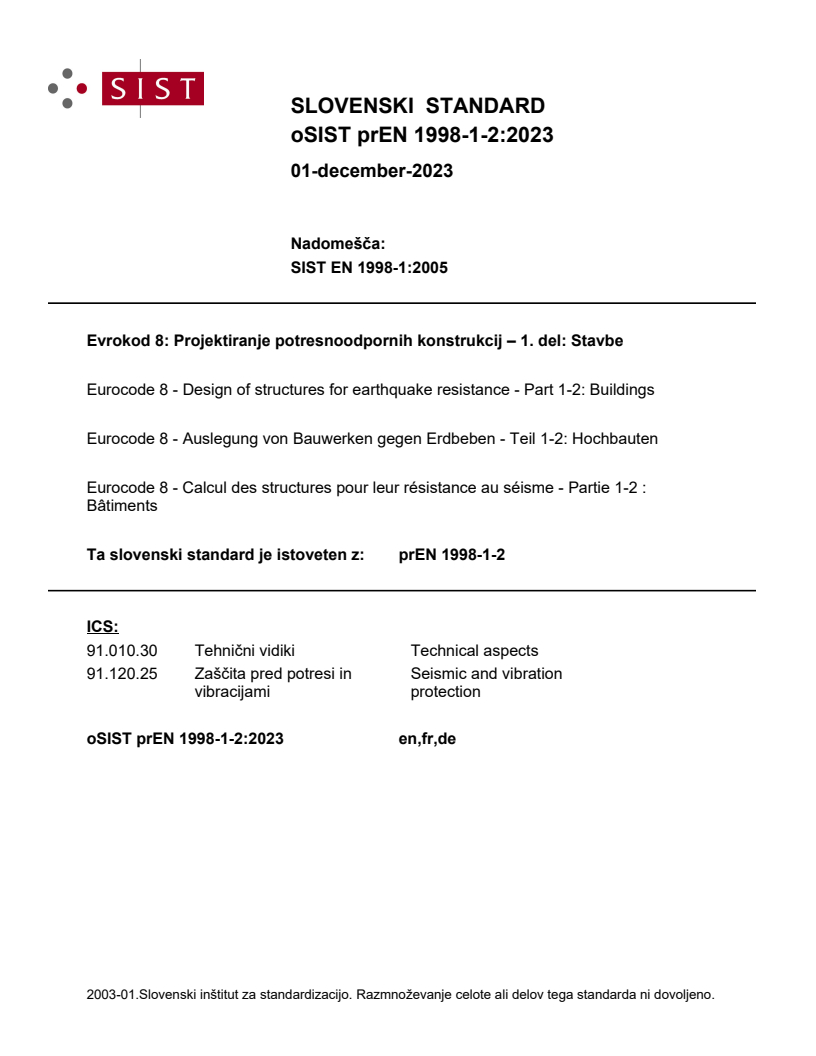
SLOVENSKI STANDARD
oSIST prEN 1998-1-2:2023
01-december-2023
Nadomešča:
SIST EN 1998-1:2005
Evrokod 8: Projektiranje potresnoodpornih konstrukcij – 1. del: Stavbe
Eurocode 8 - Design of structures for earthquake resistance - Part 1-2: Buildings
Eurocode 8 - Auslegung von Bauwerken gegen Erdbeben - Teil 1-2: Hochbauten
Eurocode 8 - Calcul des structures pour leur résistance au séisme - Partie 1-2 :
Bâtiments
Ta slovenski standard je istoveten z: prEN 1998-1-2
ICS:
91.010.30 Tehnični vidiki Technical aspects
91.120.25 Zaščita pred potresi in Seismic and vibration
vibracijami protection
oSIST prEN 1998-1-2:2023 en,fr,de
2003-01.Slovenski inštitut za standardizacijo. Razmnoževanje celote ali delov tega standarda ni dovoljeno.
oSIST prEN 1998-1-2:2023
oSIST prEN 1998-1-2:2023
DRAFT
EUROPEAN STANDARD
prEN 1998-1-2
NORME EUROPÉENNE
EUROPÄISCHE NORM
September 2023
ICS 91.120.25 Will supersede EN 1998-1:2004
English Version
Eurocode 8 - Design of structures for earthquake
resistance - Part 1-2: Buildings
Eurocode 8 - Calcul des structures pour leur résistance Eurocode 8 - Auslegung von Bauwerken gegen
au séisme - Part 1-2: Bâtiments Erdbeben - Teil 1-2: Hochbauten
This draft European Standard is submitted to CEN members for enquiry. It has been drawn up by the Technical Committee
CEN/TC 250.
If this draft becomes a European Standard, CEN members are bound to comply with the CEN/CENELEC Internal Regulations
which stipulate the conditions for giving this European Standard the status of a national standard without any alteration.
This draft European Standard was established by CEN in three official versions (English, French, German). A version in any other
language made by translation under the responsibility of a CEN member into its own language and notified to the CEN-CENELEC
Management Centre has the same status as the official versions.
CEN members are the national standards bodies of Austria, Belgium, Bulgaria, Croatia, Cyprus, Czech Republic, Denmark, Estonia,
Finland, France, Germany, Greece, Hungary, Iceland, Ireland, Italy, Latvia, Lithuania, Luxembourg, Malta, Netherlands, Norway,
Poland, Portugal, Republic of North Macedonia, Romania, Serbia, Slovakia, Slovenia, Spain, Sweden, Switzerland, Türkiye and
United Kingdom.
Recipients of this draft are invited to submit, with their comments, notification of any relevant patent rights of which they are
aware and to provide supporting documentation.
Warning : This document is not a European Standard. It is distributed for review and comments. It is subject to change without
notice and shall not be referred to as a European Standard.
EUROPEAN COMMITTEE FOR STANDARDIZATION
COMITÉ EUROPÉEN DE NORMALISATION
EUROPÄISCHES KOMITEE FÜR NORMUNG
CEN-CENELEC Management Centre: Rue de la Science 23, B-1040 Brussels
© 2023 CEN All rights of exploitation in any form and by any means reserved Ref. No. prEN 1998-1-2:2023 E
worldwide for CEN national Members.
oSIST prEN 1998-1-2:2023
prEN 1998-1-2:2023 (E)
Contents Page
European foreword . 13
0 Introduction . 14
1 Scope . 17
1.1 Scope of prEN 1998-1-2 . 17
1.2 Assumptions . 17
2 Normative references . 17
3 Terms, definitions and symbols . 17
3.1 Terms and definitions . 17
3.2 Symbols and abbreviations . 21
3.2.1 Symbols . 22
3.2.2 Abbreviations . 40
3.3 S.I. Units . 40
4 Basis of design . 42
4.1 Performance requirements . 42
4.2 Seismic actions . 42
4.3 Compliance criteria . 43
4.4 Characteristics of earthquake resistant buildings . 43
4.4.1 Conceptual design . 43
4.4.2 Primary and secondary seismic members. 44
4.4.3 Torsionally flexible buildings . 45
4.4.4 Structural regularity . 46
5 Modelling and structural analysis . 47
5.1 Modelling . 47
5.1.1 General. 47
5.1.2 Masses . 47
5.1.3 Stiffness . 47
5.2 Minimum design eccentricity in buildings . 48
5.3 Methods of analysis . 49
5.3.1 General. 49
5.3.2 Force-based approach . 49
5.3.3 Lateral forces method of analysis . 50
5.3.4 Response spectrum analysis . 50
5.3.5 Non-linear static analysis. 51
5.3.6 Response-history analysis . 53
6 Verifications of structural members to limit states . 53
6.1 General. 53
6.2 Verification of Significant Damage (SD) limit state . 54
6.2.1 General. 54
6.2.2 Equilibrium condition . 54
6.2.3 Resistance conditions . 54
6.2.4 Control of second-order effects . 55
6.2.5 Limitation of interstorey drift . 55
6.2.6 Capacity design in DC2 . 56
6.2.7 Capacity design in DC3 . 57
oSIST prEN 1998-1-2:2023
prEN 1998-1-2:2023 (E)
6.2.8 Resistance of horizontal diaphragms and bracings . 57
6.2.9 Resistance of foundations . 58
6.2.10 Seismic joint condition . 58
6.2.11 Verification of transfer zones in DC2 and DC3 . 58
6.2.12 Verification of underground basements . 59
6.3 Verification to other limit states . 60
6.3.1 Verification to Near Collapse (NC) limit state . 60
6.3.2 Verification of Damage Limitation (DL) limit state . 60
6.3.3 Verification of fully Operational (OP) limit state . 61
7 Ancillary elements . 61
7.1 General . 61
7.2 Verification at Significant Damage (SD) limit state . 61
7.2.1 Seismic action effects . 61
7.2.2 Performance factors . 63
7.3 Verification at Near Collapse (NC) limit state . 63
7.4 Masonry infilled frames . 63
7.4.1 General . 63
7.4.2 Design of frames with interacting infills . 64
7.4.3 Design of frames with non-interacting infills . 71
7.5 Structures with claddings . 71
7.5.1 Basis of design . 71
7.5.2 Analysis . 72
7.5.3 Cladding panels . 72
7.6 Partitions . 74
7.6.1 Basis of design . 74
7.6.2 Verification of partitions. 74
8 Base isolated buildings . 74
8.1 Field of application . 74
8.2 Basis of design . 74
8.2.1 Compliance criteria. 74
8.2.2 Control of undesirable movements . 74
8.2.3 Control of differential seismic ground motions . 75
8.2.4 Control of displacements relative to surrounding ground and constructions . 75
8.3 Structural analysis . 75
8.3.1 General . 75
8.3.2 Fundamental-mode equivalent linear response-spectrum analysis . 75
8.4 Verification of Significant Damage Limit State . 76
9 Buildings with energy dissipation systems . 77
9.1 General . 77
9.2 Basis of design . 77
9.2.1 Compliance criteria. 77
9.2.2 Main structural system . 77
9.2.3 Energy dissipation system . 78
9.2.4 Control of torsional effects . 78
9.3 Structural analysis . 78
9.3.1 General . 78
9.3.2 Non-linear response spectrum analysis . 78
9.3.3 Energy-balance based analysis . 87
9.3.4 Non-linear response history analysis. 92
9.3.5 Combination of the effects of the components of seismic action. 92
9.4 Verification to Limit States . 92
oSIST prEN 1998-1-2:2023
prEN 1998-1-2:2023 (E)
9.4.1 General. 92
9.4.2 Verification to Significant Damage (SD) limit state . 92
9.4.3 Verification to Near Collapse (NC) limit state . 92
9.4.4 Verification to Damage Limitation (DL) limit state . 93
9.4.5 Verification of fully Operational (OP) limit state . 93
10 Specific rules for concrete buildings . 93
10.1 General. 93
10.2 Basis of design and design criteria . 93
10.2.1 General rules on design action effects. 93
10.2.2 Local resistance condition . 94
10.2.3 Local ductility condition . 94
10.2.4 Capacity design rule for moment resisting frames . 94
10.3 Materials requirements . 95
10.3.1 General. 95
10.3.2 Design for DC1 . 95
10.3.3 Design for DC2 and DC3 . 95
10.3.4 Safety verifications . 95
10.4 Structural types, behaviour factors, limits of seismic action, limits of drift and partial
factors for the displacement-based approach . 95
10.4.1 Structural types . 95
10.4.2 Behaviour factor for horizontal components of the seismic action in force-based
analysis . 97
10.4.3 Limits of seismic action for design to DC1, DC2 and DC3 . 98
10.4.4 Limits of drift . 98
10.4.5 Partial factors on resistances for the displacement-based approach . 98
10.5 Beams . 99
10.5.1 Geometrical and other provisions . 99
10.5.2 Specific rules for beams supporting discontinued vertical members . 99
10.5.3 Design action effects . 100
10.5.4 SD limit state verifications and detailing . 101
10.6 Columns . 103
10.6.1 Geometrical and other provisions . 103
10.6.2 Design action effects . 103
10.6.3 SD limit state verifications and detailing . 104
10.7 Beam-column joints . 106
10.8 Ductile walls . 108
10.8.1 Geometrical and other constraints . 108
10.8.2 Design action effects . 109
10.8.3 SD limit state verifications and detailing . 111
10.9 Large walls. 116
10.9.1 Geometrical provisions. 116
10.9.2 Design action effects . 116
10.9.3 SD limit state verifications and detailing . 117
10.10 Flat slabs . 118
10.10.1 Basis of design . 118
10.10.2 SD limit state verifications and detailing. 119
10.11 Provisions for anchorages and laps . 124
10.11.1 General . 124
10.11.2 Anchorage of reinforcement in beams . 124
10.11.3 Laps and mechanical couplers . 126
10.12 Provisions for concrete diaphragms . 127
10.12.1 Cast in place diaphragms . 127
oSIST prEN 1998-1-2:2023
prEN 1998-1-2:2023 (E)
10.12.2 Precast concrete diaphragms . 128
10.13 Prestressed concrete . 128
10.14 Precast concrete structures . 128
10.14.1 Structural types and behaviour factor q . 128
10.14.2 Rules applicable to all structural types and to DC1, DC2 and DC3 . 129
10.14.3 Precast moment resisting frames . 130
10.14.4 Precast walls . 132
10.14.5 Precast floors and roof diaphragms. Rules for ductility classes DC1, DC2 and DC3
10.15 Design and detailing of foundations . 135
11 Specific rules for steel buildings . 135
11.1 General . 135
11.2 Basis of Design . 135
11.2.1 Ductility classes . 135
11.2.2 Safety verifications . 135
11.3 Materials . 135
11.4 Structural types, behaviour factors and limits of seismic action . 136
11.4.1 Structural types . 136
11.4.2 Behaviour factors . 140
11.4.3 Limits of seismic action for design to DC1, DC2 and DC3 . 141
11.5 Structural analysis . 142
11.6 Verification to Limit States . 143
11.6.1 General . 143
11.6.2 Verification at Significant Damage limit state in a force-based approach . 143
11.6.3 Verification at Significant Damage limit state in a displacement-based approach . 143
11.6.4 Limitation of interstorey drift at Significant Damage limit state . 144
11.7 Design rules for low-dissipative (DC1) and non-dissipative structural behaviour for
all structural types . 145
11.7.1 General . 145
11.7.2 Design rules for low-dissipative structures . 145
11.7.3 Design rules for non-dissipative structures . 145
11.8 Design rules for dissipative (DC2 and DC3) structural behaviour common to all
structural types . 146
11.8.1 General . 146
11.8.2 Design criteria for dissipative structures . 146
11.8.3 Verification for dissipative members in compression or bending . 146
11.8.4 Verification for dissipative parts of members in tension . 147
11.8.5 Verification of members. 147
11.8.6 Verification of connections in dissipative zones . 149
11.8.7 Verification of column-to-column splices . 151
11.9 Design rules for moment resisting frames . 152
11.9.1 Design criteria . 152
11.9.2 Verification of beams . 152
11.9.3 Verification of columns. 153
11.9.4 Verification of beam to column joints . 155
11.9.5 Verification of column base joints . 157
11.10 Design rules for frames with concentric bracings . 158
11.10.1 Design criteria for DC2 and DC3 . 158
11.10.2 Analysis . 159
11.10.3 Verification of diagonal members . 160
11.10.4 Verification of beams and columns . 162
11.10.5 Verification of beam to column connections . 163
oSIST prEN 1998-1-2:2023
prEN 1998-1-2:2023 (E)
11.10.6 Verification of brace connections . 163
11.10.7 Verification of column base joints . 164
11.11 Design rules for frames with eccentric bracings . 165
11.11.1 Design criteria . 165
11.11.2 Verification of seismic links . 165
11.11.3 Verification of members and connections not containing seismic links . 169
11.11.4 Verification of connections of the seismic links . 170
11.11.5 Verification of beam to column connections . 170
11.12 Design rules for frames with buckling restrained bracings . 170
11.12.1 Design criteria . 170
11.12.2 Analysis . 171
11.12.3 Verification of buckling restrained bracings . 172
11.12.4 Conformity criteria . 172
11.12.5 Verification of beams and columns . 173
11.12.6 Verification of beam to column connections . 173
11.12.7 Verification of brace connections . 173
11.12.8 Verification of column base joints . 174
11.13 Design rules for dual frames - moment resisting frames combined with either
concentric, eccentric or buckling restrained bracings . 175
11.14 Design rules for lightweight steel systems . 175
11.14.1 General . 175
11.14.2 General verification rules for low-dissipative (DC1) and dissipative (DC2 and
DC3) structural behaviour common to all lightweight steel systems . 175
11.14.3 Additional verification rules for dissipative (DC2 and DC3) structural behaviour
common to all lightweight steel systems. . 176
11.14.4 Specific verification for dissipative (DC2 and DC3) strap braced walls . 177
11.14.5 Specific verification for dissipative (DC2 and DC3) shear walls with steel sheet
sheathing . 177
11.14.6 Specific verification for dissipative (DC2 and DC3) shear walls with wood
sheathing . 177
11.14.7 Specific verification for dissipative (DC2 and DC3) shear walls with gypsum
sheathing . 178
11.15 Verification of inverted pendulum structures . 178
11.16 Design rules for steel structures with concrete cores or concrete walls and for
moment resisting frames combined with infills . 178
11.16.1 Structures with concrete cores or concrete walls . 178
11.16.2 Moment resisting frames combined with infills . 178
11.17 Steel diaphragms. 178
11.18 Transfer zones. Design for DC2 and DC3 . 179
11.19 Requirements for supply of material and execution . 179
12 Specific rules for composite steel–concrete buildings . 180
12.1 General. 180
12.2 Basis of design . 180
12.2.1 Design concepts . 180
12.2.2 Safety verifications . 180
12.3 Materials . 180
12.3.1 Concrete . 180
12.3.2 Reinforcing steel . 181
12.3.3 Structural steel . 181
12.4 Structural types, behaviour factors, limits of seismic action and limits of drifts . 181
12.4.1 Structural types . 181
12.4.2 Behaviour factors . 182
oSIST prEN 1998-1-2:2023
prEN 1998-1-2:2023 (E)
12.4.3 Limits of seismic action for design to DC1, DC2 and DC3 . 183
12.5 Structural analysis . 184
12.5.1 General . 184
12.5.2 Stiffness of sections . 184
12.6 Verification to limit states . 185
12.6.1 General . 185
12.6.2 Verifications at Significant Damage limit state in a force-based approach . 185
12.6.3 Verifications at Significant Damage limit state in a displacement-based approach 185
12.6.4 Limitation of interstorey drift at Significant Damage limit state . 185
12.7 Design rules for low-dissipative (DC1) and non-dissipative structural behaviour for
all structural types . 186
12.7.1 General . 186
12.7.2 Design rules for low-dissipative structures . 186
12.7.3 Design rules for non-dissipative structures . 186
12.8 Design rules for dissipative (DC2 and DC3) structural behaviour common to all
structural types . 186
12.8.1 General . 186
12.8.2 Design criteria for dissipative structures . 186
12.8.3 Verification of dissipative members in compression or bending . 187
12.8.4 Verification of dissipative members in tension . 188
12.8.5 Verification of members in DC2 and DC3 . 188
12.8.6 Verification of beams . 189
12.8.7 Verification of composite columns . 192
12.8.8 Verification of composite joints in dissipative zones . 195
12.8.9 Verification of column-to-column splices . 196
12.9 Design and detailing rules for composite moment resisting frames in DC2 and DC3
................................................................................................................................................................ 196
12.9.1 Design criteria . 196
12.9.2 Analysis . 197
12.9.3 Verification of beams . 197
12.9.4 Verification of columns. 198
12.9.5 Verification of column diaphragm plates . 198
12.9.6 Verification of beam to column joints . 199
12.9.7 Verification of column base joints . 199
12.10 Design and detailing rules for composite frames with concentric bracings in DC2 and
DC3 . 199
12.10.1 Design criteria . 199
12.10.2 Analysis . 200
12.10.3 Verification of diagonal members . 200
12.10.4 12.10.4. Verification of beams and columns . 200
12.10.5 Verification of beam to column connections . 200
12.10.6 Verification of brace connections . 200
12.10.7 Verification of column base joints . 201
12.11 Design and detailing rules for composite frames with eccentric bracings in DC2 and
DC3 .
...
Questions, Comments and Discussion
Ask us and Technical Secretary will try to provide an answer. You can facilitate discussion about the standard in here.