


EN 15158:2006
(Main)Advanced technical ceramics - Mechanical properties of ceramic composites at high temperature under inert atmosphere - Determination of fatigue properties at constant amplitude
General Information
- Abstract
This European Standard specifies the conditions for the determination of constant-amplitude of load or strain in uniaxial tension/tension or in uniaxial tension/compression cyclic fatigue properties of ceramic matrix composite materials (CMCs) with fibre reinforcement for temperature up to 2 000 °C under vacuum or a gas atmosphere which is inert to the material under test.
NOTE Test environments are specified which are intended to prevent the material under test from chemically reacting with them.
This European Standard applies to all ceramic matrix composites with fibre reinforcement, unidirectional (1D), bi-directional (2D), and tri-directional (xD, where 2 < x 3).
- Status
- Published
- Publication Date
- 08-Aug-2006
- Withdrawal Date
- 27-Feb-2007
- Technical Committee
- CEN/TC 184 - Advanced technical ceramics
- Drafting Committee
- CEN/TC 184/SC 1 - Ceramic composites
- Current Stage
- 9093 - Decision to confirm - Review Enquiry
- Start Date
- 06-Sep-2024
- Completion Date
- 23-Sep-2026

Overview
EN 15158:2006 is a CEN European Standard that defines a test method for determining the constant‑amplitude cyclic fatigue properties of ceramic matrix composites (CMCs) with fibre reinforcement at high temperatures (up to 2 000 °C) under vacuum or inert gas atmospheres. It covers uniaxial tension/tension and tension/compression fatigue testing for unidirectional (1D), bi‑directional (2D) and multi‑directional (xD, 2 < x ≤ 3) CMCs and specifies environment controls intended to prevent chemical reaction between the test atmosphere and the material.
Key topics and technical requirements
- Test principle
- Two methods: Method A (load‑control) - cycling between constant stress levels; Method B (strain‑control) - cycling between constant strain levels.
- Record total number of cycles and time to failure (Nf, tf); optional periodic stress‑strain recording to extract damage parameters.
- Temperature & atmosphere
- Tests up to 2 000 °C in vacuum or a gas atmosphere inert to the material; controlled temperature zone must be within ±50 °C of the test temperature.
- Specimens
- Applies to fibre‑reinforced CMCs (1D, 2D, xD). Standards specify specimen preparation, gauge length definition, and number of specimens required.
- Apparatus & measurement
- Hydraulic fatigue test machine (load or strain control) with cycle counter; force measurement complying with EN ISO 7500‑1 (grade 1).
- Gas‑tight test chamber for atmosphere control; heating system that maintains temperature uniformity in the controlled zone.
- Extensometry compatible with test temperature and frequency; conforming to EN ISO 9513 (class 1 or better).
- Load train, grips and alignment must avoid changes due to heating; cooled‑grip techniques are described.
- Damage parameters
- Examples include residual strain at zero load, secant elastic modulus (relative damage), hysteresis loop area (internal friction), and evolution of maximum/minimum strains.
- Outputs
- Life‑time diagrams (stress/strain amplitude vs. Nf or tf), damage evolution plots, and residual property assessment for unfailed specimens.
Applications and users
- Who uses it
- Materials engineers, test laboratories, CMC manufacturers, aerospace and power‑generation component developers, research institutes, and quality/control departments.
- Practical uses
- Characterizing high‑temperature fatigue life of CMCs for turbine components, thermal protection systems, combustion liners, and other high‑temperature structural parts.
- Supporting design margins, material selection, durability assessment, and certification testing where inert atmospheres or vacuum are required to avoid oxidation.
Related standards
- EN 1892, EN 1893, EN 12291 (high‑temperature tensile/compression methods for CMCs)
- EN ISO 7500‑1 (force measurement verification)
- EN ISO 9513 (extensometer calibration)
- EN 60584‑1/2 (thermocouples reference/tolerances)
- prCEN/TR 13233:2007 (notations and symbols)
Keywords: EN 15158:2006, ceramic matrix composites, CMC fatigue, high temperature fatigue testing, inert atmosphere, constant amplitude cyclic fatigue, uniaxial fatigue tests.
Relations
- Effective Date
- 25-Aug-2026
- Effective Date
- 09-Feb-2026
- Effective Date
- 28-Jan-2026
- Effective Date
- 28-Jan-2026
- Effective Date
- 28-Jan-2026
- Effective Date
- 28-Jan-2026
- Effective Date
- 28-Jan-2026
- Effective Date
- 28-Jan-2026
- Effective Date
- 28-Jan-2026
Frequently Asked Questions
EN 15158:2006 is a standard published by the European Committee for Standardization (CEN). Its full title is "Advanced technical ceramics - Mechanical properties of ceramic composites at high temperature under inert atmosphere - Determination of fatigue properties at constant amplitude". This standard covers: This European Standard specifies the conditions for the determination of constant-amplitude of load or strain in uniaxial tension/tension or in uniaxial tension/compression cyclic fatigue properties of ceramic matrix composite materials (CMCs) with fibre reinforcement for temperature up to 2 000 °C under vacuum or a gas atmosphere which is inert to the material under test. NOTE Test environments are specified which are intended to prevent the material under test from chemically reacting with them. This European Standard applies to all ceramic matrix composites with fibre reinforcement, unidirectional (1D), bi-directional (2D), and tri-directional (xD, where 2 < x 3).
This European Standard specifies the conditions for the determination of constant-amplitude of load or strain in uniaxial tension/tension or in uniaxial tension/compression cyclic fatigue properties of ceramic matrix composite materials (CMCs) with fibre reinforcement for temperature up to 2 000 °C under vacuum or a gas atmosphere which is inert to the material under test. NOTE Test environments are specified which are intended to prevent the material under test from chemically reacting with them. This European Standard applies to all ceramic matrix composites with fibre reinforcement, unidirectional (1D), bi-directional (2D), and tri-directional (xD, where 2 < x 3).
EN 15158:2006 is classified under the following ICS (International Classification for Standards) categories: 81.060.30 - Advanced ceramics. The ICS classification helps identify the subject area and facilitates finding related standards.
EN 15158:2006 has the following relationships with other standards: It is inter standard links to ISO 3611:1978, EN 60584-1:2013, EN ISO 9513:2012, CEN/TR 13233:2007, EN ISO 14544:2025, EN ISO 14574:2025, ENV 1186-12:1995, EN 658-1:1998, EN ISO 7500-1:2018. Understanding these relationships helps ensure you are using the most current and applicable version of the standard.
EN 15158:2006 is available in PDF format for immediate download after purchase. The document can be added to your cart and obtained through the secure checkout process. Digital delivery ensures instant access to the complete standard document.
Standards Content (Sample)
2003-01.Slovenski inštitut za standardizacijo. Razmnoževanje celote ali delov tega standarda ni dovoljeno.Advanced technical ceramics - Mechanical properties of ceramic composites at high temperature under inert atmosphere - Determination of fatigue properties at constant amplitudeCéramiques techniques avancées - Propriétés mécaniques des céramiques composites a haute température sous atmosphere inerte - Détermination des propriétés de fatigue a amplitude constanteHochleistungskeramik - Mechanische Eigenschaften von keramischen Verbundwerkstoffen bei hoher Temperatur in inerter Atmosphäre - Bestimmung der Dauerschwingeigenschaften bei Belastung mit konstanter AmplitudeTa slovenski standard je istoveten z:EN 15158:2006SIST EN 15158:2007en,fr,de81.060.30Sodobna keramikaAdvanced ceramicsICS:SLOVENSKI
STANDARDSIST EN 15158:200701-januar-2007
EUROPEAN STANDARDNORME EUROPÉENNEEUROPÄISCHE NORMEN 15158August 2006ICS 81.060.30 English VersionAdvanced technical ceramics - Mechanical properties of ceramiccomposites at high temperature under inert atmosphere -Determination of fatigue properties at constant amplitudeCéramiques techniques avancées - Propriétés mécaniquesdes céramiques composites à haute température sousatmosphère inerte - Détermination des propriétés defatigue à amplitude constanteHochleistungskeramik - Mechanische Eigenschaften vonkeramischen Verbundwerkstoffen bei hoher Temperatur ininerter Atmosphäre - Bestimmung derDauerschwingeigenschaften bei Belastung mit konstanterAmplitudeThis European Standard was approved by CEN on 14 July 2006.CEN members are bound to comply with the CEN/CENELEC Internal Regulations which stipulate the conditions for giving this EuropeanStandard the status of a national standard without any alteration. Up-to-date lists and bibliographical references concerning such nationalstandards may be obtained on application to the Central Secretariat or to any CEN member.This European Standard exists in three official versions (English, French, German). A version in any other language made by translationunder the responsibility of a CEN member into its own language and notified to the Central Secretariat has the same status as the officialversions.CEN members are the national standards bodies of Austria, Belgium, Cyprus, Czech Republic, Denmark, Estonia, Finland, France,Germany, Greece, Hungary, Iceland, Ireland, Italy, Latvia, Lithuania, Luxembourg, Malta, Netherlands, Norway, Poland, Portugal, Romania,Slovakia, Slovenia, Spain, Sweden, Switzerland and United Kingdom.EUROPEAN COMMITTEE FOR STANDARDIZATIONCOMITÉ EUROPÉEN DE NORMALISATIONEUROPÄISCHES KOMITEE FÜR NORMUNGManagement Centre: rue de Stassart, 36
B-1050 Brussels© 2006 CENAll rights of exploitation in any form and by any means reservedworldwide for CEN national Members.Ref. No. EN 15158:2006: E
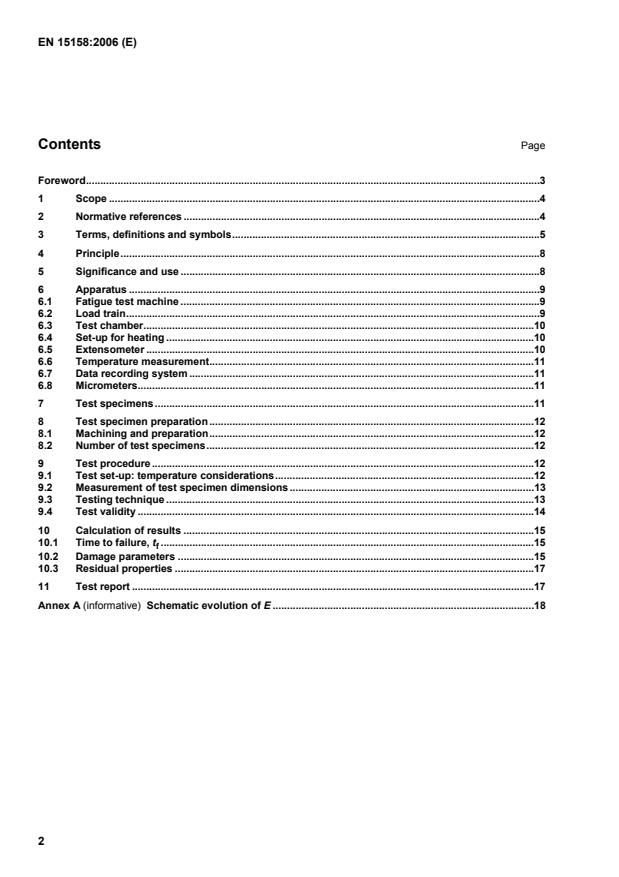
Schematic evolution of E.18
1 To be published in 2007
Key 1 time 6 mean 2 control parameter (test mode) 7 peak (maximum) 3 triangular form 8 valley (minimum) 4 trapezoidal form 9 amplitude 5 sinusoidal form 10 range Figure 1 — Cyclic fatigue nomenclature and wave forms 3.10 Cyclic fatigue phenomena 3.10.1 load ratio, R in cyclic fatigue loading, algebraic ratio of the two loading parameters of a cycle NOTE The most widely used ratios are: R = (minimum load/maximum load) or R = (valley load/peak load). 3.10.2 Stress cyclic fatigue 3.10.2.1 maximum stress, σσσσmax maximum applied stress during cyclic fatigue 3.10.2.2 minimum stress, σσσσmin minimum applied stress during cyclic fatigue
...