


EN 15280:2013
(Main)Evaluation of a.c. corrosion likelihood of buried pipelines applicable to cathodically protected pipelines
General Information
- Abstract
This European Standard is applicable to buried cathodically protected metallic structures that are influenced by a.c. traction systems and/or a.c. power lines.
In this document, a buried pipeline (or structure) is a buried or immersed pipeline (or structure), as defined in EN 12954.
In the presence of a.c. interference, the protection criteria given in EN 12954:2001, Table 1, are not sufficient to demonstrate that the steel is being protected against corrosion.
This European Standard provides limits, measurement procedures, mitigation measures and information to deal with long term a.c. interference for a.c voltages at frequencies between 16,7 Hz and 60 Hz and the evaluation of a.c. corrosion likelihood.
This European Standard deals with the possibility of a.c. corrosion of metallic pipelines due to a.c. interferences caused by inductive, conductive or capacitive coupling with a.c. power systems and the maximum tolerable limits of these interference effects. It takes into account the fact that this is a long-term effect, which occurs during normal operating conditions of the a.c. power system.
This European Standard does not cover the safety issues associated with a.c. voltages on pipelines. These are covered in national standards and regulations (see EN 50443).
- Status
- Withdrawn
- Publication Date
- 13-Aug-2013
- Withdrawal Date
- 22-Sep-2026
- Technical Committee
- CEN/TC 219 - Cathodic protection (provisional)
- Current Stage
- 9960 - Withdrawal effective - Withdrawal
- Start Date
- 20-Sep-2017
- Completion Date
- 23-Sep-2026

Relations
- Effective Date
- 08-Jun-2022
- Effective Date
- 27-Sep-2017
- Effective Date
- 09-Feb-2026
- Effective Date
- 09-Feb-2026
- Effective Date
- 28-Jan-2026
- Effective Date
- 28-Jan-2026
Get Certified
Connect with accredited certification bodies for this standard

Element Materials Technology
Materials testing and product certification.

Inštitut za kovinske materiale in tehnologije
Institute of Metals and Technology. Materials testing, metallurgical analysis, NDT.
Institut za varilstvo d.o.o. (Welding Institute)
Slovenia's leading welding institute since 1952. ISO 3834, EN 1090, pressure equipment certification, NDT personnel, welder qualification. Only IIW Au
Sponsored listings
Frequently Asked Questions
EN 15280:2013 is a standard published by the European Committee for Standardization (CEN). Its full title is "Evaluation of a.c. corrosion likelihood of buried pipelines applicable to cathodically protected pipelines". This standard covers: This European Standard is applicable to buried cathodically protected metallic structures that are influenced by a.c. traction systems and/or a.c. power lines. In this document, a buried pipeline (or structure) is a buried or immersed pipeline (or structure), as defined in EN 12954. In the presence of a.c. interference, the protection criteria given in EN 12954:2001, Table 1, are not sufficient to demonstrate that the steel is being protected against corrosion. This European Standard provides limits, measurement procedures, mitigation measures and information to deal with long term a.c. interference for a.c voltages at frequencies between 16,7 Hz and 60 Hz and the evaluation of a.c. corrosion likelihood. This European Standard deals with the possibility of a.c. corrosion of metallic pipelines due to a.c. interferences caused by inductive, conductive or capacitive coupling with a.c. power systems and the maximum tolerable limits of these interference effects. It takes into account the fact that this is a long-term effect, which occurs during normal operating conditions of the a.c. power system. This European Standard does not cover the safety issues associated with a.c. voltages on pipelines. These are covered in national standards and regulations (see EN 50443).
This European Standard is applicable to buried cathodically protected metallic structures that are influenced by a.c. traction systems and/or a.c. power lines. In this document, a buried pipeline (or structure) is a buried or immersed pipeline (or structure), as defined in EN 12954. In the presence of a.c. interference, the protection criteria given in EN 12954:2001, Table 1, are not sufficient to demonstrate that the steel is being protected against corrosion. This European Standard provides limits, measurement procedures, mitigation measures and information to deal with long term a.c. interference for a.c voltages at frequencies between 16,7 Hz and 60 Hz and the evaluation of a.c. corrosion likelihood. This European Standard deals with the possibility of a.c. corrosion of metallic pipelines due to a.c. interferences caused by inductive, conductive or capacitive coupling with a.c. power systems and the maximum tolerable limits of these interference effects. It takes into account the fact that this is a long-term effect, which occurs during normal operating conditions of the a.c. power system. This European Standard does not cover the safety issues associated with a.c. voltages on pipelines. These are covered in national standards and regulations (see EN 50443).
EN 15280:2013 is classified under the following ICS (International Classification for Standards) categories: 23.040.03 - Pipeline and its parts for external water conveyance systems; 23.040.99 - Other pipeline components; 77.060 - Corrosion of metals. The ICS classification helps identify the subject area and facilitates finding related standards.
EN 15280:2013 has the following relationships with other standards: It is inter standard links to CEN/TS 15280:2006, EN ISO 18086:2017, EN 50443:2011, EN 61010-1:2010, EN 12954:2001, EN 13509:2003. Understanding these relationships helps ensure you are using the most current and applicable version of the standard.
EN 15280:2013 is available in PDF format for immediate download after purchase. The document can be added to your cart and obtained through the secure checkout process. Digital delivery ensures instant access to the complete standard document.
Standards Content (Sample)
2003-01.Slovenski inštitut za standardizacijo. Razmnoževanje celote ali delov tega standarda ni dovoljeno.Beurteilung der Korrosionswahrscheinlichkeit durch Wechselstrom an erdverlegten Rohrleitungen - Anwendung für kathodisch geschützte RohrleitungenÉvaluation du risque de corrosion occasionnée par les courants alternatifs des canalisations enterrées protégées cathodiquementEvaluation of a.c. corrosion likelihood of buried pipelines applicable to cathodically protected pipelines77.060Korozija kovinCorrosion of metals23.040.01Deli cevovodov in cevovodi na splošnoPipeline components and pipelines in generalICS:Ta slovenski standard je istoveten z:EN 15280:2013SIST EN 15280:2013en,fr,de01-oktober-2013SIST EN 15280:2013SLOVENSKI
STANDARDSIST-TS CEN/TS 15280:20061DGRPHãþD
EUROPEAN STANDARD NORME EUROPÉENNE EUROPÄISCHE NORM
EN 15280
August 2013 ICS 23.040.99; 77.060 Supersedes CEN/TS 15280:2006English Version
Evaluation of a.c. corrosion likelihood of buried pipelines applicable to cathodically protected pipelines
Évaluation du risque de corrosion occasionnée par les courants alternatifs des canalisations enterrées protégées cathodiquement
Beurteilung der Korrosionswahrscheinlichkeit durch Wechselstrom an erdverlegten Rohrleitungen anwendbar für kathodisch geschützte Rohrleitungen This European Standard was approved by CEN on 5 July 2013.
CEN members are bound to comply with the CEN/CENELEC Internal Regulations which stipulate the conditions for giving this European Standard the status of a national standard without any alteration. Up-to-date lists and bibliographical references concerning such national standards may be obtained on application to the CEN-CENELEC Management Centre or to any CEN member.
This European Standard exists in three official versions (English, French, German). A version in any other language made by translation under the responsibility of a CEN member into its own language and notified to the CEN-CENELEC Management Centre has the same status as the official versions.
CEN members are the national standards bodies of Austria, Belgium, Bulgaria, Croatia, Cyprus, Czech Republic, Denmark, Estonia, Finland, Former Yugoslav Republic of Macedonia, France, Germany, Greece, Hungary, Iceland, Ireland, Italy, Latvia, Lithuania, Luxembourg, Malta, Netherlands, Norway, Poland, Portugal, Romania, Slovakia, Slovenia, Spain, Sweden, Switzerland, Turkey and United Kingdom.
EUROPEAN COMMITTEE FOR STANDARDIZATION
COMITÉ EUROPÉEN DE NORMALISATION EUROPÄISCHES KOMITEE FÜR NORMUNG
Management Centre:
Avenue Marnix 17,
B-1000 Brussels © 2013 CEN All rights of exploitation in any form and by any means reserved worldwide for CEN national Members. Ref. No. EN 15280:2013: ESIST EN 15280:2013
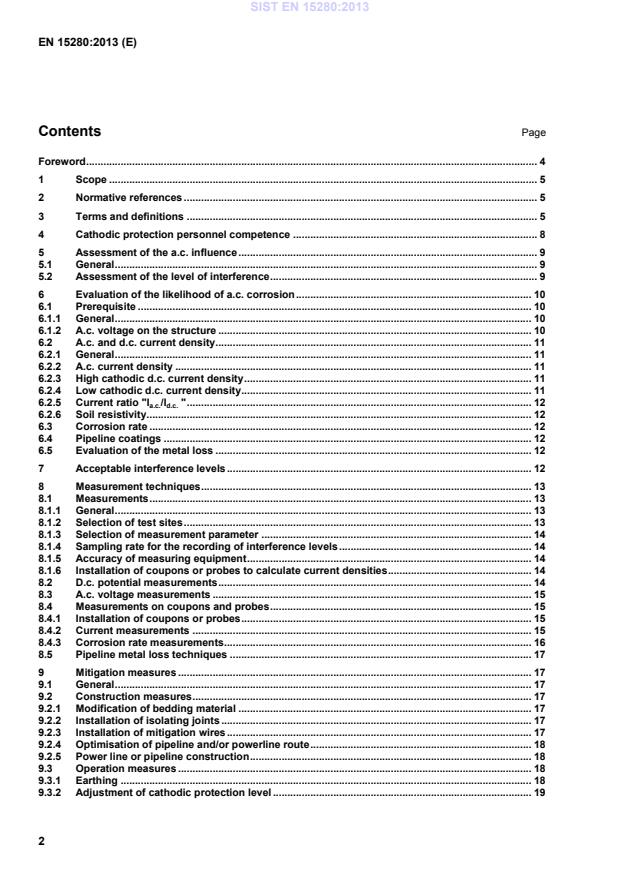
Simplified description of the a.c. corrosion phenomenon . 23 A.1 Cathodically protected pipeline . 23 A.2 Cathodically protected pipeline with a.c. voltage . 23 A.2.1 Description of the phenomena . 23 A.2.2 Reduction of the a.c. corrosion rate . 24 Annex B (informative)
Coupons and probes . 25 B.1 Use and sizes of coupons and probes . 25 B.1.1 Use of coupons or probes . 25 B.1.2 Sizes of coupons or probes . 25 B.2 Installation of buried coupons and probes. 25 B.2.1 General . 25 B.2.2 Before installing the coupon or probe . 25 B.2.3 Installation of the buried coupon or probe . 26 B.3 ER probes principles. 27 B.3.1 Assessment of the corrosion using the electrical resistance (ER) probe technique . 27 B.3.2 ER probe application in the field . 29 B.4 Perforation probes . 29 Annex C (informative)
Coulometric oxidation . 31 Annex D (informative)
Influence of soil characteristics on the a.c. corrosion process . 32 D.1 Influence of electrical parameters . 32 D.2 Influence of the electrochemical process . 32 D.3 Influence of alkaline ions and cations . 32 Annex E (informative)
Other criteria that have been used in the presence of a.c. influence . 33 E.1 General . 33 E.2 ON-potential approach . 33 E.2.1 General . 33 E.2.2 More negative (Eon) cathodic protection level . 33 E.2.3 Less negative (Eon) cathodic protection level . 33 E.2.4 Criteria . 34 Annex F (informative)
Parameters to take into account to choose a d.c. decoupling device . 36 F.1 General aspects to be taken into account . 36 F.2 Electrical parameters . 36 Annex G (informative)
Method to determine the reference electrode location to remote earth . 37 Bibliography . 38
6.1 Prerequisite 6.1.1 General The a.c. voltage on a pipeline is the driving force for the a.c. corrosion processes taking place on the steel surface at coating defects. Among other things, corrosion damage depends on a.c. current density, level of d.c. polarisation, defect geometry, local soil composition and resistivity (Annex D). There are three different approaches to prevent a.c. corrosion: one to limit the a.c. current flowing through a defect, one to control the cathodic protection level, and the other to ensure that any coating remains defect free. These approaches are not mutually exclusive. The evaluation of a.c. corrosion likelihood should be performed by evaluation of some or all of the following parameters: a.c. voltage on the structure, ON-potential, IR-free potential, a.c. current density, d.c. current density, a.c./d.c. current density ratio, soil resistivity, corrosion rate. Annexes B, C and E provide further information. 6.1.2 A.c. voltage on the structure The acceptable a.c. voltage thresholds (see Clause 7 and Annex E) depend on the chosen strategy to prevent a.c. corrosion. Hence, a given interference situation on the pipeline can influence the decision regarding the applicable strategy. SIST EN 15280:2013
...