


EN 13463-1:2009
(Main)Non-electrical equipment for use in potentially explosive atmospheres - Part 1: Basic method and requirements
General Information
- Abstract
This European Standard specifies the basic method and requirements for design, construction, testing and marking of non-electrical equipment intended for use in potentially explosive atmospheres in air of gas, vapour, mist and dusts. Such atmospheres can also exist inside the equipment. In addition, the external atmosphere can be drawn inside the equipment by natural breathing produced as a result of fluctuations in the equipment’s internal operating pressure, and/or temperature.
This European Standard is valid for atmospheres having pressures ranging from 0,8 bar to 1,1 bar and temperatures ranging from - 20 °C to + 60 °C., i.e. equipment built to this European Standard will be satisfactory to any service conditions within this range unless otherwise specified.
NOTE 1 The requirements of this European Standard can also be helpful for the design, construction, testing and marking of equipment intended for use in atmospheres outside the validity range stated above. In this case however, the ignition hazard assessment, ignition protection provided, additional testing (if necessary), manufacturer’s technical documentation and instructions to the user, should clearly demonstrate and indicate the equipment’s suitability for the conditions it may encounter. It should also be recognized that changes in temperature and pressure can have a significant influence on ignitability.
This European Standard does not cover additional marking for equipment intended for use outside the scope of its validity such as an oxygen-enriched atmosphere.
This European Standard is also applicable for the design, construction, testing and marking of components, protective systems, devices and assemblies of these products which have possible ignition sources and are intended for use in potentially explosive atmospheres.
- Status
- Withdrawn
- Publication Date
- 20-Jan-2009
- Withdrawal Date
- 22-Sep-2026
- Current Stage
- 9960 - Withdrawal effective - Withdrawal
- Start Date
- 06-Apr-2016
- Completion Date
- 23-Sep-2026
- Directive
- Harmonized Standard2014/34/EU - Directive 2014/34/EU Of The European Parliament And Of The Council of 26 February 2014 on the harmonisation of the laws of the Member States relating to equipment and protective systems intended for use in potentially explosive atmospheres (recast)OJ Ref: C, C 126, HARMONIZIRAN OJ Date: 08-Apr-2016
Not Harmonized94/9/EC - Equipment and protective systems intended for use in potentially explosive atmospheres (ATEX)OJ Ref: C, C 97 OJ Date: 16-Apr-2010

Relations
- Effective Date
- 28-Jan-2009
- Effective Date
- 22-Dec-2008
- Effective Date
- 01-May-2010
- Effective Date
- 25-Aug-2026
- Effective Date
- 09-Feb-2026
- Effective Date
- 09-Feb-2026
- Refers
EN 60079-0:2006 - Electrical apparatus for explosive gas atmospheres - Part 0: General requirements - Effective Date
- 09-Feb-2026
- Refers
EN ISO 14916:2017 - Thermal spraying - Determination of tensile adhesive strength (ISO 14916:2017) - Effective Date
- 28-Jan-2026
- Effective Date
- 28-Jan-2026
- Effective Date
- 28-Jan-2026
- Effective Date
- 28-Jan-2026
- Effective Date
- 28-Jan-2026
- Effective Date
- 28-Jan-2026
- Referred By
CLC/TR 60079-32-1:2015 - Explosive atmospheres - Part 32-1: Electrostatic Hazards - Guidance - Effective Date
- 09-Feb-2026
- Referred By
CLC/TR 60079-32-1:2018 - Explosive atmospheres - Part 32-1: Electrostatic hazards, guidance - Effective Date
- 09-Feb-2026
Get Certified
Connect with accredited certification bodies for this standard

CIS Institut d.o.o.
Personal Protective Equipment (PPE) certification body. Notified Body NB-2890 for EU Regulation 2016/425 PPE.

Kiwa BDA Testing
Building and construction product certification.
Kmetijski inštitut Slovenije
Agricultural Institute of Slovenia. Soil testing, plant health, agricultural product analysis.
Sponsored listings
Frequently Asked Questions
EN 13463-1:2009 is a standard published by the European Committee for Standardization (CEN). Its full title is "Non-electrical equipment for use in potentially explosive atmospheres - Part 1: Basic method and requirements". This standard covers: This European Standard specifies the basic method and requirements for design, construction, testing and marking of non-electrical equipment intended for use in potentially explosive atmospheres in air of gas, vapour, mist and dusts. Such atmospheres can also exist inside the equipment. In addition, the external atmosphere can be drawn inside the equipment by natural breathing produced as a result of fluctuations in the equipment’s internal operating pressure, and/or temperature. This European Standard is valid for atmospheres having pressures ranging from 0,8 bar to 1,1 bar and temperatures ranging from - 20 °C to + 60 °C., i.e. equipment built to this European Standard will be satisfactory to any service conditions within this range unless otherwise specified. NOTE 1 The requirements of this European Standard can also be helpful for the design, construction, testing and marking of equipment intended for use in atmospheres outside the validity range stated above. In this case however, the ignition hazard assessment, ignition protection provided, additional testing (if necessary), manufacturer’s technical documentation and instructions to the user, should clearly demonstrate and indicate the equipment’s suitability for the conditions it may encounter. It should also be recognized that changes in temperature and pressure can have a significant influence on ignitability. This European Standard does not cover additional marking for equipment intended for use outside the scope of its validity such as an oxygen-enriched atmosphere. This European Standard is also applicable for the design, construction, testing and marking of components, protective systems, devices and assemblies of these products which have possible ignition sources and are intended for use in potentially explosive atmospheres.
This European Standard specifies the basic method and requirements for design, construction, testing and marking of non-electrical equipment intended for use in potentially explosive atmospheres in air of gas, vapour, mist and dusts. Such atmospheres can also exist inside the equipment. In addition, the external atmosphere can be drawn inside the equipment by natural breathing produced as a result of fluctuations in the equipment’s internal operating pressure, and/or temperature. This European Standard is valid for atmospheres having pressures ranging from 0,8 bar to 1,1 bar and temperatures ranging from - 20 °C to + 60 °C., i.e. equipment built to this European Standard will be satisfactory to any service conditions within this range unless otherwise specified. NOTE 1 The requirements of this European Standard can also be helpful for the design, construction, testing and marking of equipment intended for use in atmospheres outside the validity range stated above. In this case however, the ignition hazard assessment, ignition protection provided, additional testing (if necessary), manufacturer’s technical documentation and instructions to the user, should clearly demonstrate and indicate the equipment’s suitability for the conditions it may encounter. It should also be recognized that changes in temperature and pressure can have a significant influence on ignitability. This European Standard does not cover additional marking for equipment intended for use outside the scope of its validity such as an oxygen-enriched atmosphere. This European Standard is also applicable for the design, construction, testing and marking of components, protective systems, devices and assemblies of these products which have possible ignition sources and are intended for use in potentially explosive atmospheres.
EN 13463-1:2009 is classified under the following ICS (International Classification for Standards) categories: 13.230 - Explosion protection. The ICS classification helps identify the subject area and facilitates finding related standards.
EN 13463-1:2009 has the following relationships with other standards: It is inter standard links to EN 13463-1:2001/AC:2002, EN 13463-1:2001, EN ISO 80079-36:2016, ISO 1817:2005, EN 50303:2000, CLC/TR 50404:2003, EN 60079-0:2006, EN ISO 14916:2017, EN 13237:2003, EN 1127-1:2007, EN 13463-6:2005, EN 1127-2:2014, EN 14986:2024, CLC/TR 60079-32-1:2015, CLC/TR 60079-32-1:2018. Understanding these relationships helps ensure you are using the most current and applicable version of the standard.
EN 13463-1:2009 is associated with the following European legislation: EU Directives/Regulations: 2014/34/EU, 94/9/EC; Standardization Mandates: M/BC/CEN/92/46. When a standard is cited in the Official Journal of the European Union, products manufactured in conformity with it benefit from a presumption of conformity with the essential requirements of the corresponding EU directive or regulation.
EN 13463-1:2009 is available in PDF format for immediate download after purchase. The document can be added to your cart and obtained through the secure checkout process. Digital delivery ensures instant access to the complete standard document.
Standards Content (Sample)
2003-01.Slovenski inštitut za standardizacijo. Razmnoževanje celote ali delov tega standarda ni dovoljeno.Nicht-elektrische Geräte für den Einsatz in explosionsgefährdeten Bereichen - Teil 1: Grundlagen und AnforderungenAppareils non électriques destinés à être utilisés en atmosphères explosibles - Partie 1: Prescriptions et méthodologieNon-electrical equipment for use in potentially explosive atmospheres - Part 1: Basic method and requirements13.230Varstvo pred eksplozijoExplosion protectionICS:Ta slovenski standard je istoveten z:EN 13463-1:2009SIST EN 13463-1:2009en,fr,de01-maj-2009SIST EN 13463-1:2009SLOVENSKI
STANDARDSIST EN 13463-1:2002/AC:2002SIST EN 13463-1:20021DGRPHãþD
EUROPEAN STANDARDNORME EUROPÉENNEEUROPÄISCHE NORMEN 13463-1January 2009ICS 13.230Supersedes EN 13463-1:2001
English VersionNon-electrical equipment for use in potentially explosiveatmospheres - Part 1: Basic method and requirementsAppareils non électriques destinés à être utilisés enatmosphères explosibles - Partie 1: Prescriptions etméthodologieNicht-elektrische Geräte für den Einsatz inexplosionsgefährdeten Bereichen - Teil 1: Grundlagen undAnforderungenThis European Standard was approved by CEN on 29 November 2008.CEN members are bound to comply with the CEN/CENELEC Internal Regulations which stipulate the conditions for giving this EuropeanStandard the status of a national standard without any alteration. Up-to-date lists and bibliographical references concerning such nationalstandards may be obtained on application to the CEN Management Centre or to any CEN member.This European Standard exists in three official versions (English, French, German). A version in any other language made by translationunder the responsibility of a CEN member into its own language and notified to the CEN Management Centre has the same status as theofficial versions.CEN members are the national standards bodies of Austria, Belgium, Bulgaria, Cyprus, Czech Republic, Denmark, Estonia, Finland,France, Germany, Greece, Hungary, Iceland, Ireland, Italy, Latvia, Lithuania, Luxembourg, Malta, Netherlands, Norway, Poland, Portugal,Romania, Slovakia, Slovenia, Spain, Sweden, Switzerland and United Kingdom.EUROPEAN COMMITTEE FOR STANDARDIZATIONCOMITÉ EUROPÉEN DE NORMALISATIONEUROPÄISCHES KOMITEE FÜR NORMUNGManagement Centre: rue de Stassart, 36
B-1050 Brussels© 2009 CENAll rights of exploitation in any form and by any means reservedworldwide for CEN national Members.Ref. No. EN 13463-1:2009: ESIST EN 13463-1:2009
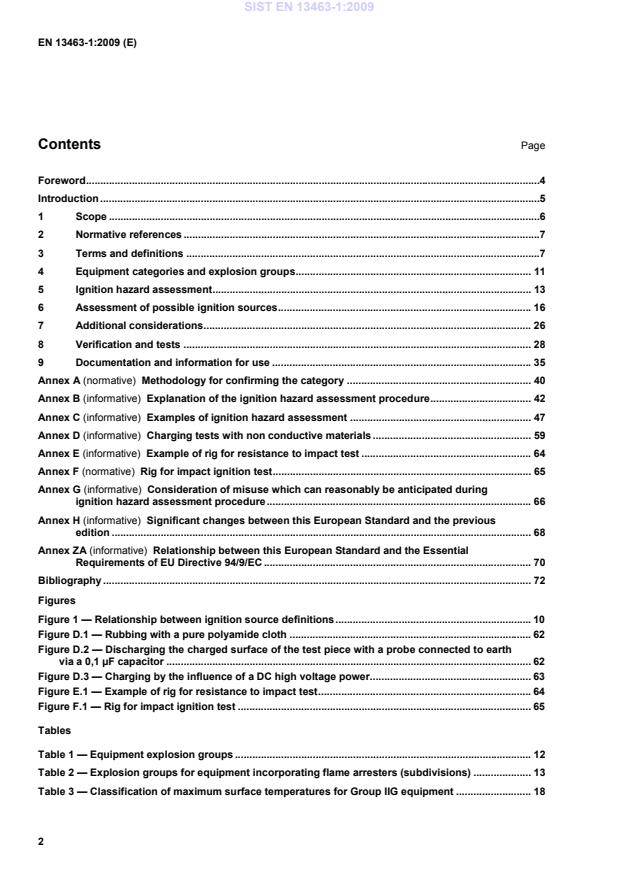
Methodology for confirming the category . 40Annex B (informative)
Explanation of the ignition hazard assessment procedure . 42Annex C (informative)
Examples of ignition hazard assessment . 47Annex D (informative)
Charging tests with non conductive materials . 59Annex E (informative)
Example of rig for resistance to impact test . 64Annex F (normative)
Rig for impact ignition test . 65Annex G (informative)
Consideration of misuse which can reasonably be anticipated during ignition hazard assessment procedure . 66Annex H (informative)
Significant changes between this European Standard and the previous edition . 68Annex ZA (informative)
Relationship between this European Standard and the Essential Requirements of EU Directive 94/9/EC . 70Bibliography . 72Figures Figure 1 — Relationship between ignition source definitions . 10 Figure D.1 — Rubbing with a pure polyamide cloth . 62 Figure D.2 — Discharging the charged surface of the test piece with a probe connected to earth via a 0,1 µF capacitor . 62 Figure D.3 — Charging by the influence of a DC high voltage power . 63 Figure E.1 — Example of rig for resistance to impact test . 64 Figure F.1 — Rig for impact ignition test . 65 Tables Table 1 — Equipment explosion groups . 12 Table 2 — Explosion groups for equipment incorporating flame arresters (subdivisions) . 13 Table 3 — Classification of maximum surface temperatures for Group IIG equipment . 18 SIST EN 13463-1:2009
Introduction Non-electrical equipment in accordance with this European Standard means mainly mechanical equipment. The extent of explosion protection and prevention measures applied to mechanical equipment differ from those applied to electrical equipment. Whereas common electrical equipment working within its design parameters often contains effective ignition sources, this is not true for most mechanical equipment. In most cases, the normal operation of mechanical equipment within its design parameters will not lead to ignition of an explosive atmosphere. In other words, most mechanical equipment performing its designed duty without malfunctions and with proper maintenance will not produce ignition sources in normal operation. Thus, additional protective measures that are commonly used for electrical explosion protected equipment (e.g. enclosures) are not needed. Even where malfunctions have to be considered, much mechanical equipment can meet the requirements for category 2 equipment by a proper choice of well-tried constructional measures that would reduce failures causing ignition sources to an acceptably low level.
Essential to this decision is the use of the ignition hazard assessment to evaluate the potential ignition sources of mechanical equipment and under which conditions they will become effective. This is the fundamental difference to standards for electrical equipment. SIST EN 13463-1:2009
(Protection by pressurization described in EN 60079-2 can also be used for non-electrical equipment.) EN 13463-8, Non-electrical equipment for use in potentially explosive atmospheres – Protection by liquid immersion (k) EN 50303, Group I, category M1 equipment intended to remain functional in atmospheres endangered by firedamp and/or coal dust. NOTE 3 Equipment designed and constructed in accordance with this European Standard for a particular category may be used in areas requiring a category with a higher level of safety by the application of additional explosion prevention and/or protection methods. Such applications are not covered in this standard. NOTE 4 Such explosion prevention and/or protection measures include for example inerting, suppression, venting or containment as described in EN 1127-1, for Group II equipment or for example by dilution, drainage, monitoring and shut-down as described in EN 1127-2 for Group I equipment. Such explosion protection methods are outside the scope of this European Standard. SIST EN 13463-1:2009
[EN 1127-1:2007] NOTE 1 If equipment supplied to the user contains any interconnecting parts e.g. fastenings, pipes, etc. these form part of the equipment. SIST EN 13463-1:2009
3.2 equipment category 3.2.1 equipment Group I category M 1 equipment designed and, where necessary, equipped with additional special means of protection to be capable of functioning in conformity with the operational parameters established by the manufacturer and ensuring a very high level of protection NOTE 1 Equipment of this category is intended for use in underground parts of mines as well as those parts of surface installations of such mines endangered by firedamp and/or combustible dust. NOTE 2 Equipment of this category is required to remain functional even in the event of rare incidents relating to equipment, with an explosive atmosphere present, and is characterised by means of protection such that: either, in the event of failure of one means of protection, at least an independent second means provides the requisite level of protection, or the requisite level of protection is assured in the event of two faults occurring independently of each other. 3.2.2 equipment Group I category M 2 equipment designed to be capable of functioning in conformity with the operational parameters established by the manufacturer and ensuring a high level of protection NOTE 1 Equipment of this category is intended for use in underground parts of mines as well as those parts of surface installations of such mines likely to be endangered by firedamp and/or combustible dust. NOTE 2 This equipment is intended to be de-energised in the presence of an explosive atmosphere. NOTE 3 The means of protection relating to equipment in this category assure the requisite level of protection during normal operation and also in the case of more severe operating conditions, in particular, those arising from rough handling and changing environmental conditions. 3.2.3 equipment Group II category 1 equipment designed to be capable of functioning in conformity with the operational parameters established by the manufacturer and ensuring a very high level of protection NOTE 1 Equipment in this category is intended for use in areas in which explosive atmospheres caused by mixtures of air and gases, vapours or mists or by air/dusts mixtures are present continuously, for long periods or frequently. NOTE 2 Equipment of this category ensures the requisite level of protection, even in the event of rare malfunctions relating to equipment, and is characterised by means of protection such that: either, in the event of failure of one means of protection, at least an independent second means provides the requisite level of protection, or the requisite level of protection is assured in the event of two faults occurring independently of each other. 3.2.4 equipment Group II category 2 equipment designed to be capable of functioning in conformity with the operational parameters established by the manufacturer and ensuring a high level of protection NOTE 1 Equipment in this category is intended for use in areas in which explosive atmospheres caused by mixtures of air and gases, vapours or mists or by air/dusts mixtures are likely to occur. SIST EN 13463-1:2009
NOTE 2 All equipment related ignition sources are considered in the ignition hazard assessment to determine whether they are potential ignition sources. NOTE 3 See Figure 1 3.5 potential ignition source equipment related ignition source which has the capability to ignite an explosive atmosphere (i.e. to become effective) NOTE 1 The probability of becoming effective determines the equipment category (they may arise in normal operation, expected malfunction, rare malfunction). NOTE 2 See Figure 1 3.6 effective ignition source potential ignition source which is able to ignite an explosive atmosphere when consideration is taken of when it occurs (i.e. in normal operation, expected malfunction or rare malfunction) which determines the intended category NOTE 1 An effective ignition source is a potential ignition source which can ignite the explosive atmosphere if preventive or protective measures are not used. NOTE 2 For example the frictional heat which may be produced by a bearing is a possible ignition source. This is an equipment related ignition source if the piece of equipment contains a bearing. If the energy which may be produced by the friction in the bearing is capable of igniting an explosive atmosphere then this is a potential ignition source. Whether this potential ignition source is effective depends on the probability that it will occur in a particular situation (e.g. following loss of lubrication). NOTE 3 See Figure 1 SIST EN 13463-1:2009
Figure 1 — Relationship between ignition source definitions 3.7 normal operation situation when the equipment, protective systems, and components are operating for their intended use within their design parameters NOTE 1 Failures (such as a breakdown of pump seals, flange gaskets or releases of substances caused by accidents) which involve repair or shut-down are not considered to be part of normal operation
NOTE 2 Minor releases of flammable material may be part of normal operation. For example, releases of substances from seals which rely on wetting by the fluid which is being pumped are considered to be minor releases. [EN 13237:2003] 3.8 malfunction equipment, protective systems and components do not perform the intended function NOTE 1 See also EN ISO 12100-1:2003, 5.3 b) 2) NOTE 2 For the purposes of this standard this can happen due to a variety of reasons, including – variation of a property or of a dimension of the processed material or of the workpiece; – failure of one (or more) of the component parts of the equipment, protective systems and components; – external disturbances (e.g. shocks, vibration, electromagnetic fields); – design error or deficiency (e.g. software errors); – disturbance of the power supply or other services; – loss of control by the operator (especially for hand-held machines). 3.8.1 expected malfunction disturbances or equipment faults which are known to occur in practice SIST EN 13463-1:2009
Equipment without any explosion group marking can be used for explosive atmospheres of explosion group IIA, IIB and IIC provided the equipment is not marked for specific atmospheres. For equipment incorporating flame arresters the classification is extended as shown in Table 2 (see EN 12874). SIST EN 13463-1:2009
For general use with explosive atmospheres containing hydrogen, explosion group IIC is required. 4.3 Specific explosive atmospheres The equipment may be tested for a specific explosive atmosphere. In this case it shall be marked accordingly, see 9.3.2 e). 5 Ignition hazard assessment 5.1 General requirements Non-electrical equipment for use in potentially explosive atmospheres shall comply with the requirements of this part of EN 13463 and if relevant modified by the specific parts of EN 13463 for other types of ignition protection. All intended service conditions for the equipment (e.g. rough handling, humidity effects, ambient temperature and pressure variations, effects of chemical agents, corrosion, vibration) shall be specified by the manufacturer and included in the required instructions for use (see Clause 9). If equipment is designed and constructed according to good engineering practice and the ignition hazard assessment ensures that the equipment does not contain any effective ignition sources in normal operation, the equipment can be classified as category 3 equipment. Similarly where the ignition hazard assessment confirms that the equipment does not contain any effective ignition sources during
expected malfunctions or
rare malfunctions,
the equipment can be classified as category 2 or
category 1 equipment
respectively. To confirm the category of the equipment, Annex A shall be applied. SIST EN 13463-1:2009
...