


EN 12791:2016
(Main)Chemical disinfectants and antiseptics - Surgical hand disinfection - Test method and requirements (phase 2, step 2)
General Information
- Abstract
This European Standard specifies a test method simulating practical conditions for establishing whether a product for surgical handrub and handwash reduces the release of resident and eventually present transient microbial flora on hands when used for the treatment of clean hands of volunteers.
This European Standard applies to products for surgical handrub or handwash for use in areas and situations where disinfection is medically indicated. Such indications occur in patient care, for example:
- in hospitals, in community medical facilities and in dental institutions;
- in clinics of schools, of kindergartens and of nursing homes.
and may occur in the workplace and in the home. It may also include services such as laundries and kitchens supplying products directly for the patient.
EN 14885 specifies in detail the relationship of the various tests to one another and to “use recommendations”.
NOTE This method corresponds to a phase 2, step 2 test.
- Status
- Withdrawn
- Publication Date
- 16-Feb-2016
- Withdrawal Date
- 22-Sep-2026
- Technical Committee
- CEN/TC 216 - Chemical disinfectants and antiseptics
- Drafting Committee
- CEN/TC 216/WG 1 - Human medicine
- Current Stage
- 9960 - Withdrawal effective - Withdrawal
- Start Date
- 01-Nov-2017
- Completion Date
- 23-Sep-2026

Relations
- Effective Date
- 24-Feb-2016
- Effective Date
- 18-Jan-2023
- Effective Date
- 28-Jan-2026
- Effective Date
- 28-Jan-2026
- Effective Date
- 28-Jan-2026
- Effective Date
- 12-Oct-2016
Get Certified
Connect with accredited certification bodies for this standard

BSI Group
BSI (British Standards Institution) is the business standards company that helps organizations make excellence a habit.

TÜV Rheinland
TÜV Rheinland is a leading international provider of technical services.

TÜV SÜD
TÜV SÜD is a trusted partner of choice for safety, security and sustainability solutions.
Sponsored listings
Frequently Asked Questions
EN 12791:2016 is a standard published by the European Committee for Standardization (CEN). Its full title is "Chemical disinfectants and antiseptics - Surgical hand disinfection - Test method and requirements (phase 2, step 2)". This standard covers: This European Standard specifies a test method simulating practical conditions for establishing whether a product for surgical handrub and handwash reduces the release of resident and eventually present transient microbial flora on hands when used for the treatment of clean hands of volunteers. This European Standard applies to products for surgical handrub or handwash for use in areas and situations where disinfection is medically indicated. Such indications occur in patient care, for example: - in hospitals, in community medical facilities and in dental institutions; - in clinics of schools, of kindergartens and of nursing homes. and may occur in the workplace and in the home. It may also include services such as laundries and kitchens supplying products directly for the patient. EN 14885 specifies in detail the relationship of the various tests to one another and to “use recommendations”. NOTE This method corresponds to a phase 2, step 2 test.
This European Standard specifies a test method simulating practical conditions for establishing whether a product for surgical handrub and handwash reduces the release of resident and eventually present transient microbial flora on hands when used for the treatment of clean hands of volunteers. This European Standard applies to products for surgical handrub or handwash for use in areas and situations where disinfection is medically indicated. Such indications occur in patient care, for example: - in hospitals, in community medical facilities and in dental institutions; - in clinics of schools, of kindergartens and of nursing homes. and may occur in the workplace and in the home. It may also include services such as laundries and kitchens supplying products directly for the patient. EN 14885 specifies in detail the relationship of the various tests to one another and to “use recommendations”. NOTE This method corresponds to a phase 2, step 2 test.
EN 12791:2016 is classified under the following ICS (International Classification for Standards) categories: 11.080.20 - Disinfectants and antiseptics. The ICS classification helps identify the subject area and facilitates finding related standards.
EN 12791:2016 has the following relationships with other standards: It is inter standard links to EN 12791:2005, EN 12791:2016+A1:2017, EN 14885:2022, EN 13727:2012+A2:2015, EN 13624:2021, EN 12791:2016/prA1. Understanding these relationships helps ensure you are using the most current and applicable version of the standard.
EN 12791:2016 is available in PDF format for immediate download after purchase. The document can be added to your cart and obtained through the secure checkout process. Digital delivery ensures instant access to the complete standard document.
Standards Content (Sample)
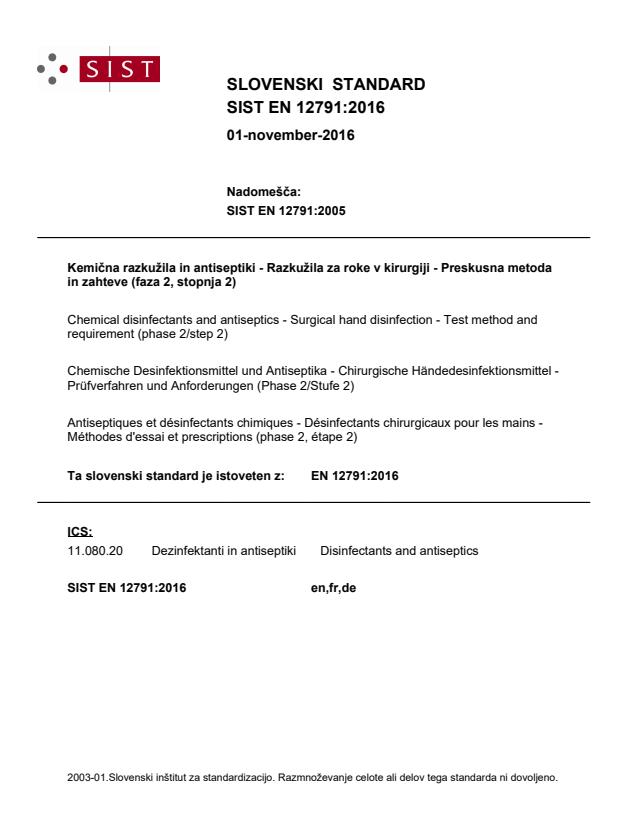
2003-01.Slovenski inštitut za standardizacijo. Razmnoževanje celote ali delov tega standarda ni dovoljeno.Chemische Desinfektionsmittel und Antiseptika - Chirurgische Händedesinfektionsmittel - Prüfverfahren und Anforderungen (Phase 2/Stufe 2)Antiseptiques et désinfectants chimiques - Désinfectants chirurgicaux pour les mains - Méthodes d'essai et prescriptions (phase 2, étape 2)Chemical disinfectants and antiseptics - Surgical hand disinfection - Test method and requirement (phase 2/step 2)11.080.20Dezinfektanti in antiseptikiDisinfectants and antisepticsICS:Ta slovenski standard je istoveten z:EN 12791:2016SIST EN 12791:2016en,fr,de01-november-2016SIST EN 12791:2016SLOVENSKI
STANDARDSIST EN 12791:20051DGRPHãþD
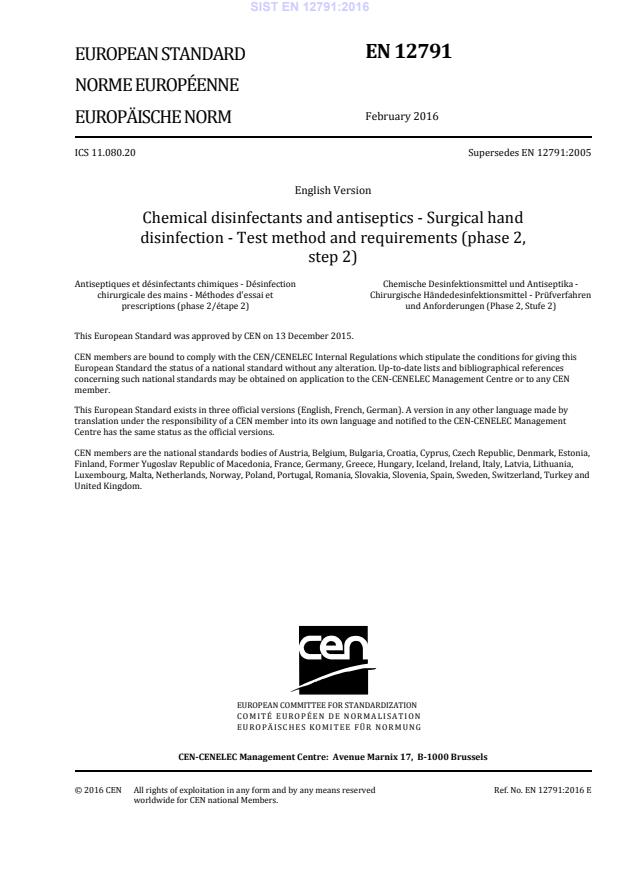
EUROPEAN STANDARD NORME EUROPÉENNE EUROPÄISCHE NORM
EN 12791
February
t r s x ICS
s sä r z rä t r Supersedes EN
s t y { sã t r r wEnglish Version
Chemical disinfectants and antiseptics æ Surgical hand Antiseptiques et désinfectants chimiques æ Désinfection chirurgicale des mains æ Méthodes d 5essai et
Chemische Desinfektionsmittel und Antiseptika æ Chirurgische Händedesinfektionsmittel æ Prüfverfahren This European Standard was approved by CEN on
s u December
t r s wä
egulations which stipulate the conditions for giving this European Standard the status of a national standard without any alterationä Upætoædate lists and bibliographical references concerning such national standards may be obtained on application to the CENæCENELEC Management Centre or to any CEN memberä
translation under the responsibility of a CEN member into its own language and notified to the CENæCENELEC Management Centre has the same status as the official versionsä
CEN members are the national standards bodies of Austriaá Belgiumá Bulgariaá Croatiaá Cyprusá Czech Republicá Denmarká Estoniaá Finlandá Former Yugoslav Republic of Macedoniaá Franceá Germanyá Greeceá Hungaryá Icelandá Irelandá Italyá Latviaá Lithuaniaá Luxembourgá Maltaá Netherlandsá Norwayá Polandá Portugalá Romaniaá Slovakiaá Sloveniaá Spainá Swedená Switzerlandá Turkey and United Kingdomä
EUROPEAN COMMITTEE FOR STANDARDIZATION COMITÉ EUROPÉEN DE NORMALISATION EUROPÄISCHES KOMITEE FÜR NORMUNG
CEN-CENELEC Management Centre:
Avenue Marnix 17,
B-1000 Brussels
t r s x CEN All rights of exploitation in any form and by any means reserved worldwide for CEN national Membersä Refä Noä EN
s t y { sã t r s x ESIST EN 12791:2016
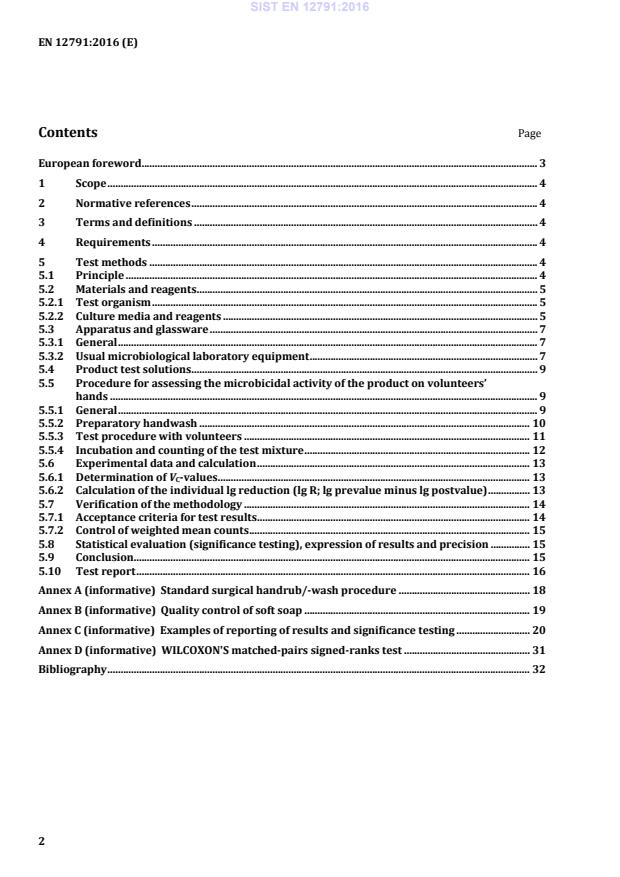
Standard surgical handrub/-wash procedure . 18 Annex B (informative)
Quality control of soft soap . 19 Annex C (informative)
Examples of reporting of results and significance testing . 20 Annex D (informative)
WILCOXON'S matched-pairs signed-ranks test . 31 Bibliography . 32
7,0 parts by weight Hot distilled water (75 °C ± 5 °C) as needed Prepare a solution of 9,5 parts potassium hydroxide in 15 parts water (5.2.2.2) and add 50 parts linseed oil. Heat up to approximately 70 °C while constantly stirring. Add the ethanol and continue heating while stirring until the saponification process is completed and a sample dissolves clearly in water and almost clearly in alcohol. The weight of the soft soap is then brought up to 100 parts by addition of water (5.2.2.2), heated up to 75 °C ± 5 °C to dilute the soft soap. Take 200 g of the soft soap, fill up to 1000 g with water (5.2.2.2) and sterilize in the autoclave [5.3.2.1a)]. The pH of the final diluted soft soap shall range between 10,0 and 11,0. For quality control of the soft soap see Annex B. SIST EN 12791:2016
1) Disposable sterile equipment is an acceptable alternative to reusable glassware. SIST EN 12791:2016
2) Vortex® in an example of a suitable product available commercially. This information is given for the convenience of users of this European Standard and does not constitute an endorsement by CEN of this product. SIST EN 12791:2016
−+===×+×01(29931)3303000cfu/ml0,110,1100,110Z sampling fluid If colony counts of different dilution steps are grossly disproportional (e.g. countable results in each of three dilution steps), insufficient neutralization of the product should be taken into consideration. See also 5.7.2. All viable counts per ml sampling fluid are transformed to decimal logarithms (lg). For computational reasons values of “0” (lg 0 = -have to be set “1” (lg 1 = 0). NOTE Since “0”-values should be found only among postvalues and should occur only with the most active products, this adjustment can, at worst, introduce a conservative bias of underestimating the antimicrobial efficacy of a product. From the difference between the lg prevalue and the lg postvalue assessed per hand (one hand: immediate, the other hand: 3 h effect), a lg reduction (lg R) is established for each volunteer’s hand. Then, the arithmetic means and standard deviations of all individual lg reductions (lg Rs) are calculated for both the reference procedure (RP) and the product test procedure (PP). 5.7 Verification of the methodology 5.7.1 Acceptance criteria for test results Only if the results of the test procedure fulfil the following requirements, they shall be accepted for further evaluation otherwise the test shall be repeated. a) A complete set of results from at least 23, but maximum 28 volunteers shall be available. All complete sets of results shall be used for further evaluation, but it is allowed to remove up to three volunteers from further evaluation if only this manipulation enables meeting the requirements of 5.7.1 b) (see below) and if still at least 23 volunteers will be evaluated. It has to be documented that the manipulation is the smallest to achieve the goal. b) The overall means of the lg prevalues for RP and PP shall be both at least 3,5. SIST EN 12791:2016
10 « s dilution: 161 cfu/ml;
10 « t dilution: 28 cfu/ml;
(161) / (28) = 5,75, i.e. between 5 and 15. 5.8 Statistical evaluation (significance testing), expression of results and precision If the quality of the data has been found to be acceptable (5.7.1), they shall be used for the evaluation of the product under test by applying the following pass criterion: a) Neither the immediate effect nor the 3 h effect of the product (PP) shall be inferior to the respective effects of the reference product, propan-1-ol (RP). b) For testing the performance of PP against that of RP, a non-parametric test for non-inferiority such as that of Hodges and Lehmann [2] shall be applied to the lg reductions in each evaluation. The statistical method described in Annex C should be used. NOTE Computer programs exist for this method, for instance: StatXact™ or SAS™ (with macro). Other methods are acceptable if they have the same or superior power and their applicability can be demonstrated by suitable statistical methods (e.g. given there is no significant deviation from a normal distribution of the differences of RP – PP parametric methods may be used). c) The level of significance is set at P = 0,025 (one-sided) for the statistical evaluation of the immediate effect and the 3h effect of PP. d) For the non-inferiority tests a safety margin of 0,75 lg (for the 3h effect 0,85 lg) is agreed upon. e) For claiming an additional “sustained effect” the following pass criterion shall be applied: The mean lg reduction obtained with PP for the 3 h effect shall be significantly larger than that with RP. For the statistical evaluation of a sustained effect of PP the Wilcoxon matched-pairs signed-ranks test is used at P = 0,01. A one-sided test is to be used (Annex D). 5.9 Conclusion A product which has fulfilled the requirements (4 and 5.8) is deemed suitable to be used as surgical handrub or handwash. If – in addition - a product fulfils the requirements for the sustained effect (4 and 5.8) this effect may be claimed. SIST EN 12791:2016
...