


EN 18196:2026
(Main)Algae and algae products - Determination of inorganic arsenic in algae and algae products by anion-exchange (HPLC-ICP-MS)
General Information
- Abstract
This document describes a method for the determination of inorganic arsenic in algae and algae products by anion-exchange HPLC-ICP-MS following water bath extraction. The method is specifically designed for seaweeds containing inorganic arsenic and arsenosugar 408 (i.e. sulfate-arsinoylriboside). The peaks of inorganic arsenic and arsenosugar 408 are separated by gradient elution.
The method was initially tested and evaluated on the algae species Ascophyllum nodosum, Fucus vesiculosus and Saccharina latissima. Given the limited number of participating laboratories in the interlaboratory studies, this document is only validated for Ascophyllum nodosum and Saccharina latissima, but it can also be used for other algae species.
- Status
- Published
- Publication Date
- 12-May-2026
- Technical Committee
- CEN/TC 454 - Algae and algae products
- Drafting Committee
- CEN/TC 454/WG 4 - Specifications for food/feed sector applications
- Current Stage
- 6060 - Definitive text made available (DAV) - Publishing
- Start Date
- 13-May-2026
- Due Date
- 15-Jul-2024
- Completion Date
- 13-May-2026

Overview
EN 18196:2026 - Algae and Algae Products: Determination of Inorganic Arsenic by Anion-Exchange (HPLC-ICP-MS) sets a standardized method for quantifying inorganic arsenic in algae and algae-derived products using anion-exchange High Performance Liquid Chromatography coupled with Inductively Coupled Plasma Mass Spectrometry (HPLC-ICP-MS). This document, developed by CEN, supports laboratories and businesses operating in the seaweed, biobased products, and food safety sectors, ensuring accurate detection and regulatory compliance for inorganic arsenic content.
The method is optimized for seaweeds containing inorganic arsenic and arsenosugar 408 (sulfate-arsinoylriboside) and includes clear separation of these compounds by gradient elution. Validated through interlaboratory studies for Ascophyllum nodosum and Saccharina latissima, the method is also applicable to other algae species, promoting broader adoption across industry and research laboratories.
Key Topics
Scope and Target Analytes
- Determination of inorganic arsenic (arsenite and arsenate) in algae, seaweed, and algae-derived products
- Specific detection and separation of arsenosugar 408 alongside inorganic arsenic species
Sample Extraction and Preparation
- Water bath extraction using diluted nitric acid and hydrogen peroxide to oxidize and solubilize arsenic species
Analytical Procedure
- Use of anion-exchange HPLC for chromatographic separation of arsenic compounds
- ICP-MS used for detection and quantification of inorganic arsenic
- Matrix-matched calibration solutions and quality control practices to ensure traceability and accuracy
Precision and Method Validation
- Repeatability and reproducibility established through interlaboratory studies, supporting method reliability
- Detailed guidance on avoiding contamination and handling blanks
Reporting Requirements
- Standardized structure for reporting results, ensuring transparency and comparability
Applications
Food Safety and Regulatory Compliance
- Ensures safe levels of inorganic arsenic in edible seaweed and commercially available algae products
- Supports businesses in meeting European and international regulations for contaminants in biobased products
Research and Development
- Provides a validated methodology for scientific studies involving the toxicological assessment of arsenic in marine and plant-derived materials
Quality Assurance in Manufacturing
- Enables manufacturers of algae-based ingredients, food supplements, and feed additives to verify product safety through precise inorganic arsenic measurement
Environmental Monitoring
- Facilitates routine surveillance of arsenic accumulation in marine biomass, supporting sustainability and consumer health
Related Standards
EN 17399: Algae and algae products - Vocabulary
Provides terminology necessary for standardization in the algae sector.EN 16802: Foodstuffs - Determination of inorganic arsenic by anion-exchange HPLC-ICP-MS
Sets guidelines for quantifying inorganic arsenic in foodstuffs, complementing EN 18196 for edible algae.EN 17374: Animal feeding stuffs - Determination of inorganic arsenic by HPLC-ICP-MS
Methods for assessing arsenic in animal feed, relevant for algae-based feed additives.EN 17605: Algae and algae products - Methods of sampling and analysis - Sample treatment
Guidance for proper sample collection and preparation, vital for reliable testing.
Practical Value
Adopting EN 18196:2026 enables laboratories and manufacturers to achieve accurate, consistent measurements of inorganic arsenic in algae and algae products. By following a harmonized protocol, organizations can demonstrate due diligence in food safety, support market access, and build consumer trust in algae-derived products. This standard underpins quality control, risk assessment, and regulatory oversight in the growing biobased product sector, emphasizing safety and sustainability.
Get Certified
Connect with accredited certification bodies for this standard

BSI Group
BSI (British Standards Institution) is the business standards company that helps organizations make excellence a habit.

Bureau Veritas
Bureau Veritas is a world leader in laboratory testing, inspection and certification services.

DNV
DNV is an independent assurance and risk management provider.
Sponsored listings
Frequently Asked Questions
EN 18196:2026 is a standard published by the European Committee for Standardization (CEN). Its full title is "Algae and algae products - Determination of inorganic arsenic in algae and algae products by anion-exchange (HPLC-ICP-MS)". This standard covers: This document describes a method for the determination of inorganic arsenic in algae and algae products by anion-exchange HPLC-ICP-MS following water bath extraction. The method is specifically designed for seaweeds containing inorganic arsenic and arsenosugar 408 (i.e. sulfate-arsinoylriboside). The peaks of inorganic arsenic and arsenosugar 408 are separated by gradient elution. The method was initially tested and evaluated on the algae species Ascophyllum nodosum, Fucus vesiculosus and Saccharina latissima. Given the limited number of participating laboratories in the interlaboratory studies, this document is only validated for Ascophyllum nodosum and Saccharina latissima, but it can also be used for other algae species.
This document describes a method for the determination of inorganic arsenic in algae and algae products by anion-exchange HPLC-ICP-MS following water bath extraction. The method is specifically designed for seaweeds containing inorganic arsenic and arsenosugar 408 (i.e. sulfate-arsinoylriboside). The peaks of inorganic arsenic and arsenosugar 408 are separated by gradient elution. The method was initially tested and evaluated on the algae species Ascophyllum nodosum, Fucus vesiculosus and Saccharina latissima. Given the limited number of participating laboratories in the interlaboratory studies, this document is only validated for Ascophyllum nodosum and Saccharina latissima, but it can also be used for other algae species.
EN 18196:2026 is classified under the following ICS (International Classification for Standards) categories: 13.020.55 - Biobased products. The ICS classification helps identify the subject area and facilitates finding related standards.
EN 18196:2026 is associated with the following European legislation: Standardization Mandates: M/547. When a standard is cited in the Official Journal of the European Union, products manufactured in conformity with it benefit from a presumption of conformity with the essential requirements of the corresponding EU directive or regulation.
EN 18196:2026 is available in PDF format for immediate download after purchase. The document can be added to your cart and obtained through the secure checkout process. Digital delivery ensures instant access to the complete standard document.
Standards Content (Sample)
SLOVENSKI STANDARD
01-julij-2026
Alge in izdelki iz alg - Ugotavljanje anorganskega arzena v algah in izdelkih iz alg z
anionsko izmenjavo (HPLC-ICP-MS)
Algae and algae products - Determination of inorganic arsenic in algae and algae
products by anion-exchange (HPLC-ICP-MS)
Algen und Algenprodukte - Bestimmung von anorganischem Arsen in Algen und
Algenprodukten durch Anionenaustausch (HPLC-ICP-MS)
Algues et produits d’algues - Détermination de l’arsenic inorganique dans les algues et
les produits d’algues par échange d’anions et spectrométrie de masse à plasma à
couplage inductif (CLHP/ICP-SM)
Ta slovenski standard je istoveten z: EN 18196:2026
ICS:
13.020.55 Biološki izdelki Biobased products
2003-01.Slovenski inštitut za standardizacijo. Razmnoževanje celote ali delov tega standarda ni dovoljeno.
EN 18196
EUROPEAN STANDARD
NORME EUROPÉENNE
May 2026
EUROPÄISCHE NORM
ICS 13.020.55
English Version
Algae and algae products - Determination of inorganic
arsenic in algae and algae products by anion-exchange
(HPLC-ICP-MS)
Algues et produits d'algues - Détermination de l'arsenic Algen und Algenprodukte - Bestimmung von
inorganique dans les algues et les produits d'algues par anorganischem Arsen in Algen und Algenprodukten
échange d'anions et spectrométrie de masse à plasma à durch Anionenaustausch (HPLC-ICP-MS)
couplage inductif (CLHP/ICP-SM)
This European Standard was approved by CEN on 13 April 2026.
CEN members are bound to comply with the CEN/CENELEC Internal Regulations which stipulate the conditions for giving this
European Standard the status of a national standard without any alteration. Up-to-date lists and bibliographical references
concerning such national standards may be obtained on application to the CEN-CENELEC Management Centre or to any CEN
member.
This European Standard exists in three official versions (English, French, German). A version in any other language made by
translation under the responsibility of a CEN member into its own language and notified to the CEN-CENELEC Management
Centre has the same status as the official versions.
CEN members are the national standards bodies of Austria, Belgium, Bulgaria, Croatia, Cyprus, Czech Republic, Denmark, Estonia,
Finland, France, Germany, Greece, Hungary, Iceland, Ireland, Italy, Latvia, Lithuania, Luxembourg, Malta, Netherlands, Norway,
Poland, Portugal, Republic of North Macedonia, Romania, Serbia, Slovakia, Slovenia, Spain, Sweden, Switzerland, Türkiye and
United Kingdom.
EUROPEAN COMMITTEE FOR STANDARDIZATION
COMITÉ EUROPÉEN DE NORMALISATION
EUROPÄISCHES KOMITEE FÜR NORMUNG
CEN-CENELEC Management Centre: Rue de la Science 23, B-1040 Brussels
© 2026 CEN All rights of exploitation in any form and by any means reserved Ref. No. EN 18196:2026 E
worldwide for CEN national Members.
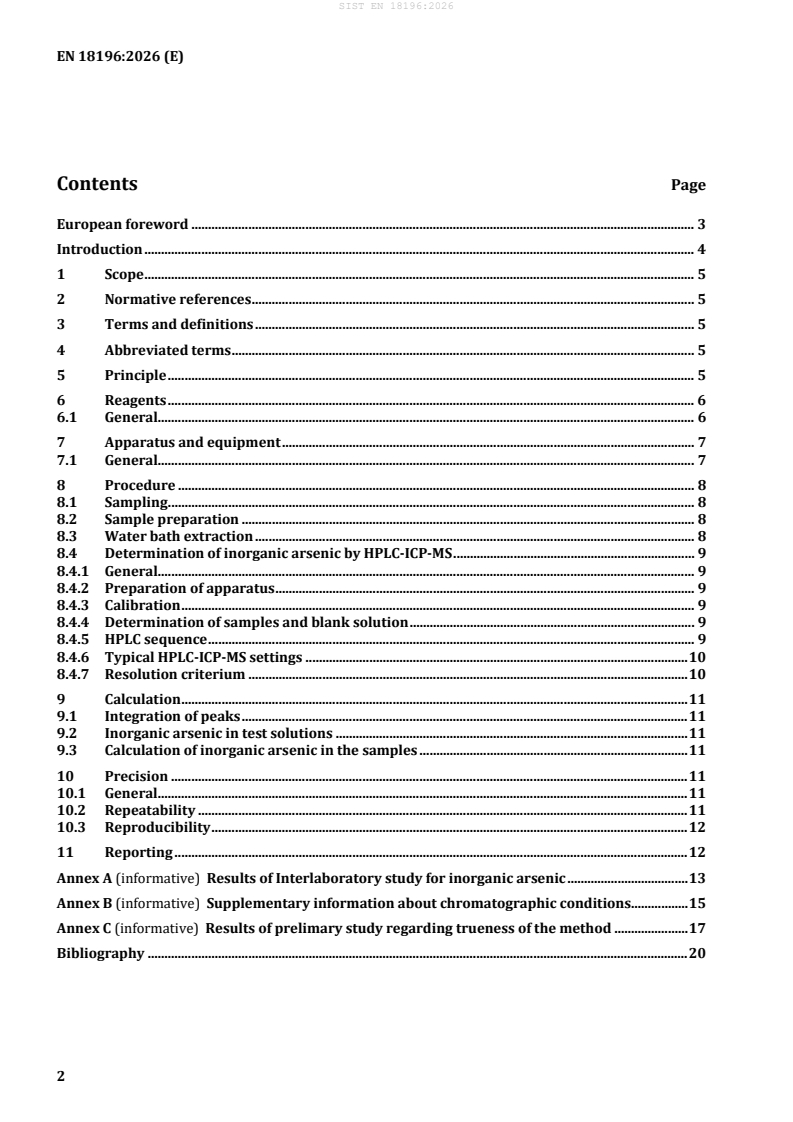
Contents Page
European foreword . 3
Introduction . 4
1 Scope . 5
2 Normative references . 5
3 Terms and definitions . 5
4 Abbreviated terms . 5
5 Principle . 5
6 Reagents . 6
6.1 General. 6
7 Apparatus and equipment . 7
7.1 General. 7
8 Procedure . 8
8.1 Sampling . 8
8.2 Sample preparation . 8
8.3 Water bath extraction . 8
8.4 Determination of inorganic arsenic by HPLC-ICP-MS . 9
8.4.1 General. 9
8.4.2 Preparation of apparatus . 9
8.4.3 Calibration . 9
8.4.4 Determination of samples and blank solution . 9
8.4.5 HPLC sequence . 9
8.4.6 Typical HPLC-ICP-MS settings . 10
8.4.7 Resolution criterium . 10
9 Calculation . 11
9.1 Integration of peaks . 11
9.2 Inorganic arsenic in test solutions . 11
9.3 Calculation of inorganic arsenic in the samples . 11
10 Precision . 11
10.1 General. 11
10.2 Repeatability . 11
10.3 Reproducibility . 12
11 Reporting . 12
Annex A (informative) Results of Interlaboratory study for inorganic arsenic . 13
Annex B (informative) Supplementary information about chromatographic conditions. 15
Annex C (informative) Results of prelimary study regarding trueness of the method . 17
Bibliography . 20
European foreword
This document (EN 18196:2026) has been prepared by Technical Committee CEN/TC 454 “Algae and
algae products”, the secretariat of which is held by NEN.
This European Standard shall be given the status of a national standard, either by publication of an
identical text or by endorsement, at the latest by November 2026, and conflicting national standards shall
be withdrawn at the latest by November 2026.
Attention is drawn to the possibility that some of the elements of this document may be the subject of
patent rights. CEN shall not be held responsible for identifying any or all such patent rights.
This document has been prepared under a standardization request addressed to CEN by the European
Commission. The Standing Committee of the EFTA States subsequently approves these requests for its
Member States.
Any feedback and questions on this document should be directed to the users’ national standards body.
A complete listing of these bodies can be found on the CEN website.
According to the CEN-CENELEC Internal Regulations, the national standards organisations of the
following countries are bound to implement this European Standard: Austria, Belgium, Bulgaria, Croatia,
Cyprus, Czech Republic, Denmark, Estonia, Finland, France, Germany, Greece, Hungary, Iceland, Ireland,
Italy, Latvia, Lithuania, Luxembourg, Malta, Netherlands, Norway, Poland, Portugal, Republic of North
Macedonia, Romania, Serbia, Slovakia, Slovenia, Spain, Sweden, Switzerland, Türkiye and the United
Kingdom.
Introduction
This document has been prepared by the experts of CEN/TC 454 'Algae and algae products'.
The European Committee for Standardization (CEN) was requested by the European Commission (EC) to
draft European standards or European standardization deliverables to support the implementation of
Article 3 of Directive 2009/28/EC for algae and algae-based products or intermediates.
This request, presented as Mandate M/547, also contributes to the Communication on “Innovating for
Sustainable Growth: A Bio economy for Europe”.
The former working group CEN Technical Board Working Group 218 “Algae”, was created in 2016 to
develop a work programme as part of this Mandate. The technical committee CEN/TC 454 'Algae and
algae products' was established to carry out the work programme that will prepare a series of standards.
The interest in algae and algae-based products or intermediates has increased significantly in Europe as
a valuable source including but not limited to, carbohydrates, proteins, lipids, and several pigments.
These materials are suitable for use in a wide range of applications from food and feed purposes to other
sectors, such as textile, cosmetics, biopolymers, biofuel and fertilizer/biostimulants. Standardization was
identified as having an important role in order to promote the use of algae and algae products.
The work of CEN/TC 454 should improve the reliability of the supply chain, thereby improving the
confidence of industry and consumers in algae, which include macroalgae, microalgae, cyanobacteria,
Labyrinthulomycetes, algae-based products or intermediates and will promote and support
commercialisation of the European algae industry.
This standard was developed with respect to standards EN 16802 [1], EN 17374 [2] and EN 17706 [3]. It
shares the same extraction procedure with these standards. The detection procedure was modified by
changing the isocratic elution condition into a gradient elution.
1 Scope
This document describes a method for the determination of inorganic arsenic in algae and algae products
by anion-exchange HPLC-ICP-MS following water bath extraction. The method is specifically designed for
seaweeds containing inorganic arsenic and arsenosugar 408 (i.e. sulfate-arsinoylriboside). The peaks of
inorganic arsenic and arsenosugar 408 are separated by gradient elution.
The method was initially tested and evaluated on the algae species Ascophyllum nodosum, Fucus
vesiculosus and Saccharina latissima. Given the limited number of participating laboratories in the
interlaboratory studies, this document is only validated for Ascophyllum nodosum and Saccharina
latissima, but it can also be used for other algae species.
2 Normative references
The following documents are referred to in the text in such a way that some or all of their content
constitutes requirements of this document. For dated references, only the edition cited applies. For
undated references, the latest edition of the referenced document (including any amendments) applies.
EN 17399, Algae and algae products — Vocabulary
3 Terms and definitions
For the purposes of this document, the terms and definitions given in EN 17399 apply.
ISO and IEC maintain terminology databases for use in standardization at the following addresses:
— ISO Online browsing platform: available at https://www.iso.org/obp/
— IEC Electropedia: available at https://www.electropedia.org/
4 Abbreviated terms
For the purposes of this document, the following abbreviated terms apply.
As(III) Arsenite
As(V) Arsenate
HPLC High performance liquid chromatography
ICP-MS Inductively coupled plasma mass spectrometry
5 Principle
Inorganic arsenic consists of As(III) and As(V). A representative test portion of the sample is treated with
a diluted nitric acid and hydrogen peroxide solution in a heated water bath. Hereby the arsenic species
are extracted into solution and As(III) is oxidized to As(V).
The inorganic arsenic is selectively separated from other arsenic compounds using anion exchange HPLC
coupled online to the element-specific detector ICP-MS for the determination of the mass fraction of
inorganic arsenic. External calibration with solvent matrix-matched standards is used for quantification
of the amount of inorganic arsenic.
6 Reagents
6.1 General
The concentration of arsenic species in the reagents and water used shall be low enough to not affect the
results of the determination. Reagents should be of minimum p.a. quality where possible. Special facilities
should be used in order to avoid contamination during the steps of preparation and measurement (e.g.
uses of laminar flow benches or comparable clean room facilities).
NOTE 1 When using a method of high sensitivity like ICP-MS, the control of the blank levels of water, acid and
other reagents is very important. Generally ultra-pure water complying with ISO 3696 [4] grade 1 (i.e. electrical
conductivity below 0,1 μS/cm at 25 °C) and acid of high purity, e.g. cleaned by sub- boiling distillation, are used.
NOTE 2 Estimate the total volume of the prepared reagents needed for the immediate use and produce only this
amount.
6.2 Nitric acid (HNO ), concentrated, ≥ 65 % (mass fraction), mass concentration of approximately ρ
(HNO ) 1,4 g/ml
Use only nitric acid available with high purity or perform a clean-up by a sub-boiling distillation in order
to avoid potential contamination.
6.3 Hydrogen peroxide, H O not less than 30 % (mass fraction)
2 2
High purity is essential to avoid potential contamination. Commercially available hydrogen peroxide for
analysis should be tested for contamination of arsenic prior to use.
6.4 Ammonium carbonate, (NH ) CO , mass fraction w ≥ 99,999 %, for production of mobile phase
4 2 3
solution
6.5 Standard solution As(V), with an arsenic mass concentration of 1 000 mg/l
The use of commercial standards of arsenic, As(III) and/or As(V), with a mass concentration of
1 000 mg/l is recommended.
NOTE By preparing the standard in the extraction solution (6.10) all As(III) will be completely oxidized to
As(V).
6.6 Chloride (Cl), 100 mg/l
6.7 Monomethylarsenous acid (MMA), optional
6.8 Dimethylarsinic acid (DMA), optional
6.9 Arsenobetaine (AB), optional
6.10 Sulfate-arsinoylriboside (AsSug_408), optional
NOTE Arsenic standards are used for checking chromatographic separation
6.11 Extraction solution, 0,1 mol/l HNO in 3 % (V/V) H O
3 2 2
Pour 800 ml of H O and then 6,5 ml of HNO (6.2) and thereafter 100 ml of H O (6.3) into a 1 000 ml
2 3 2 2
volumetric flask. Fill it up to the mark with H O. This solution should be prepared on the same day of use.
It is recommended that the total volume needed for the analysis is estimated and only this amount is
produced.
6.12 Ammonium carbonate mobile phase
EXAMPLE 200 mmol/l ammonium carbonate mobile phase.
For a volumetric flask of 1 000 ml, dissolve 19,22 g of ammonium carbonate (6.4) in water. If necessary,
filter the mobile phase solution through a 0,45 µm filter prior to use.
6.13 Calibration solutions
Prepare a range of standards (standard As V (6.5) mandatory) including a blank calibration solution that
covers the linear range (e.g. 2 µg/l to 50 µg/l) of the analyte to be determined by diluting the analyte
stock solution with extraction solution (6.10).
Appropriate matrix matching of the calibration solutions shall be performed by using the extraction
solution (6.10) for the final dilution step, which furthermore will prevent reduction of As(V) to As(III).
Transfer an aliquot of the calibration solutions to HPLC vials prior to analysis.
The quantitative oxidation of As(III) to As(V) in the standard solutions should be verified (e.g. visual
inspection of chromatogram by looking for an additional peak or a reduced intensity of the As(V) peak).
6.14 Solution for checking chromatographic separation, a solution containing the different arsenic
compounds (e.g. 10 μg/l), MMA, DMA, AB, AsSug_408 and As(V), and chloride (e.g. 100 mg/l).
Alternatively, an extract of a reference material certified for at least inorganic As or AsSug_408 could be
used to check sufficient separation.
7 Apparatus and equipment
7.1 General
To minimize the contamination, all apparatus and equipment that come into direct contact with the
sample and the solutions shall be carefully pre-treated. It is recommended to avoid the use of glassware,
since this may cause contamination with arsenate.
WARNING — Some auto sampler systems use syringes made of glass. In this case, you can only check for
contamination and minimize it.
7.2 Laboratory grinder, capable of grinding to a particle size of 90 % less than 0,5 mm
7.3 Analytical balance, accuracy of 1 mg
7.4 Filtering device, for filtration of mobile phase, pore size 0,45 µm, optional
7.5 Water bath, capable of programming of the temperature at 90 °C
-1
7.6 Centrifuge, for minimum 4 000 min (2 010 g)
7.7 Single use syringe filters (0,45 µm) or HPLC vials with filters, compatible with acidic solutions
for filtering of test solutions prior to analysis
7.8 Plastic volumetric flasks, for preparation of mobile phase and calibration and extraction solutions
7.9 Plastic centrifugation tubes with screw caps, resistance to temperature of 90 °C
7.10 Plastics sealable tubes, for storage of f
...