


EN 1570-1:2011+A1:2014
(Main + Amendment)Safety requirements for lifting tables - Part 1: Lifting tables serving up to two fixed landings
General Information
- Abstract
1.1 This European Standard specifies the safety requirements for industrial lifting tables for raising and/or lowering goods and the operator(s):
- where the lifting table does not pass a fixed landing;
- serving not more than 2 fixed landings.
1.2 This European Standard deals with all significant hazards pertinent to lifting tables when they are used as intended by the operating instructions and under the conditions foreseen (including foreseeable misuse) with the operating instructions (see Clause 4). This European Standard specifies the appropriate technical measures to eliminate or reduce the risks arising from the significant hazards.
1.3 Both power operated and manually operated lifting tables are included whether stationary or mobile.
1.4 This European Standard does not apply to the following equipment:
- lifting tables, serving more than 2 fixed landings of a building, for lifting goods with a vertical travel speed not exceeding 0,15 m/s (EN 1570-2);
- lifting tables, serving more than 2 fixed landings of a building for lifting operators, with a vertical travel speed not exceeding 0,15 m/s (EN 1570-3);
- lifting tables carrying operators and installed in full enclosures (EN 1570-3);
- permanently and temporarily installed lifting tables, serving specific levels of a building for lifting operators, with a vertical travel speed exceeding 0,15 m/s (EN 81-1 and EN 81-2);
- lifting tables with flat or toothed belts lifting systems for the carrying of operators;
- lifting tables whose vertical travel speed exceeds 0,15 m/s (unless safe by position and non person carrying);
- power operated lifting platforms for persons with impaired mobility (EN 81-41);
- mobile lifting tables for airport ground support equipment (EN 1915-2 and EN 12312 1);
- lifting tables which are designed as part of a lift according to Directive (95/16/EC);
- lifting tables used on ships;
- mobile elevating work platforms (EN 280);
- static elevating work platforms;
- vehicle lifts for maintenance (EN 1493);
- mobile lifting tables used for fire fighting (EN 1777);
- mobile lifting tables used as fork lift trucks and order pickers;
- mobile lifting tables with a horizontal travelling speed of more than 1,6 m/s;
- rail dependent storage and retrieval equipment (EN 528);
- theatre stage lifts intended to move performers;
- scissor lift pallet trucks (EN ISO 3691 5);
- suspended lifting tables;
- lifting tables operated by pushing chains.
1.5 This standard does not establish the additional requirements for:
- electromagnetic compatibility;
- operation in severe conditions (e.g. extreme climates, freezer applications, strong magnetic fields);
- operation subject to special rules (e.g. potentially explosive atmospheres, mines);
- handling of loads, the nature of which could lead to dangerous situations (e.g. molten metal, acids, radiating materials, especially brittle loads);
- hazards occurring during construction, transportation and disposal;
- equipment installed on the load platform or replacing it;
- integration into systems or other machines, control from more than two control stations, etc.;
- cable-less controls;
- lifting tables where the hydraulic pressure is derived directly from gas pressure;
- the power supply to the lifting table by internal combustion engine.
- Status
- Withdrawn
- Publication Date
- 30-Sep-2014
- Withdrawal Date
- 22-Sep-2026
- Technical Committee
- CEN/TC 98 - Lifting platforms
- Drafting Committee
- CEN/TC 98/WG 2 - Lifting tables
- Current Stage
- 9960 - Withdrawal effective - Withdrawal
- Start Date
- 10-Apr-2024
- Completion Date
- 23-Sep-2026
- Directive
- Harmonized Standard2006/42/EC - Directive 2006/42/EC of the European Parliament and of the Council of 17 May 2006 on machinery, and amending Directive 95/16/EC (recast)OJ Ref: C 332/01, C 173 OJ Date: 13-May-2016

Relations
- Effective Date
- 30-Jul-2014
- Effective Date
- 19-Jan-2023
- Effective Date
- 25-Aug-2026
- Effective Date
- 25-Aug-2026
- Effective Date
- 25-Aug-2026
- Effective Date
- 25-Aug-2026
- Effective Date
- 25-Aug-2026
- Effective Date
- 25-Aug-2026
- Effective Date
- 25-Aug-2026
- Effective Date
- 09-Feb-2026
- Effective Date
- 09-Feb-2026
- Effective Date
- 09-Feb-2026
- Effective Date
- 09-Feb-2026
- Effective Date
- 09-Feb-2026
- Effective Date
- 09-Feb-2026
Frequently Asked Questions
EN 1570-1:2011+A1:2014 is a standard published by the European Committee for Standardization (CEN). Its full title is "Safety requirements for lifting tables - Part 1: Lifting tables serving up to two fixed landings". This standard covers: 1.1 This European Standard specifies the safety requirements for industrial lifting tables for raising and/or lowering goods and the operator(s): - where the lifting table does not pass a fixed landing; - serving not more than 2 fixed landings. 1.2 This European Standard deals with all significant hazards pertinent to lifting tables when they are used as intended by the operating instructions and under the conditions foreseen (including foreseeable misuse) with the operating instructions (see Clause 4). This European Standard specifies the appropriate technical measures to eliminate or reduce the risks arising from the significant hazards. 1.3 Both power operated and manually operated lifting tables are included whether stationary or mobile. 1.4 This European Standard does not apply to the following equipment: - lifting tables, serving more than 2 fixed landings of a building, for lifting goods with a vertical travel speed not exceeding 0,15 m/s (EN 1570-2); - lifting tables, serving more than 2 fixed landings of a building for lifting operators, with a vertical travel speed not exceeding 0,15 m/s (EN 1570-3); - lifting tables carrying operators and installed in full enclosures (EN 1570-3); - permanently and temporarily installed lifting tables, serving specific levels of a building for lifting operators, with a vertical travel speed exceeding 0,15 m/s (EN 81-1 and EN 81-2); - lifting tables with flat or toothed belts lifting systems for the carrying of operators; - lifting tables whose vertical travel speed exceeds 0,15 m/s (unless safe by position and non person carrying); - power operated lifting platforms for persons with impaired mobility (EN 81-41); - mobile lifting tables for airport ground support equipment (EN 1915-2 and EN 12312 1); - lifting tables which are designed as part of a lift according to Directive (95/16/EC); - lifting tables used on ships; - mobile elevating work platforms (EN 280); - static elevating work platforms; - vehicle lifts for maintenance (EN 1493); - mobile lifting tables used for fire fighting (EN 1777); - mobile lifting tables used as fork lift trucks and order pickers; - mobile lifting tables with a horizontal travelling speed of more than 1,6 m/s; - rail dependent storage and retrieval equipment (EN 528); - theatre stage lifts intended to move performers; - scissor lift pallet trucks (EN ISO 3691 5); - suspended lifting tables; - lifting tables operated by pushing chains. 1.5 This standard does not establish the additional requirements for: - electromagnetic compatibility; - operation in severe conditions (e.g. extreme climates, freezer applications, strong magnetic fields); - operation subject to special rules (e.g. potentially explosive atmospheres, mines); - handling of loads, the nature of which could lead to dangerous situations (e.g. molten metal, acids, radiating materials, especially brittle loads); - hazards occurring during construction, transportation and disposal; - equipment installed on the load platform or replacing it; - integration into systems or other machines, control from more than two control stations, etc.; - cable-less controls; - lifting tables where the hydraulic pressure is derived directly from gas pressure; - the power supply to the lifting table by internal combustion engine.
1.1 This European Standard specifies the safety requirements for industrial lifting tables for raising and/or lowering goods and the operator(s): - where the lifting table does not pass a fixed landing; - serving not more than 2 fixed landings. 1.2 This European Standard deals with all significant hazards pertinent to lifting tables when they are used as intended by the operating instructions and under the conditions foreseen (including foreseeable misuse) with the operating instructions (see Clause 4). This European Standard specifies the appropriate technical measures to eliminate or reduce the risks arising from the significant hazards. 1.3 Both power operated and manually operated lifting tables are included whether stationary or mobile. 1.4 This European Standard does not apply to the following equipment: - lifting tables, serving more than 2 fixed landings of a building, for lifting goods with a vertical travel speed not exceeding 0,15 m/s (EN 1570-2); - lifting tables, serving more than 2 fixed landings of a building for lifting operators, with a vertical travel speed not exceeding 0,15 m/s (EN 1570-3); - lifting tables carrying operators and installed in full enclosures (EN 1570-3); - permanently and temporarily installed lifting tables, serving specific levels of a building for lifting operators, with a vertical travel speed exceeding 0,15 m/s (EN 81-1 and EN 81-2); - lifting tables with flat or toothed belts lifting systems for the carrying of operators; - lifting tables whose vertical travel speed exceeds 0,15 m/s (unless safe by position and non person carrying); - power operated lifting platforms for persons with impaired mobility (EN 81-41); - mobile lifting tables for airport ground support equipment (EN 1915-2 and EN 12312 1); - lifting tables which are designed as part of a lift according to Directive (95/16/EC); - lifting tables used on ships; - mobile elevating work platforms (EN 280); - static elevating work platforms; - vehicle lifts for maintenance (EN 1493); - mobile lifting tables used for fire fighting (EN 1777); - mobile lifting tables used as fork lift trucks and order pickers; - mobile lifting tables with a horizontal travelling speed of more than 1,6 m/s; - rail dependent storage and retrieval equipment (EN 528); - theatre stage lifts intended to move performers; - scissor lift pallet trucks (EN ISO 3691 5); - suspended lifting tables; - lifting tables operated by pushing chains. 1.5 This standard does not establish the additional requirements for: - electromagnetic compatibility; - operation in severe conditions (e.g. extreme climates, freezer applications, strong magnetic fields); - operation subject to special rules (e.g. potentially explosive atmospheres, mines); - handling of loads, the nature of which could lead to dangerous situations (e.g. molten metal, acids, radiating materials, especially brittle loads); - hazards occurring during construction, transportation and disposal; - equipment installed on the load platform or replacing it; - integration into systems or other machines, control from more than two control stations, etc.; - cable-less controls; - lifting tables where the hydraulic pressure is derived directly from gas pressure; - the power supply to the lifting table by internal combustion engine.
EN 1570-1:2011+A1:2014 is classified under the following ICS (International Classification for Standards) categories: 53.020.99 - Other lifting equipment. The ICS classification helps identify the subject area and facilitates finding related standards.
EN 1570-1:2011+A1:2014 has the following relationships with other standards: It is inter standard links to EN 1570-1:2011, EN 1570-1:2024, ISO 4308-1:2003, ISO 606:2004, ISO 2408:2004, ISO 8598:1996, ISO 11228-2:2007, ISO 4301-1:1986, ISO 11228-1:2003, ISO 4308-2:1988, EN 61310-2:2008, CLC/TS 61496-2:2006, EN IEC 61496-1:2020, EN 60529:1991, EN IEC 60947-5-1:2025. Understanding these relationships helps ensure you are using the most current and applicable version of the standard.
EN 1570-1:2011+A1:2014 is associated with the following European legislation: EU Directives/Regulations: 2006/42/EC; Standardization Mandates: M/396. When a standard is cited in the Official Journal of the European Union, products manufactured in conformity with it benefit from a presumption of conformity with the essential requirements of the corresponding EU directive or regulation.
EN 1570-1:2011+A1:2014 is available in PDF format for immediate download after purchase. The document can be added to your cart and obtained through the secure checkout process. Digital delivery ensures instant access to the complete standard document.
Standards Content (Sample)
2003-01.Slovenski inštitut za standardizacijo. Razmnoževanje celote ali delov tega standarda ni dovoljeno.Varnostne zahteve za dvižne mize - 1. del: Dvižne mize za dvigovanje do dveh stalnih nivojevSicherheitsanforderungen an Hubtische - Teil 1: Hubtische, die bis zu zwei feste Haltestellen anfahrenPrescriptions de sécurité des tables élévatrices - Partie 1 : Tables élévatrices desservant jusqu’à deux niveaux définisSafety requirements for lifting tables - Part 1: Lifting tables serving up to two fixed landings53.020.99Druga dvigalna opremaOther lifting equipmentICS:Ta slovenski standard je istoveten z:EN 1570-1:2011+A1:2014SIST EN 1570-1:2012+A1:2014en,fr01-december-2014SIST EN 1570-1:2012+A1:2014SLOVENSKI
STANDARD
EUROPEAN STANDARD NORME EUROPÉENNE EUROPÄISCHE NORM
EN 1570-1:2011+A1
October 2014 ICS 53.020.99 Supersedes EN 1570-1:2011English Version
Safety requirements for lifting tables - Part 1: Lifting tables serving up to two fixed landings
Prescriptions de sécurité des tables élévatrices - Partie 1 : Tables élévatrices desservant jusqu'à deux niveaux définis Sicherheitsanforderungen an Hubtische - Teil 1: Hubtische, die bis zu zwei feste Haltestellen anfahren This European Standard was approved by CEN on 17 September 2011 and includes Amendment 1 approved by CEN on 11 August 2014.
CEN members are bound to comply with the CEN/CENELEC Internal Regulations which stipulate the conditions for giving this European Standard the status of a national standard without any alteration. Up-to-date lists and bibliographical references concerning such national standards may be obtained on application to the CEN-CENELEC Management Centre or to any CEN member.
This European Standard exists in three official versions (English, French, German). A version in any other language made by translation under the responsibility of a CEN member into its own language and notified to the CEN-CENELEC Management Centre has the same status as the official versions.
CEN members are the national standards bodies of Austria, Belgium, Bulgaria, Croatia, Cyprus, Czech Republic, Denmark, Estonia, Finland, Former Yugoslav Republic of Macedonia, France, Germany, Greece, Hungary, Iceland, Ireland, Italy, Latvia, Lithuania, Luxembourg, Malta, Netherlands, Norway, Poland, Portugal, Romania, Slovakia, Slovenia, Spain, Sweden, Switzerland, Turkey and United Kingdom.
EUROPEAN COMMITTEE FOR STANDARDIZATION
COMITÉ EUROPÉEN DE NORMALISATION EUROPÄISCHES KOMITEE FÜR NORMUNG
CEN-CENELEC Management Centre:
Avenue Marnix 17,
B-1000 Brussels © 2014 CEN All rights of exploitation in any form and by any means reserved worldwide for CEN national Members. Ref. No. EN 1570-1:2011+A1:2014 ESIST EN 1570-1:2012+A1:2014
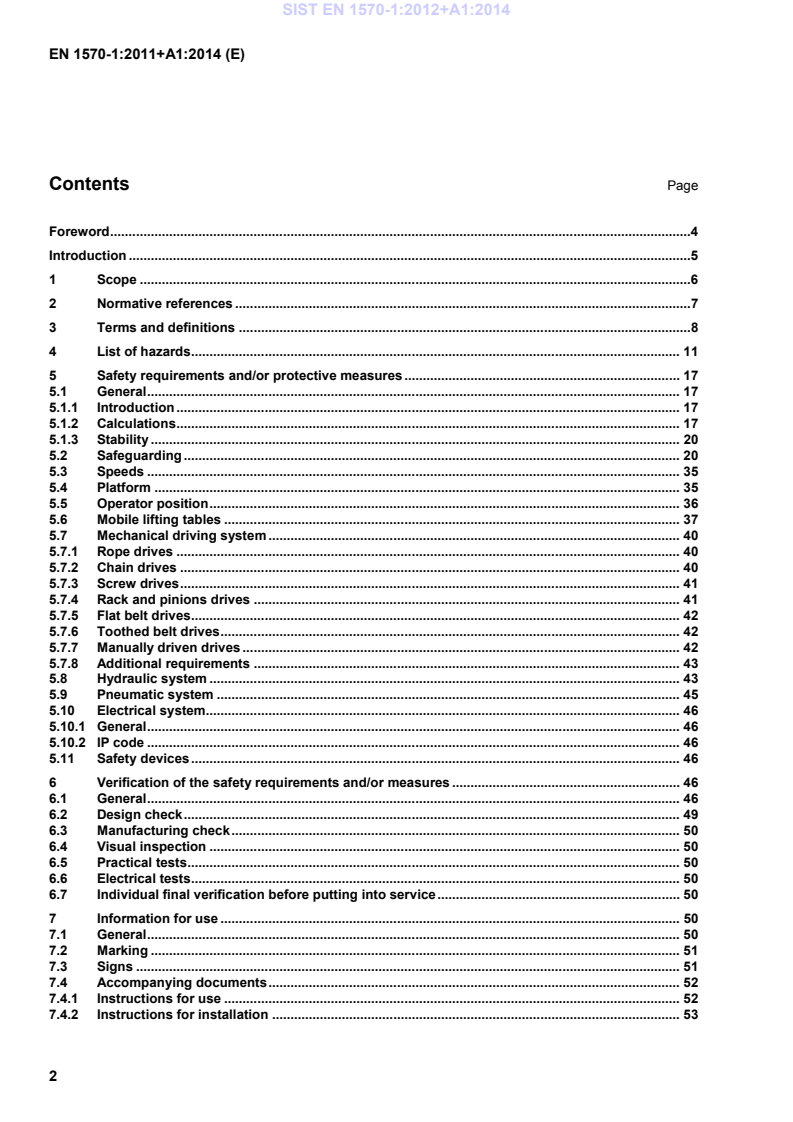
Overloading . 55 Annex B (normative)
Noise . 56 Annex C (normative)
Test procedures . 57 C.1 Practical testing procedure . 57 Annex D (informative)
Controls . 58 D.1 General . 58 D.2 Requirements according to 5.5.3 . 58 D.3 Requirements according to 5.5.4 . 58 D.4 Requirements according to 5.5.5 . 59 Annex E (normative)
Manual force measurement methods . 62 E.1 Driving the lifting table . 62 E.1.1 Maximum allowed forces for mobile lifting tables . 62 E.1.2 Conditions for test . 62 E.1.3 Measurement of starting force and rolling force . 62 E.1.4 The maximum starting force . 62 E.1.5 The maximum rolling force. 62 E.1.6 Average forces . 62 E.2 Lifting and lowering . 62 E.2.1 Hand or foot forces . 62 Annex F (informative)
Signs . 64 Annex ZA (informative)
Relationship between this European Standard and the Essential Requirements of EU Directive 2006/42/EC . 65 Bibliography . 66
This European Standard does not apply to the following equipment: — lifting tables, serving more than 2 fixed landings of a building, for lifting goods with a vertical travel speed not exceeding 0,15 m/s (EN 1570-2); — lifting tables, serving more than 2 fixed landings of a building for lifting operators, with a vertical travel speed not exceeding 0,15 m/s (EN 1570-3); — lifting tables carrying operators and installed in full enclosures (EN 1570-3); — permanently and temporarily installed lifting tables, serving specific levels of a building for lifting operators, with a vertical travel speed exceeding 0,15 m/s (EN 81-1 and EN 81-2); — lifting tables with flat or toothed belts lifting systems for the carrying of operators; — lifting tables whose vertical travel speed exceeds 0,15 m/s (unless safe by position and non person carrying); — power operated lifting platforms for persons with impaired mobility (EN 81-41); — mobile lifting tables for airport ground support equipment (EN 1915-2 and EN 12312-1); — lifting tables which are designed as part of a lift according to Directive (95/16/EC); — lifting tables used on ships; — mobile elevating work platforms (EN 280); — static elevating work platforms; — vehicle lifts for maintenance (EN 1493); — mobile lifting tables used for fire fighting (EN 1777); — mobile lifting tables used as fork lift trucks and order pickers; — mobile lifting tables with a horizontal travelling speed of more than 1,6 m/s; — rail dependent storage and retrieval equipment (EN 528); SIST EN 1570-1:2012+A1:2014
consequences b 1 Mechanical hazards Acceleration, deceleration
(kinetic energy) Being run over Being thrown Crushing Cutting or severing Drawing-in or trapping Entanglement Friction or abrasion Impact Injection Shearing Slipping, tripping and falling Stabbing or puncture Suffocation 5.1.2.6, 5.1.2.7, 5.3.2, Angular parts 5.2.1, 5.2.5, 5.2.10.1 Approach of a moving element to a fixed part 5.2.1, 5.2.2.2.3, 5.2.2.3.1, 5.2.2.5, !5.2.3/5.2.4/5.2.5", 5.2.10.3, 5.2.10.6 Cutting parts 5.2.5 Elastic elements 5.9.7, 7.2.6 Falling objects 5.2.9, 5.2.10.11, 5.2.12, 5.4.2 Gravity (stored energy) 5.1.2.7 Height from the ground 5.2.9, !5.2.11/5.2.12" High pressure !5.8.2/5.8.3", 5.8.4.1, 5.8.8, !5.9.3/5.9.4/5.9.5/5.9.6/5.9.7/5.9.9", 7.3.5, 7.5.7 Machinery mobility 5.3.2, 5.5.1, 5.6 Moving elements !5.2.2.2/5.2.2.3/5.2.2.4/5.2.2.5/5.2.2.6", !5.2.5/5.2.6/5.2.7", 5.6 Rotating elements 5.2.11, 5.2.12.2, !5.2.13.3/5.2.13.4", 5.3.3, 5.4.4 Rough, slippery surface 5.2.5, 5.4.1, 5.4.4 Sharp edges 5.2.5, 5.2.10.13, 5.7.5.4, D.4 d) Stability 5.1.3, 6.2 Vacuum Not applicable 2 Electrical hazards Arc Burn Chemical effects Effects on medical implants Not applicable Electromagnetic phenomena 5.10.2 Electrostatic phenomena 5.10.2 SIST EN 1570-1:2012+A1:2014
7.4.2.3 Unbalanced rotating parts
Not applicable Whistling pneumatics
Not applicable Worn parts Not applicable 5 Vibration hazards Cavitation phenomena Discomfort Low-back morbidity Neurological disorder Osteo-articular disorder Trauma of the spine Vascular disorder Not applicable Misalignment of moving parts
Not applicable Mobile equipment Not applicable Scraping surfaces Not applicable Unbalanced rotating parts Not applicable SIST EN 1570-1:2012+A1:2014
Ionising radiation source Burn Damage to eyes and skin Effects on reproductive capability Genetic mutation Headache, insomnia, etc. Not applicable Low frequency electromagnetic radiation
Optical radiation (infrared, visible and ultraviolet), including laser Not applicable Radio frequency electromagnetic radiation Not applicable 7
Material / substance hazards Aerosol Breathing difficulties, suffocation Cancer Corrosion Effects on reproductive capability Explosion Fire Infection Mutation Poisoning Sensitization Not applicable Biological and microbiological (viral or bacterial) agent Not applicable Combustible Not applicable Dust Not applicable Explosive Not applicable Fibre Not applicable Flammable
Fluid !7.5.4/7.5.6" Fume Not applicable Gas Not applicable Mist Not applicable Oxidizer Not applicable 8 Ergonomic hazards Access Discomfort Fatigue Musculoskeletal disorder Stress Any other (e.g. mechanical, electrical) as a consequence of human error
5.2.15 Design or location of indicators and visual displays units 5.8.4.2 Design, location or identification of control devices Annex D, 5.2.12.1, 5.2.12.4, 5.5.1, 5.5.6, 5.7.7.1, 7.4.2.14 Effort 5.2.11 d), 5.6.4, 5.6.12, 5.8.11 Flicker, dazzling, shadow, stroboscopic effect Not applicable Local lighting Introduction Mental overload/underload
Posture Repetitive activity 5.6.4, 5.6.11, 5.8.11 Visibility 7.1, Table 3, 5.2.2.2.4, 5.2.2.5, 5.2.12.1, 5.5.1, 7.4.2.14 SIST EN 1570-1:2012+A1:2014
Not applicable Electromagnetic disturbance
Lightning Not applicable Moisture Not applicable Pollution 5.8.5, 7.5.6 Snow Not applicable Temperature 5.9.12, E.1.2, 5.2.14 Water Not applicable Wind 5.1.2.3 Lack of oxygen Not applicable 10 Combination of hazards
e.g. repetitive activity + effort + high environmental temperature e.g. dehydration, loss of awareness, heat stroke
Not applicable Examples of hazards according to EN ISO 12100:2010, A.1: a One origin of hazards can have several potential consequences. b For each type or group of hazards, some potential consequences can be related with several origins of hazards.
Table 1b — Examples of hazardous situations according to EN ISO 12100:2010, A.3 Phases of machine life cycle Examples of tasks Clause in this standard Transport Lifting 7.3.4 Loading 7.3.7 Packing 7.4.1 Transportation 7.4.1.3 Unloading 7.4.2.1 Unpacking 7.4.2.1 Assembly and installation Commissioning Adjustments of the machine and its components 7.4.2 Assembly of the machine 7.4.2.1 Connecting to disposal system (e.g. exhaust system, waste water installation) Not applicable Connecting to power supply (e.g. electric power supply, compressed air) 7.3.6, 7.5.11 Demonstration
Feeding, filling, loading of ancillary fluids (e.g. lubricant, grease, glue) 7.5.9 Fencing Not applicable SIST EN 1570-1:2012+A1:2014
Functional test, trials Annex C Mounting or changing tools, tool-setting Not applicable Programming verification Annex C Verification of the final product Clause 6 Operation Clamping/fastening the work piece 7.4.1 Control/inspection 5.5.4 Driving the machine 5.5.4
Feeding, filling, loading of raw material Not applicable Manual loading/unloading Annex C Minor adjustments and setting of functional parameters of the machine (e.g. speed, pressure, force, travel limits) Annex C Minor interventions during operation (e.g. removing waste material, eliminating jams, local cleaning) Not applicable Operating manual controls Annex D Restarting the machine after stopping / interruption 5.5.3 Supervision 7.4.1 Verification of the final product 6.7 Cleaning Maintenance Adjustments 7.4.1 Cleaning, disinfection 7.4.1 Dismantling/removal of parts, components, devices of the machine 7.5 Housekeeping 7.5 Isolation and energy dissipation
Lubrication 7.5.9 Replacement of tools Not applicable Replacement of worn parts 7.5 Resetting 7.5.8 SIST EN 1570-1:2012+A1:2014
Table 1c — Examples of hazardous events according to EN ISO 12100:2010, A.4 Origin related to Hazardous event Clause in this standard Shape and/or superficial finishing of accessible parts of the machine Contact with rough surfaces 5.2.5 Contact with sharp edges and corners, protruding parts 5.2.5 Moving parts of the machine Contact with moving parts 5.2.1, 5.2.2.2.3, 5.2.2.3.1, 5.2.2.5, !5.2/5.2.4/5.2.5/5.2.6", 5.2.10.3, 5.2.10.6 Contact with rotating open ends
Kinetic energy and/or potential energy (gravity) of the machine, parts of the machine, tools and materials used, processed, handled Falling or ejection of objects 5.3, 5.4.2 Stability of the machine and/or parts of the machine Loss of stability 6.1, 6.2, 6.3, 6.4, 6.5, 6.6, 6.7, 5.1.2.7, 5.1.3, 5.1.3.4 Mechanical strength of parts of the machine, tools etc. Break-up during operation 5.1.2 Pneumatic, hydraulic equipment Displacement of moving elements
Projection of high pressure fluids !5.8.1/5.8.2/5.8.3/5.8.4", 7.5.6 Uncontrolled movements 5.6.3, 5.8.10, 5.9.11 Electrical equipment Direct contact !5.10.1/5.10.2" Disruptive discharge
Electric arc Not applicable Fire Not applicable Indirect contact !5.10.1/5.10.2" Short-circuit !5.10.1/5.10.2" Control system Dropping or ejection of a moving part of the machine or of a work piece clamped by the machine Not applicable Failure to stop moving parts 5.5.5, 5.6.2, 5.6.8, !5.7.8.1/5.7.8.2/5.7.8.4", 5.8.8, 5.9.9, 5.11.2, !7.4.1.6" Machine action resulting from inhibition (defeating or failure) of protective devices
Uncontrolled movements (including speed change) 5.6.3, 5.8.10, 5.9.11 Unintended/unexpected start-up 5.2.11 SIST EN 1570-1:2012+A1:2014
Contact with objects with high or low temperature 5.2.14, 5.9.12 Emission of a substance that can be hazardous !5.8.2/5.8.3", 7.5.6 Emission of a level of noise that can be hazardous Annex B Emission of a level of noise that can interfere with a speech communication or with acoustic signals Annex B Emission of a level of vibration that can be hazardous Not applicable Emission of radiation fields that can be hazardous Not applicable Harsh environmental conditions Not applicable (see Clause 1) Workstation and/or work process design Excessive effort !5.2.11 d)", 5.6.4, 5.6.12, !5.8.11/5.8.12" Human errors / misbehaviour (unintentional and/or deliberately induced by the design) !5.5.2/5.5.3/5.5.4/5.5.5/5.5.6", 5.7.7, Clause 7 Loss of direct visibility of the working area Not applicable Painful and tiring postures 5.6.12, 5.6.4, !5.8.11/5.8.12" Repetitive handling at high frequency Not applicable
5 Safety requirements and/or protective measures 5.1 General 5.1.1 Introduction Machinery shall comply with the safety requirements and/or protective measures of this clause. In addition, the machine shall be designed according to the principles of EN ISO 12100 for relevant but not significant hazards, which are not dealt with by this standard. 5.1.2 Calculations Calculations for stress shall meet the following requirements: 5.1.2.1 The lifting table shall be designed in accordance with usual calculation codes and good engineering practice and all failure modes of the material shall be considered including fatigue failure. 5.1.2.2 The stresses in any part of the lifting table using the permissible stress method, under normal working conditions, shall not exceed the lower of the following unless stated otherwise: a) 0,66 times the yield stress of the material used or SIST EN 1570-1:2012+A1:2014
Lifting tables with mounted gravity conveyors. 5 1,4 10 % 512 Lifting tables suited for a high number of cycles When a lifting table is crossed by vehicles, or is integrated in a handling device, the lateral forces have to be verified in individual cases. Higher horizontal load coefficients have to be established if required. a This minimum number of cycles shall be increased by the manufacturer according to the purpose of use of the lifting table. b When used (load cycle) according to lifting categories lifetime of lifting tables is generally 10 years when maintained in accordance with the manufacturers instructions.
%/)2(1−+=y b) is the maximum tilting or deflection ( y ) of any side above 2,0m ( l ) long and is
%0,1=y Dimensions in metres
Key y percentage tilting or deflection of a side l l length of the side of a lifting table platform (in metres) a maximum tilting or deflection of any side up to 2,0 m b maximum tilting or deflection of any side above 2,0 m Figure 1 — Deflection of platform SIST EN 1570-1:2012+A1:2014
...