


EN 415-7:2025
(Main)Safety of packaging machines - Part 7: Cartoning and case packing machines
Safety of packaging machines - Part 7: Cartoning and case packing machines
This document is applicable to the main types of cartoners, case packing machines and crate loading and unloading machines.
This document covers the safety requirements for machine design, construction and all phases of life of the machines including installation, commissioning, operation, adjustment, maintenance and cleaning.
This document is applicable to machines manufactured after the date of issue of this document.
This document does not apply to mandrel carton form, fill and seal machines.
NOTE Mandrel carton form, fill and seal machines are covered by EN 415-3:2021.
Sicherheit von Verpackungsmaschinen - Teil 7: Faltschachtel- und Faltkisten-Verpackungsmaschinen
Dieses Dokument gilt für die Hauptarten von Faltschachtel-Verpackungsmaschinen, Faltkisten-Verpackungsmaschinen und Kistenbelade- und -entlademaschinen.
Dieses Dokument erstreckt sich auf die Sicherheitsanforderungen für Konstruktion, Bau und alle Lebenszyklusphasen der Maschinen, einschließlich Montage, Inbetriebnahme, Betrieb, Einstellung, Instandhaltung und Reinigung der Maschinen.
Dieses Dokument gilt für Maschinen, die nach dem Ausgabedatum dieses Dokuments hergestellt wurden.
Dieses Dokument gilt nicht für Dornrad-Faltschachtelform-, -füll- und -verschließmaschinen.
ANMERKUNG Dornrad-Faltschachtelform-, füll- und verschließmaschinen werden durch EN 415 3:2021 abgedeckt.
Sécurité des machines d’emballage - Partie 7 : Machines de cartonnage et d'emballage carton
Le présent document s'applique aux principaux types de machines de cartonnage, d'emballage de carton et de chargeuses et déchargeuses de caisses.
Le présent document couvre les exigences de sécurité relatives à la conception et la construction des machines, ainsi qu'à toutes les phases du cycle de vie des machines comprenant l'installation, la mise en service, le fonctionnement, le réglage, la maintenance et le nettoyage.
Le présent document s'applique aux machines fabriquées après la date de sa publication.
Le présent document ne s'applique pas aux formeuses de cartons à mandrin, remplisseuses et scelleuses.
NOTE Les formeuses de cartons à mandrin, remplisseuses et scelleuses sont couvertes par l'EN 415-3:2021.
Varnost pakirnih strojev - 7. del: Stroji za kartoniranje in pakiranje v zložljive škatle
General Information
- Status
- Not Published
- Publication Date
- 11-Jan-2027
- Technical Committee
- CEN/TC 146 - Packaging machines - Safety
- Drafting Committee
- CEN/TC 146/WG 7 - Group packaging machines
- Current Stage
- 5060 - Closure of Vote - Formal Approval
- Completion Date
- 17-Nov-2026
Relations
- Effective Date
- 28-Jan-2026
- Effective Date
- 28-Jan-2026
- Effective Date
- 28-Jan-2026
- Effective Date
- 28-Jan-2026
- Effective Date
- 07-Mar-2018
Overview
EN 415-7:2025 - Safety of packaging machines - Part 7: Cartoning and case packing machines is a CEN type-C standard that defines safety requirements for the main types of cartoners, case packing machines and crate loading/unloading machines. It covers machine design and construction and all phases of the machine lifecycle including installation, commissioning, operation, adjustment, maintenance and cleaning. The standard applies to machines manufactured after its date of issue and excludes mandrel carton form, fill and seal machines (see EN 415-3:2021).
Key topics and technical requirements
- Scope and definitions for cartoning, case packing, crate handling and associated terms to ensure consistent interpretation.
- Machine-specific safety requirements for functions such as carton/tray erectors, case erectors, place packers/unpackers, robot loaders/unloaders, horizontal case loaders, case taping, wraparound lidders, and top/horizontal load cartoners.
- General safety principles aligned with EN ISO 12100 (risk assessment and risk reduction) and EN 415-10 (general requirements).
- Control and protective measures referencing safety-related control system standards (e.g., EN ISO 13849-1), guards (EN ISO 14120), interlocks (EN ISO 14119) and access provisions.
- Verification and testing procedures covering visual inspections, measurements and running tests; includes a noise test code (normative annex).
- Information and marking obligations: residual risk warnings, instructions and operator documentation.
- Annexes include a list of significant hazards, noise measurement code, and the relationship to EU Machinery Directive requirements (Annex ZA).
Practical applications and users
EN 415-7 is essential for:
- Machine manufacturers and OEMs designing and building cartoning and case packing machinery to meet European safety expectations and regulatory compliance.
- System integrators and robotics integrators applying robot loaders/unloaders within packing lines (references to robot safety standards).
- Plant operators and safety managers assessing risk, implementing protective measures and preparing maintenance and cleaning procedures.
- Maintenance and service providers who need to follow safe adjustment and changeover practices and work on safety-related parts.
- Notified bodies and market surveillance verifying conformity with the Machinery Directive (2006/42/EC).
Related standards (selected)
- EN 415-1, EN 415-3, EN 415-10 (Packaging machines series)
- EN ISO 12100 (Risk assessment)
- EN ISO 13849-1 (Safety-related control systems)
- EN ISO 10218 (Robot safety)
- EN 60204-1 (Electrical equipment of machines)
Keywords: EN 415-7:2025, safety of packaging machines, cartoning machines, case packing machines, crate loading, machine safety standard, packaging machinery safety.

Get Certified
Connect with accredited certification bodies for this standard

BRCGS (Brand Reputation Compliance Global Standards)
Global food safety and quality standards owner.
Sponsored listings
Frequently Asked Questions
EN 415-7:2025 is a draft published by the European Committee for Standardization (CEN). Its full title is "Safety of packaging machines - Part 7: Cartoning and case packing machines". This standard covers: This document is applicable to the main types of cartoners, case packing machines and crate loading and unloading machines. This document covers the safety requirements for machine design, construction and all phases of life of the machines including installation, commissioning, operation, adjustment, maintenance and cleaning. This document is applicable to machines manufactured after the date of issue of this document. This document does not apply to mandrel carton form, fill and seal machines. NOTE Mandrel carton form, fill and seal machines are covered by EN 415-3:2021.
This document is applicable to the main types of cartoners, case packing machines and crate loading and unloading machines. This document covers the safety requirements for machine design, construction and all phases of life of the machines including installation, commissioning, operation, adjustment, maintenance and cleaning. This document is applicable to machines manufactured after the date of issue of this document. This document does not apply to mandrel carton form, fill and seal machines. NOTE Mandrel carton form, fill and seal machines are covered by EN 415-3:2021.
EN 415-7:2025 is classified under the following ICS (International Classification for Standards) categories: 55.200 - Packaging machinery. The ICS classification helps identify the subject area and facilitates finding related standards.
EN 415-7:2025 has the following relationships with other standards: It is inter standard links to EN ISO 11125-9:2022, EN ISO 16961:2024, EN ISO 8504-2:2019, EN ISO 21809-1:2018, EN 415-7:2006+A1:2008. Understanding these relationships helps ensure you are using the most current and applicable version of the standard.
EN 415-7:2025 is associated with the following European legislation: EU Directives/Regulations: 2006/42/EC; Standardization Mandates: M/396. When a standard is cited in the Official Journal of the European Union, products manufactured in conformity with it benefit from a presumption of conformity with the essential requirements of the corresponding EU directive or regulation.
EN 415-7:2025 is available in PDF format for immediate download after purchase. The document can be added to your cart and obtained through the secure checkout process. Digital delivery ensures instant access to the complete standard document.
Standards Content (Sample)
SLOVENSKI STANDARD
oSIST prEN 415-7:2022
01-oktober-2022
Varnost pakirnih naprav - 7. del: Stroji za kartoniranje in pakiranje
Safety of packaging machines - Part 7: Cartoning and case packing machines
Sicherheit von Verpackungsmaschinen - Teil 7: Kartonier- und Faltkistenpackmaschinen
Sécurité des machines d’emballage - Partie 7 : Machines de cartonnage et d'emballage
carton
Ta slovenski standard je istoveten z: prEN 415-7
ICS:
55.200 Pakirni stroji Packaging machinery
oSIST prEN 415-7:2022 en,fr,de
2003-01.Slovenski inštitut za standardizacijo. Razmnoževanje celote ali delov tega standarda ni dovoljeno.
oSIST prEN 415-7:2022
oSIST prEN 415-7:2022
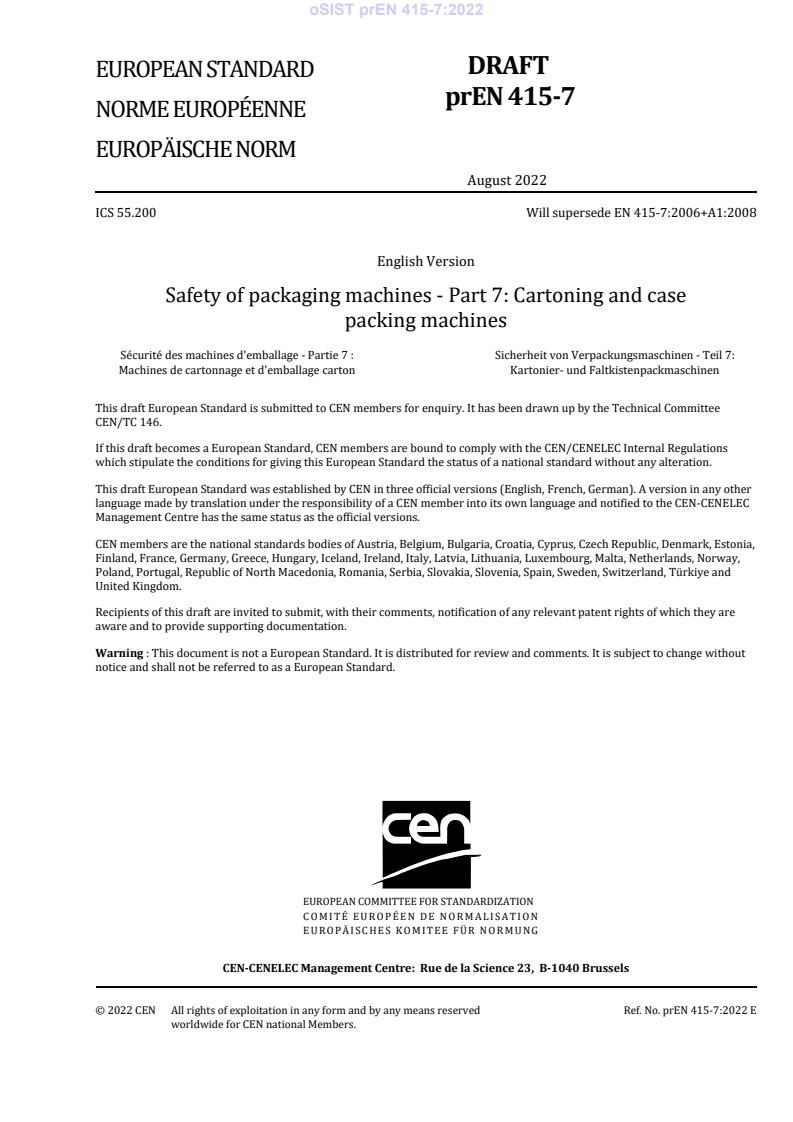
DRAFT
EUROPEAN STANDARD
prEN 415-7
NORME EUROPÉENNE
EUROPÄISCHE NORM
August 2022
ICS 55.200 Will supersede EN 415-7:2006+A1:2008
English Version
Safety of packaging machines - Part 7: Cartoning and case
packing machines
Sécurité des machines d'emballage - Partie 7 : Sicherheit von Verpackungsmaschinen - Teil 7:
Machines de cartonnage et d'emballage carton Kartonier- und Faltkistenpackmaschinen
This draft European Standard is submitted to CEN members for enquiry. It has been drawn up by the Technical Committee
CEN/TC 146.
If this draft becomes a European Standard, CEN members are bound to comply with the CEN/CENELEC Internal Regulations
which stipulate the conditions for giving this European Standard the status of a national standard without any alteration.
This draft European Standard was established by CEN in three official versions (English, French, German). A version in any other
language made by translation under the responsibility of a CEN member into its own language and notified to the CEN-CENELEC
Management Centre has the same status as the official versions.
CEN members are the national standards bodies of Austria, Belgium, Bulgaria, Croatia, Cyprus, Czech Republic, Denmark, Estonia,
Finland, France, Germany, Greece, Hungary, Iceland, Ireland, Italy, Latvia, Lithuania, Luxembourg, Malta, Netherlands, Norway,
Poland, Portugal, Republic of North Macedonia, Romania, Serbia, Slovakia, Slovenia, Spain, Sweden, Switzerland, Türkiye and
United Kingdom.
Recipients of this draft are invited to submit, with their comments, notification of any relevant patent rights of which they are
aware and to provide supporting documentation.
Warning : This document is not a European Standard. It is distributed for review and comments. It is subject to change without
notice and shall not be referred to as a European Standard.
EUROPEAN COMMITTEE FOR STANDARDIZATION
COMITÉ EUROPÉEN DE NORMALISATION
EUROPÄISCHES KOMITEE FÜR NORMUNG
CEN-CENELEC Management Centre: Rue de la Science 23, B-1040 Brussels
© 2022 CEN All rights of exploitation in any form and by any means reserved Ref. No. prEN 415-7:2022 E
worldwide for CEN national Members.
oSIST prEN 415-7:2022
prEN 415-7: 2022 (E)
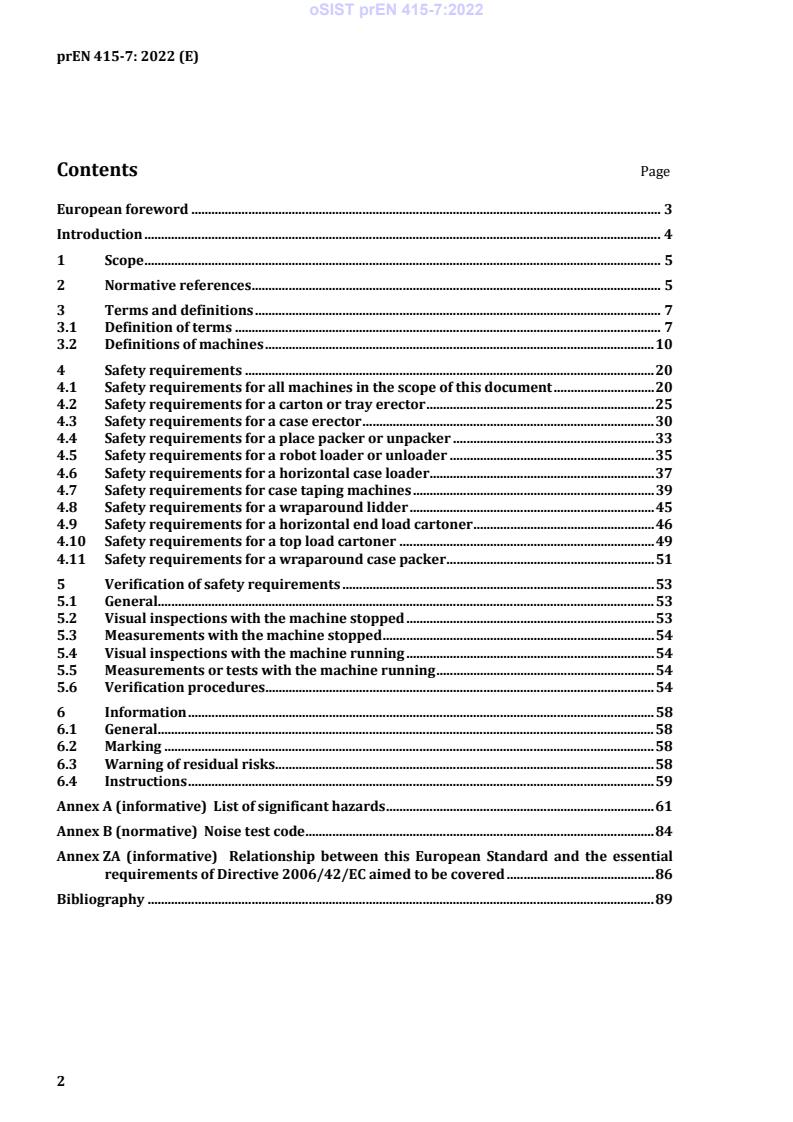
Contents Page
European foreword . 3
Introduction . 4
1 Scope . 5
2 Normative references . 5
3 Terms and definitions . 7
3.1 Definition of terms . 7
3.2 Definitions of machines . 10
4 Safety requirements . 20
4.1 Safety requirements for all machines in the scope of this document . 20
4.2 Safety requirements for a carton or tray erector . 25
4.3 Safety requirements for a case erector . 30
4.4 Safety requirements for a place packer or unpacker . 33
4.5 Safety requirements for a robot loader or unloader . 35
4.6 Safety requirements for a horizontal case loader . 37
4.7 Safety requirements for case taping machines . 39
4.8 Safety requirements for a wraparound lidder . 45
4.9 Safety requirements for a horizontal end load cartoner . 46
4.10 Safety requirements for a top load cartoner . 49
4.11 Safety requirements for a wraparound case packer . 51
5 Verification of safety requirements . 53
5.1 General. 53
5.2 Visual inspections with the machine stopped . 53
5.3 Measurements with the machine stopped . 54
5.4 Visual inspections with the machine running . 54
5.5 Measurements or tests with the machine running . 54
5.6 Verification procedures . 54
6 Information . 58
1 General. 58
6.
6.2 Marking . 58
6.3 Warning of residual risks. 58
6.4 Instructions . 59
Annex A (informative) List of significant hazards . 61
Annex B (normative) Noise test code . 84
Annex ZA (informative) Relationship between this European Standard and the essential
requirements of Directive 2006/42/EC aimed to be covered . 86
Bibliography . 89
oSIST prEN 415-7:2022
prEN 415-7:2022 (E)
European foreword
This document (prEN 415-7:2022) has been prepared by Technical Committee CEN/TC 146 “Packaging
machines - Safety”, the secretariat of which is held by UNI.
This document is currently submitted to the CEN Enquiry.
This document will supersede EN 415-7:2006+A1:2008.
In comparison with the previous edition, the following technical modifications have been made:
— Scope now includes cartoning machines;
— Safety requirements have been rewritten so they are in line with EN 415-10:2014;
— Normative references have been changed to reflect the many changes that have been made to B1 and
B2 standards.
Other Parts of EN 415, Safety of packaging machines, include:
— Part 1: Terminology and classification of packaging machines and associated equipment
— Part 2: Pre-formed rigid container packaging machines
— Part 3: Form, fill and seal machines; fill and seal machines
— Part 4: Palletizers and depalletizers
— Part 5: Wrapping machines
— Part 6: Pallet wrapping machines
— Part 8: Strapping machines
— Part 9: Noise measurement methods for packaging machines, packaging lines and auxiliary
equipment, grade of accuracy 2 and 3
— Part 10: General requirements
This document has been prepared under a Standardization Request given to CEN by the European
Commission and the European Free Trade Association and supports essential requirements of EU
Directive(s) / Regulation(s).
For the relationship with EU Directive(s) / Regulation(s), see informative Annex ZA, which is an integral
part of this document.
oSIST prEN 415-7:2022
prEN 415-7:2022 (E)
Introduction
Cartoning and case packing machines are used extensively in Europe, in an increasingly wide range of
industries. They contain many hazards and have the potential to cause serious injury.
This document is a type-C standard as stated in EN ISO 12100:2010.
This document is of relevance, in particular, for the following stakeholder groups representing the market
players with regard to machinery safety:
— machine manufacturers (small, medium and large enterprises);
— health and safety bodies (regulators, accident prevention organizations, market surveillance etc.).
Others can be affected by the level of machinery safety achieved with the means of the document by the
above-mentioned stakeholder groups:
— machine users/employers (small, medium and large enterprises);
— machine users/employees (e.g. trade unions, organizations for people with special needs);
— service providers, e.g. for maintenance (small, medium and large enterprises).
The above-mentioned stakeholder groups have been given the possibility to participate in the drafting
process of this document.
The machinery concerned and the extent to which hazards, hazardous situations or hazardous events are
covered are indicated in Clause 1.
When requirements of this type-C standard are different from those which are stated in type-A or type-B
standards, the requirements of this type-C standard take precedence over the requirements of the other
standards for machines that have been designed and built according to the requirements of this type-C
standard.
This document makes several references to EN 415-10:2014, but where requirements of this document
are different from those which are stated in EN 415-10:2014, the requirements of this document take
precedence over the requirements of EN 415-10:2014.
Combined function machines
Where a machine covered by EN 415-7 incorporates a mechanism described by another standard in the
EN 415 series, that mechanism shall comply with the requirements of the relevant standard.
Example 1: In the case of a palletizer which incorporates case packing mechanisms, the palletizing
mechanisms should comply with EN 415-4:1997 and the case packing mechanisms should comply with
EN 415-7.
Example 2: In the case of a cartoner which incorporates thermoform fill and seal mechanisms, the
cartoning mechanisms should comply with EN 415-7 and the thermoform fill and seal mechanisms
should comply with EN 415-3.
oSIST prEN 415-7:2022
prEN 415-7:2022 (E)
1 Scope
This document establishes safety requirements for the main types of cartoners, case packing machines
and crate loading and unloading machines.
This document covers the safety requirements for machine design, construction and all phases of life of
the machines including installation, commissioning, operation, adjustment, maintenance and cleaning.
This part of EN 415 applies to machines manufactured after the date of issue of this document.
Exclusions
This document does not apply to mandrel carton form, fill and seal machines.
NOTE Mandrel carton form, fill and seal machines are covered by EN 415-3:2021.
2 Normative references
The following documents are referred to in the text in such a way that some or all of their content
constitutes requirements of this document. For dated references, only the edition cited applies. For
undated references, the latest edition of the referenced document (including any amendments) applies.
EN 415-1:2014, Safety of packaging machines - Part 1: Terminology and classification of packaging
machines and associated equipment
EN 415-4:1997, Safety of packaging machines - Part 4: Palletisers and depalletisers
EN 415-9:2009, Safety of packaging machines - Part 9: Noise measurement methods for packaging
machines, packaging lines and associated equipment, grade of accuracy 2 and 3
EN 415-10:2014, Safety of packaging machines - Part 10: General Requirements
EN 1005-2:2003+A1:2008, Safety of machinery - Human physical performance - Part 2: Manual handling
of machinery and component parts of machinery
EN 1672-2:2020, Food processing machinery - Basic concepts - Part 2: Hygiene and cleanability
requirements
EN ISO 4413:2010, Hydraulic fluid power - General rules and safety requirements for systems and their
components (ISO 4413:2010)
EN ISO 4414:2010, Pneumatic fluid power - General rules and safety requirements for systems and their
components (ISO 4414:2010)
EN ISO 7010:2020, Graphical symbols - Safety colours and safety signs - Registered safety signs (ISO
7010:2019, Corrected version 2020-06)
EN ISO 10218-1:2011, Robots and robotic devices - Safety requirements for industrial robots - Part 1:
Robots (ISO 10218-1:2011)
EN ISO 10218-2:2011, Robots and robotic devices - Safety requirements for industrial robots - Part 2: Robot
systems and integration (ISO 10218-2:2011)
EN ISO 11688-1:2009, Acoustics - Recommended practice for the design of low-noise machinery and
equipment - Part 1: Planning (ISO/TR 11688-1:1995)
oSIST prEN 415-7:2022
prEN 415-7:2022 (E)
EN ISO 12100:2010, Safety of machinery - General principles for design - Risk assessment and risk reduction
(ISO 12100:2010)
EN ISO 13732-1:2008, Ergonomics of the thermal environment - Methods for the assessment of human
responses to contact with surfaces - Part 1: Hot surfaces (ISO 13732-1:2006)
EN ISO 13849-1:2015, Safety of machinery - Safety-related parts of control systems - Part 1: General
principles for design (ISO 13849-1:2015)
EN ISO 13854:2019, Safety of machinery - Minimum gaps to avoid crushing of parts of the human body (ISO
13854:2017)
EN ISO 13857:2019, Safety of machinery - Safety distances to prevent hazard zones being reached by upper
and lower limbs (ISO 13857:2019)
EN ISO 14119:2013, Safety of machinery - Interlocking devices associated with guards - Principles for
design and selection (ISO 14119:2013)
EN ISO 14120:2015, Safety of machinery - Guards - General requirements for the design and construction
of fixed and movable guards (ISO 14120:2015)
EN ISO 14122-2:2016, Safety of machinery - Permanent means of access to machinery - Part 2: Working
platforms and walkways (ISO 14122-2:2016)
EN ISO 14122-3:2016, Safety of machinery - Permanent means of access to machinery - Part 3: Stairs,
stepladders and guard-rails (ISO 14122-3:2016)
EN ISO 14159:2008, Safety of machinery - Hygiene requirements for the design of machinery (ISO
14159:2002)
EN ISO 14738:— , Safety of machinery — Anthropometric requirements for the design of workstations
for industries and services
EN ISO 20607:2019, Safety of machinery - Instruction handbook - General drafting principles (ISO
20607:2019)
EN 60204-1:2018, Safety of machinery - Electrical equipment of machines - Part 1: General requirements
EN 60825-1:2014, Safety of laser products - Part 1: Equipment classification and requirements
, Safety of laser products— Part 4: Laser guards
EN 60825-4:2006
EN 61496-1:2013, Safety of machinery - Electro-sensitive protective equipment - Part 1: General
requirements and tests
ISO 3864-1:2011, Graphical symbols — Safety colours and safety signs — Part 1: Design principles for safety
signs and safety markings
ISO 3864-2:2016, Graphical symbols — Safety colours and safety signs — Part 2: Design principles for
product safety labels
Under preparation. Stage at time of publication: prEN ISO 14738:2020.
As amended by EN 60825-4:2006/A1:2008 and EN 60825 4:2006/A2:2011.
oSIST prEN 415-7:2022
prEN 415-7:2022 (E)
ISO 3864-3:2012, Graphical symbols — Safety colours and safety signs — Part 3: Design principles for
graphical symbols for use in safety signs
3 Terms and definitions
For the purposes of this document, the terms and definitions given in EN ISO 12100:2010,
EN 415-1:2014, EN 415-10:2014 and the following apply.
ISO and IEC maintain terminological databases for use in standardization at the following addresses:
— IEC Electropedia: available at https://www.electropedia.org/
— ISO Online browsing platform: available at https://www.iso.org/obp
3.1 Definition of terms
3.1.1
adjustable linked guard
guard which is linked to a moveable function part and a fixed machine part so that it is adjusted by a
positive mechanical action
Note 1 to entry: Examples of moveable function parts are the adjustable side of a carton magazine or a guide rail on
a conveyor.
3.1.2
carton
container that is made from cartonboard
Note 1 to entry: It is usually delivered to the user in the form of a carton blank or a folded and side seam glued
skillet.
3.1.3
carton blank
case blank
individual carton in the flat after cutting and creasing and with the strippings removed
3.1.4
carton tray
tray made from cartonboard
3.1.5
cartonboard
paper board generally 0,25 mm to 1,0 mm thick and pliable enough so that it can be folded along score
lines without cracking the material
3.1.6
case
container, made from corrugated board
3.1.7
change parts
machine parts designed to handle a specific product, packaging material or pack size that need to be
changed when the machine is set up to handle a different product, packaging material or pack size
oSIST prEN 415-7:2022
prEN 415-7:2022 (E)
3.1.8
change part guard
fixed or interlocking guard which has been made to suit one product or pack size and must be changed
every time the product or pack size is changed
3.1.9
cold adhesive
adhesive that is liquid at room temperature
3.1.10
corrugated board
material comprising one or more sheets of fluted paper stuck between flat sheets of paper
3.1.11
crate
container for a group of products, e.g. bottles that can be made from plastic, wood or metal
3.1.12
hot melt adhesive
adhesive that is solid at room temperature and which is melted so that it can be applied
3.1.13
lock end carton
tongue and slit carton
carton provided with tongues which on closing engage with slits in the opposite flap to close the carton
3.1.14
magazine
mechanical assembly designed to hold stacks of cartons, carton blanks, cases, case blanks, leaflets, labels
or stackable containers
3.1.15
mandrel
mechanical assembly around which a flexible package or carton is formed
3.1.16
manually adjustable guard
guard with one or more moveable parts which are adjusted by a manual intervention
Note 1 to entry: The adjustable part(s) remain in position while a particular product or package size is being
handled.
3.1.17
pack
package
assembly of product and packaging materials produced by a packaging machine
3.1.18
packaging material
material used to make a package
EXAMPLES carton board, corrugated board
oSIST prEN 415-7:2022
prEN 415-7:2022 (E)
3.1.19
pre-gummed tape
tape usually made from paper, which is coated with an adhesive that forms a bond when water and
pressure is applied
3.1.20
product
substance, article or articles (including packs or packages) that are handled in the packaging machine
3.1.21
self-adhesive tape
tape usually made from a thin plastic film, which is coated with an adhesive that requires only pressure
to form a bond
3.1.22
side seam
longitudinal seal which is made on the carton blank or case blank before being handled in the packaging
machine
3.1.23
skillet
side seam glued carton blank
Note 1 to entry: Carton skillets are used in typical horizontal end load cartoners and vertical cartoners.
3.1.24
staple
U-shaped metal closure that is forced through a material and then bent over to form a seal
3.1.25
soil
any unwanted matter, including product residues, micro-organisms, residual detergent or disinfecting
agents
[SOURCE: EN 1672-2:2020]
3.1.26
tray
open topped container
Note 1 to entry: typically made from cartonboard, corrugated board or plastic.
3.1.27
trip guard
interlocking guard which is designed to move easily when touched
3.1.28
wraparound case
package made by folding corrugated board or cartonboard around a product or group of products
3.1.29
wraparound lid
cover made by folding carton board or corrugated board around a package
oSIST prEN 415-7:2022
prEN 415-7:2022 (E)
3.1.30
wraparound sleeve
package with two open ends made by folding cartonboard or corrugated board around a product or group
of products before sealing
3.1.31
wraparound tray
tray made by folding cartonboard or corrugated board around a product or group of products before
sealing
Note 1 to entry: The tray can be pre-made or cut on the machine from a reel of packaging material.
3.2 Definitions of machines
Definitions 3.2.1 to 3.2.12 refer to stand-alone machines, but they can also apply to mechanisms in a
machine which combines two or more packaging functions.
EXAMPLE 1 a machine incorporating a case erector, a product loading mechanism and a wraparound lidding
mechanism
EXAMPLE 2 a machine incorporating a case erector, a robot product loader and an automatic case taper
The figures in this clause illustrate the function of a typical machine of the type described, but machines
that work in slightly different ways are also covered by this document. Most of the machines in the scope
of this document may run either intermittently or continuously.
3.2.1
carton or tray erector
packaging machine that erects cartons or trays, usually from carton blanks
Figure 1 — Diagram showing the principle of operation of a typical carton or tray erector
oSIST prEN 415-7:2022
prEN 415-7:2022 (E)
3.2.2
case erector
packaging machine that erects side seamed cases, usually made from corrugated board
Figure 2 — Diagram showing the principle of operation of a typical case erector
3.2.3
skillet erecting machine
machine which erects pre-glued cartonboard skillets and secures them by engaging pre-cut tabs and slots,
by applying adhesive or by applying heat to pre-coated board
3.2.4
place packer or unpacker
crate loader or unloader
packaging machine that grips products or groups of products and places them vertically into a crate or
package or removes them from a crate or package
Figure 3 — Diagram showing the principle of operation of a typical crate loader or unloader
oSIST prEN 415-7:2022
prEN 415-7:2022 (E)
3.2.5
robot loader or unloader
packaging machine incorporating an industrial robot that grips products or groups of products and places
them vertically into a package or removes them from a package
Figure 4 — Diagram showing the principle of operation of a typical robot loader or unloader
3.2.6
horizontal case loader
packaging machine that loads a product or group of products horizontally into a package, usually a pre-
erected case
oSIST prEN 415-7:2022
prEN 415-7:2022 (E)
Figure 5 — Diagram showing the principle of operation of a typical horizontal case loader
3.2.7
case taper
packaging machine that seals cases with self-adhesive tape or pre-gummed paper tape
Figure 6 — Diagram showing the principle of operation of a typical case taper
Note 1 to entry: This document identifies four types of case taper: see 3.2.7.1 to 3.2.7.4.
3.2.7.1
semi-automatic case taper with manual size change
case taper, which applies tape to a case which has been folded and presented to the machine by hand; the
machine can be size changed manually
3.2.7.2
semi-automatic case taper with automatic size change
case taper, which applies tape to a case which has been folded and presented to the machine by hand; the
machine adjusts automatically to the width and height of the case
oSIST prEN 415-7:2022
prEN 415-7:2022 (E)
3.2.7.3
automatic case taper with manual size change
case taper that folds down the top flaps of a case automatically before applying tape; the machine can be
size changed manually
3.2.7.4
automatic case taper with automatic size change
case taper that folds down the top flaps of a case automatically before applying tape; the machine adjusts
automatically to the width and height of a case
3.2.8
case gluing machine
packaging machine that closes cases, usually made from corrugated board, and seals them with adhesive
3.2.9
case stapling machine
packaging machine that closes cases, usually made from corrugated board, and seals them with metal
staples
3.2.10
wraparound lidder
packaging machine that closes a package by folding a corrugated board or cartonboard blank around the
top of the package
Note 1 to entry: See Figure 7.
Figure 7 — Diagram showing the principle of operation of a typical wraparound lidder
3.2.11
end load carton sealing machine
packaging machine which closes end load cartons and secures them by engaging pre-cut tabs and slots,
by applying adhesive or by applying heat to pre-coated board
oSIST prEN 415-7:2022
prEN 415-7:2022 (E)
3.2.12
top load carton sealing machine
packaging machine which closes top load cartons and secures them with adhesive or by the application
of heat to pre-coated board
3.2.13
horizontal end load cartoner
cartoning machine which erects a folded and side seam sealed carton and places it on a horizontal
mechanism so that the carton can be filled with product horizontally through an open end-flap of the
carton before being closed
Note 1 to entry: The machine can have intermittent or continuous movements.
Note 2 to entry: See Figure 8.
Figure 8 — Diagram showing the principle of operation of a typical horizontal end load cartoner
3.2.14
top load cartoner
cartoning machine in which a carton blank is partly formed into an open top carton before being loaded
vertically with product, after loading the carton is fully formed and closed within the machine
Note 1 to entry: See Figure 9.
oSIST prEN 415-7:2022
prEN 415-7:2022 (E)
Figure 9 — Diagram showing the principle of operation of a typical top load cartoner
3.2.15
vertical cartoner
cartoning machine which erects a folded and side seam sealed carton, fills it with product vertically
through the open top and then closes the top flaps
Note 1 to entry: The machine can have intermittent or continuous movements.
Note 2 to entry: See Figure 10.
Figure 10 — Diagram showing the principle of operation of a typical vertical cartoner
oSIST prEN 415-7:2022
prEN 415-7:2022 (E)
3.2.16
wraparound case packer
packaging machine that groups packages together and forms a pre-cut case blank around them
Note 1 to entry: See Figure 11.
Figure 11 — Diagram showing the principle of operation of a typical wraparound case packer
3.2.17
wraparound tray packer
cartoning machine in which a carton tray blank is partly formed before being loaded horizontally with
product, after loading the carton tray is fully formed and sealed within the machine
Note 1 to entry: See Figure 12.
oSIST prEN 415-7:2022
prEN 415-7:2022 (E)
Figure 12 — Diagram showing the principle of operation of a typical wraparound tray packer
3.2.18
side load case packer
packaging machine that erects a case, loads one or more products horizontally through an open end and
then closes the end flaps
Note 1 to entry: See Figure 13.
oSIST prEN 415-7:2022
prEN 415-7:2022 (E)
Figure 13 — Diagram showing the principle of operation of a typical side load case packer
3.2.19
top load case packer
packaging machine that erects a case, loads one or more products vertically through the open top and
then closes the end flaps
Note 1 to entry: See Figure 14.
Figure 14 — Diagram showing the principle of operation of a typical top load case packer
oSIST prEN 415-7:2022
prEN 415-7:2022 (E)
3.2.20
bottom load case packer
packaging machine that erects a case, loads one or more products vertically through the open bottom and
then closes the end flaps
Note 1 to entry: See Figure 15.
Figure 15 — Diagram showing the principle of operation of a typical bottom load case packer
4 Safety requirements
4.1 Safety requirements for all machines in the scope of this document
4.1.1 General requirements
All the machines in the scope of this document shall comply with the safety requirements and protective
or risk reduction measures in 4.1 and the relevant machine specific measures 4.2 to 4.11 where the
equivalent hazard exists. In addition, machines shall comply with clauses of EN 415-10:2014 where they
are specifically referenced in this document.
Where a machine has hazards which are not described in Annex A because they are not significant on a
typical machine, the machine shall be designed according to relevant clauses of EN 415-10:2014.
4.1.2 Requirements to minimize mechanical risks
4.1.2.1 Inherently safe design
Inherently safe design measures shall be applied as far as possible to eliminate or reduce risks and shall
comply with the requirements of EN 415-10:2014, 5.2.1.1. Clauses 4.2 to 4.11 identify some of the
mechanisms where inherently safe design measures can typically be applied, for example by limiting the
forces applied by the mechanisms.
oSIST prEN 415-7:2022
prEN 415-7:2022 (E)
Except for cutting mechanisms, accessible parts of the machine shall have no sharp edges, no sharp angles
and no rough surfaces likely to cause injury.
Where the machine is not inherently stable during normal use as defined by EN ISO 12100:2010, 6.2.2, it
shall be fitted with means to allow it to be fixed to the floor or to a support structure. The method for
fixing the machine shall be described in the instructions for use. Where the machine is fitted with wheels,
it shall comply with EN 415-10:2014, 5.2.3.
All mechanical components shall be designed and constructed according to good engineering practices.
Mechanical components that support loads shall have a minimum working coefficient of 1.5, chains that
support loads shall have a working coefficient of 4 and toothed belts that support loads shall have a
working coefficient of 5. Where two or more components are used to support a load, the minimum
working coefficient of each component shall be not less than the working coefficients stated above
divided by the number of components that support the load. Components that require regular
maintenance or replacement to prevent break-up during use shall be described in the instructions for
use.
4.1.2.2 Design of guards
Guards shall comply with 4.1.2.2, 4.1.2.4, and with EN 415-10:2014, 5.2.1.4. Interlocking guards shall
comply with EN 415-10:2014, 5.2.1.5 and 5.16.2.3 and EN ISO 14120:2015, 5.2.3.
Where the smallest dimension of a rectangular opening or diameter of a circular opening in a guard is
less than or equal to 120 mm, the safety distances in Tables 3, 4 and 6 of EN ISO 13857:2019 shall apply.
Where the opening is larger than 120 mm, the safety distances shown in EN 415-10:2014, 5.2.1.3 shall
apply.
When an interlocking guard is opened, it shall not be possible to reach a hazard zone before the hazardous
movement has stopped. Where this objective is not achieved, a guard locking device or internal baffle
which prevents direct access to the hazard zone shall be fitted. Where a baffle is used it shall be
dimensioned and positioned so that the person’s movement will be impeded or slowed down sufficiently
for the hazardous movement to stop before the hazard zone can be reached.
Where guards are made of a transparent material and there is a risk of someone colliding with the open
guard because they have not seen that it is open, this guard shall be marked or fitted with features which
make the guard clearly visible when it is open.
Where there is a risk that someone could be shut inside a guarded area, the interlocking guard that gives
access to this area shall be fitted with an interlocking device that minimizes the risk of the guard being
closed accidentally and EN 415-10:2014, 5.16.2.3 shall apply.
Where a good view to zones inside the machine is necessary and the design of the guards causes shadows
that prevent good visibility of the process within the machine, the machine shall be equipped with
interior lighting.
4.1.2.3 Pneumatic and hydraulic equipment
4.1.2.3.1 General
The machine shall be equipped with an isolation valve which shall be located outside hazard zones and
shall be readily accessible, clearly labelled, and have features to allow it to be locked in the off position.
The machine shall have a facility to release stored energy in a safe manner.
4.1.2.3.2 Pneumatic
Pneumatic components and piping shall comply with the requirements of EN ISO 4414:2010.
oSIST prEN 415-7:2022
prEN 415-7:2022 (E)
An air service unit shall be provided with an isolation valve complying with EN ISO 4414:2010, 5.2.8a. A
pressure build-up valve, a pressure regulator, a pressure gauge and a condensate discharge valve shall
also be provided.
4.1.2.3.3 Hydraulic
Hydraulic components and piping shall comply with the requirements of EN ISO 4413:2010. Hydraulic
isolation valves shall comply with EN ISO 4413:2010, 5.4.7.2.1.
4.1.2.4 Size or product changing
4.1.2.4.1 Design of guards
The design of the machine and its guards shall ensure that hazard zones on the machine are safeguarded
without the need for adjustment of safeguards, for all the product and pack sizes for which the machine
has been specified.
Where this is not possible adjustable guards or change part guards shall be used.
Adjustable guards shall be either:
a) adjusted in a positive mode by adjusting the functional parts either manually or under power, or
b) fitted with interlocking devices which ensure that the machine cannot be started or operated unless
the guards are adjusted correctly.
Change part guards shall be either:
a) connected to the functional parts so that the machine cannot function without the appropriate
guarding being fitted, or
b) fitted with interlocking devices so that the machine cannot be started or operated without the
required guard in place.
Machines containing optical radiation sources shall be fitted with opaque guards that prevent hazards
from the source of optical radiation. Power to the source of optical radiation shall be disconnected when
an interlocking guard is opened.
4.1.2.4.2 Size or product changing under power
Where parts of the machine are adjusted under power, the risks presented by these powered movements
shall be eliminated using the following hierarchy of measures:
a) ensuring that the movements are not hazardous by following the safety by design principles
described in 4.1.2.1, or;
b) if a) is not possible by ensuring that movements can only take place when the machine’s interlocking
movable guards are closed or;
c) where it is not possible to fulfil the requirements of a) or b), the movement can only take place using
a hold-to-run control device complying with EN 415-10:2014, 5.16.3.
4.1.2.5 Drive mechanisms
Drive mechanisms shall be enclosed with guards complying with 4.1.2.2.
4.1.2.6 Measures to minimize slip, trip and fall risks
The measures described in EN 415-10:2014, 5.2.2 shall apply.
oSIST prEN 415-7:2022
prEN 415-7:2022 (E)
4.1.2.7 Tasks requiring guards to be open while mechanisms are moved under power
The design of the machine shall avoid the need to carry out any task where it is necessary to move
machine mechanisms while a guard is open. If mechanisms need to be moved in manual mode, this shall
only be possible with all the interlocking guards in the closed position.
Where for technical reasons this is not practicable, movement of the machine parts shall only be possible
if all the requirements of EN 415-10:2014, 5.16.3 have been satisfied.
4.1.2.8 Internal lighting
Internal parts of the machine that require frequent access, inspection, adjustment or maintenance shall
be provided with appropriate lighting, if ambient lighting of normal intensity will not provide sufficient
light.
4.1.3 Electrical equipment
4.1.3.1 General requirements
Electrical equipment fitted to machines in the scope of this document shall comply with EN 415-10:2014,
5.3, 5.5 and 5.14.
4.1.4 Thermal hazards
The external temperature of exposed parts of the machine, like guards, control panels and electric motors,
shall not exceed the burn threshold temperatures stated in EN ISO 13732-1:2008, 4.2, which take into
account the contact material and the foreseen contact time.
Where the machine includes parts, like heating mechanisms with a foreseeable temperature greater than
the burn thresholds described in EN ISO 13732-1:2008, the machine design shall minimize the risk of
accidental contact, for instance by fitting insulation or guards to prevent unintentional contact and by
fitting the “warning hot surface” pictogram specified in 6.3 on the outside of the machine or adjacent to
the hot parts.
If having taken these measures, there is still a residual risk of touching hot surfaces this shall be stated in
the instructions together with the measures which can be taken to avoid burn injuries, like wearing gloves
or other personal protection equipment.
4.1.5 Noise reduction
The most common sources of noise emissions from machines in the scope of this document are:
— Drive motors;
— Products impacting each other or with solid surfaces;
— Vacuum pumps;
— Vibrating mechanisms;
— Release of compressed air.
Machines in the scope of this document shall be designed to minimize noise at its source using state of
the art noise reduction technology.
Noise shall be reduced by the methods stated in this document. Where these measures are not applicable
or insufficient, additional measures stated in EN ISO 11688-1:2009 shall be applied to reduce noise at
source.
oSIST prEN 415-7:2022
prEN 415-7:2022 (E)
The criterion for assessing the efficiency of a noise reduction measure is the actual noise emission value
of the machine and not the nature of the reduction measure itself.
4.1.6 Products and substances used on machines which pose a risk
Where the machine has been specified to pack a hazardous product, the machine shall comply with the
requirements of EN ISO 14123-1:2016 and EN ISO 14123-2:2016.
4.1.7 Ergonomic design
4.1.7.1 Loading points for packaging materials
The requirements of EN 415-10:2014, 5.11.4 shall apply.
4.1.7.2 Product loading or unloading points
The requirements of EN 415-10:2014, 5.11.5 shall apply.
4.1.7.3 Change parts
On machines where change parts are used, hazards from excessive effort or strain shall be eliminated or
reduced by the following measures:
a) designing the machine and its change parts so that the handling operations of change parts are
assessed as acceptable according to EN 1005-2:2003+A1:2008, selecting 25 kg as the reference mass,
M , for the adult user as stated in Table 1 of EN 1005-2:2003+A1:2008;
ref
b) designing the machine and its change parts so that the handling operations of change parts can be
performed by two persons and are assessed as acceptable according to EN 1005-2:2003+A1:2008,
selecting 40 kg as the reference mass Mref;
c) Where the measures described in a) and b) are not possible for technical reasons, and specially
designed lifting equipment is necessary, this lifting equipment shall be provided with the machine.
NOTE Examples for generally available and therefore not special lifting equipment are: fork lift trucks, cranes,
lifting tables or mobile elevating work platforms.
The maximum mass shall be calculated using the Mref given in this document following the procedure
described in EN 1005-2:2003+A1:2008, 4.3.
4.1.8 Hygienic design requirements
Machines intended to pack foodstuffs shall comply with the requirements of EN 1672-2:2020. Machines
intended to pack cosmetics, pharmaceuticals or other products where hygiene is a concern shall comply
with the requirements of EN ISO 14159:2008. In addition, the machine supplier shall:
a) identify the level of hygienic design appropriate for the product. When this information is not known,
the limitation of use for the machine shall be clearly stated in the instructions, for example “This
machine has been designed to pack foodstuffs with the following characteristics”;
b) describe appropriate and safe cleaning procedures in the instructions including information on the
cleaning or disinfection agents that shall be used;
c) design the machine so that fallen packs or spilled products or substances can be easily detected and
removed from the machine.
oSIST prEN 415-7:2022
prEN 415-7:2022 (E)
4.2 Safety requirements for a carton or tray erector
4.2.1 General
The following safety requirements and those described in 4.1 shall apply to a carton or tray erector. The
hazard zones on a typical carton or tray erector are shown in Figure A.1 and described in A.2.1.
Key
A carton blank magazine C drive mechanisms guard
B interlocking guards D package discharge opening
Figure 16 — Guards on a typical carton erector
4.2.2 Carton blank magazine
4.2.2.1 Guards around the stack of carton blanks
4.2.2.1.1 General
The guards around the carton blank magazine shall ensure that it is not possible to reach around the stack
of carton blanks to hazard zones inside the machine.
This objective can be achieved with one or a combination of the following options:
— Adjustable linked guards;
— Change part guards;
— Manually adjustable guards;
— Fixed guards.
All carton blank magazines shall either be safeguarded or be fitted with safety related means to stop the
hazardous movements of the machine when the stack of cartons has reached or fallen below a pre-
determined number of carton blanks.
The carton sensing system shall be designed to minimize the risk of it being deliberately defeated.
NOTE An example of deliberate defeat is placing a piece of card on the active area of a sensor.
oSIST prEN 415-7:2022
prEN 415-7:2022 (E)
The risk of
...
Questions, Comments and Discussion
Ask us and Technical Secretary will try to provide an answer. You can facilitate discussion about the standard in here.
Loading comments...