


EN 15687:2010
(Main)Railway applications - Testing for the acceptance of running characteristics of freight vehicles with static axle loads higher than 225 kN and up to 250 kN
General Information
- Abstract
This European Standard specifies the testing for acceptance of the running characteristics of freight vehicles with static axle loads higher than 225 kN and up to 250 kN.
All requirements of EN 14363 are applicable with some adaptations concerning:
- the conditions of line tests;
- limit values for some assessment quantities.
Only differences for the special cases are listed.
The testing of the running characteristics applies principally to all freight vehicles, which operate without restriction on standard gauge tracks (1 435 mm).
NOTE 1 The testing of the running characteristics of:
- railways with different track layout,
- railways with non-standard gauge tracks
can be conducted by analogy with this European Standard.
The testing of running characteristics is part of the test for the acceptance of running characteristics of vehicles which
- are newly developed,
- have had relevant design modifications, or
- have changes in their operating regimes.
The testing and acceptance of running characteristics refers to the complete vehicle including the running gear. If a running gear, which has already been tested and accepted, is used under a vehicle body of another design, this is considered a design modification. The procedure as described in EN 14363:2005, 5.2 is used.
NOTE 2 In addition to the testing of running characteristics for the acceptance of vehicles, the regulations can be generally applied in other technical tasks, e.g.:
- the checking for compliance against development contracts;
- the optimization of components, vehicles or running gear;
- the testing of influences, influencing parameters and relationships of dependence;
- the monitoring of track or vehicles in operational use.
The application of the full method and the stated limit values reflects unrestricted international operation.
Testing for acceptance of vehicles is based on some reference conditions of track. If these are not respected on certain lines, appropriate measures w
- Status
- Withdrawn
- Publication Date
- 25-May-2010
- Withdrawal Date
- 22-Sep-2026
- Technical Committee
- CEN/TC 256 - Railway applications
- Drafting Committee
- CEN/TC 256/WG 10 - Vehicle/Track Interaction
- Current Stage
- 9960 - Withdrawal effective - Withdrawal
- Start Date
- 09-Mar-2016
- Completion Date
- 23-Sep-2026
- Directive
- Not Harmonized2008/57/EC - DIRECTIVE 2008/57/EC OF THE EUROPEAN PARLIAMENT AND OF THE COUNCIL of 17 June 2008 on the interoperability of the rail system within the Community (Recast)OJ Ref: C, C 214 OJ Date: 20-Jul-2011

Relations
- Effective Date
- 09-Jul-2014
- Effective Date
- 28-Jan-2026
- Effective Date
- 28-Jan-2026
- Effective Date
- 28-Jan-2026
- Referred By
EN ISO 17638:2009 - Non-destructive testing of welds - Magnetic particle testing (ISO 17638:2003) - Effective Date
- 28-Jan-2026
- Effective Date
- 28-Jan-2026
- Effective Date
- 28-Jan-2026
Get Certified
Connect with accredited certification bodies for this standard

IRIS Certification (UNIFE)
International Railway Industry Standard certification.

TÜV SÜD Rail GmbH
TÜV SÜD railway certification services.

Bureau Veritas Railway Certification
Railway and transportation certification.
Sponsored listings
Frequently Asked Questions
EN 15687:2010 is a standard published by the European Committee for Standardization (CEN). Its full title is "Railway applications - Testing for the acceptance of running characteristics of freight vehicles with static axle loads higher than 225 kN and up to 250 kN". This standard covers: This European Standard specifies the testing for acceptance of the running characteristics of freight vehicles with static axle loads higher than 225 kN and up to 250 kN. All requirements of EN 14363 are applicable with some adaptations concerning: - the conditions of line tests; - limit values for some assessment quantities. Only differences for the special cases are listed. The testing of the running characteristics applies principally to all freight vehicles, which operate without restriction on standard gauge tracks (1 435 mm). NOTE 1 The testing of the running characteristics of: - railways with different track layout, - railways with non-standard gauge tracks can be conducted by analogy with this European Standard. The testing of running characteristics is part of the test for the acceptance of running characteristics of vehicles which - are newly developed, - have had relevant design modifications, or - have changes in their operating regimes. The testing and acceptance of running characteristics refers to the complete vehicle including the running gear. If a running gear, which has already been tested and accepted, is used under a vehicle body of another design, this is considered a design modification. The procedure as described in EN 14363:2005, 5.2 is used. NOTE 2 In addition to the testing of running characteristics for the acceptance of vehicles, the regulations can be generally applied in other technical tasks, e.g.: - the checking for compliance against development contracts; - the optimization of components, vehicles or running gear; - the testing of influences, influencing parameters and relationships of dependence; - the monitoring of track or vehicles in operational use. The application of the full method and the stated limit values reflects unrestricted international operation. Testing for acceptance of vehicles is based on some reference conditions of track. If these are not respected on certain lines, appropriate measures w
This European Standard specifies the testing for acceptance of the running characteristics of freight vehicles with static axle loads higher than 225 kN and up to 250 kN. All requirements of EN 14363 are applicable with some adaptations concerning: - the conditions of line tests; - limit values for some assessment quantities. Only differences for the special cases are listed. The testing of the running characteristics applies principally to all freight vehicles, which operate without restriction on standard gauge tracks (1 435 mm). NOTE 1 The testing of the running characteristics of: - railways with different track layout, - railways with non-standard gauge tracks can be conducted by analogy with this European Standard. The testing of running characteristics is part of the test for the acceptance of running characteristics of vehicles which - are newly developed, - have had relevant design modifications, or - have changes in their operating regimes. The testing and acceptance of running characteristics refers to the complete vehicle including the running gear. If a running gear, which has already been tested and accepted, is used under a vehicle body of another design, this is considered a design modification. The procedure as described in EN 14363:2005, 5.2 is used. NOTE 2 In addition to the testing of running characteristics for the acceptance of vehicles, the regulations can be generally applied in other technical tasks, e.g.: - the checking for compliance against development contracts; - the optimization of components, vehicles or running gear; - the testing of influences, influencing parameters and relationships of dependence; - the monitoring of track or vehicles in operational use. The application of the full method and the stated limit values reflects unrestricted international operation. Testing for acceptance of vehicles is based on some reference conditions of track. If these are not respected on certain lines, appropriate measures w
EN 15687:2010 is classified under the following ICS (International Classification for Standards) categories: 45.060.01 - Railway rolling stock in general; 45.060.20 - Trailing stock. The ICS classification helps identify the subject area and facilitates finding related standards.
EN 15687:2010 has the following relationships with other standards: It is inter standard links to EN 14363:2016, EN 15528:2008, EN 14363:2005, EN ISO 10893-4:2011, EN ISO 17638:2009, EN ISO 3452-5:2008, EN ISO 3452-6:2008. Understanding these relationships helps ensure you are using the most current and applicable version of the standard.
EN 15687:2010 is associated with the following European legislation: EU Directives/Regulations: 2008/57/EC; Standardization Mandates: M/334. When a standard is cited in the Official Journal of the European Union, products manufactured in conformity with it benefit from a presumption of conformity with the essential requirements of the corresponding EU directive or regulation.
EN 15687:2010 is available in PDF format for immediate download after purchase. The document can be added to your cart and obtained through the secure checkout process. Digital delivery ensures instant access to the complete standard document.
Standards Content (Sample)
2003-01.Slovenski inštitut za standardizacijo. Razmnoževanje celote ali delov tega standarda ni dovoljeno.Bahnanwendungen- Fahrtechnische Prüfung für die fahrtechnische Zulassung von Güterfahrzeugen mit statischer Radsatzlast von 225 kN bis 250 kNApplications ferroviaires - Essais en vue de l'homologation du comportement dynamique des wagons de charge statique à l'essieu supérieure à 225 kN et jusqu'à 250 kNRailway applications - Testing for the acceptance of running characteristics of freight vehicles with static axle loads higher than 225 kN and up to 250 kN45.060.20Železniški vagoniTrailing stockICS:Ta slovenski standard je istoveten z:EN 15687:2010SIST EN 15687:2011en,fr,de01-oktober-2011SIST EN 15687:2011SLOVENSKI
STANDARD
EUROPEAN STANDARD NORME EUROPÉENNE EUROPÄISCHE NORM
EN 15687
May 2010 ICS 45.060.01 English Version
Railway applications - Testing for the acceptance of running characteristics of freight vehicles with static axle loads higher than 225 kN and up to 250 kN
Applications ferroviaires - Essais en vue de l'homologation du comportement dynamique des wagons pour charges statiques d'essieu de plus de 225 kN et jusqu'à 250kN
Bahnanwendungen- Fahrtechnische Prüfung für die fahrtechnische Zulassung von Güterfahrzeugen mit statischer Radsatzlast von 225 kN bis 250 kN This European Standard was approved by CEN on 25 March 2010.
CEN members are bound to comply with the CEN/CENELEC Internal Regulations which stipulate the conditions for giving this European Standard the status of a national standard without any alteration. Up-to-date lists and bibliographical references concerning such national standards may be obtained on application to the CEN Management Centre or to any CEN member.
This European Standard exists in three official versions (English, French, German). A version in any other language made by translation under the responsibility of a CEN member into its own language and notified to the CEN Management Centre has the same status as the official versions.
CEN members are the national standards bodies of Austria, Belgium, Bulgaria, Croatia, Cyprus, Czech Republic, Denmark, Estonia, Finland, France, Germany, Greece, Hungary, Iceland, Ireland, Italy, Latvia, Lithuania, Luxembourg, Malta, Netherlands, Norway, Poland, Portugal, Romania, Slovakia, Slovenia, Spain, Sweden, Switzerland and United Kingdom.
EUROPEAN COMMITTEE FOR STANDARDIZATION
COMITÉ EUROPÉEN DE NORMALISATION EUROPÄISCHES KOMITEE FÜR NORMUNG
Management Centre:
Avenue Marnix 17,
B-1000 Brussels © 2010 CEN All rights of exploitation in any form and by any means reserved worldwide for CEN national Members. Ref. No. EN 15687:2010: ESIST EN 15687:2011
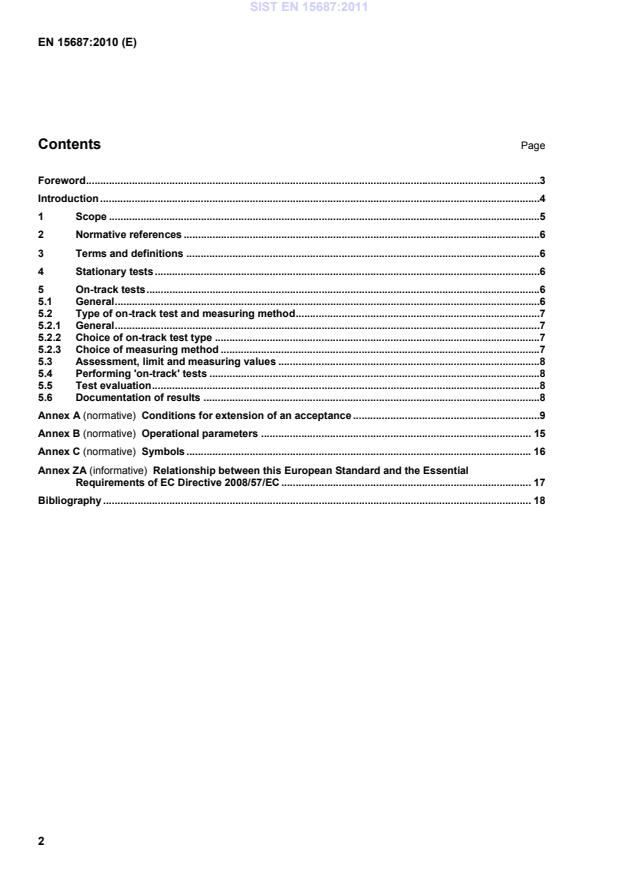
Conditions for extension of an acceptance .9Annex B (normative)
Operational parameters . 15Annex C (normative)
Symbols . 16Annex ZA (informative)
Relationship between this European Standard and the Essential Requirements of EC Directive 2008/57/EC . 17Bibliography . 18 SIST EN 15687:2011
EN 14363:2005). extension of acceptance requires compliance to factor λλλλ'; the simplified measuring methods are only applicable for extensions of acceptance with the exception of extension of cant deficiency; SIST EN 15687:2011
...