


FprEN 17769
(Main)Organic and organo-mineral fertilizers - Determination of the mercury content
General Information
- Abstract
This document specifies a method for determination of the content of mercury (Hg) using (cold) vapour generation apparatus coupled to an atomic absorption spectrophotometer and a method using a direct amalgamation technique.
It is applicable to aqua regia digests prepared according to prEN 17768.
It is applicable to organic fertilizers and organo-mineral fertilizers.
This document is applicable to the fertilizing product blends where a blend is a mix of at least two of the following components: fertilizers, liming materials, soil improvers, growing media, inhibitors, plant biostimulants and where the following category: organic fertilizers or organo-mineral fertilizers is the highest % in the blend by mass or volume, or in case of liquid form by dry mass. If organic fertilizers and organo-mineral fertilizers are not the highest % in the blend, the European Standard for the highest % of the blend applies. In case a fertilizing product blend is composed of components in equal quantity, the user decides which standard to apply. Variations in analytical methods for fertilizing product blends can lead to differing results as some components or matrix interactions can affect the outcome. Validation procedures have shown that developed standard methods are robust and reliable across diverse product compositions, but possible interferences and unexpected results when analysing fertilizing product blends are possible.
NOTE It is also possible to use other suitable methods for the determination of mercury described in Annex A if users prove that the method gives the same results as the methods described in this document.
- Status
- Not Published
- Publication Date
- 17-Feb-2027
- Technical Committee
- CEN/TC 260 - Fertilizers and liming materials
- Drafting Committee
- CEN/TC 260/WG 8 - Organic and organo-mineral fertilizers
- Current Stage
- 4599 - Dispatch of FV draft to CMC - Finalization for Vote
- Start Date
- 27-Aug-2026
- Due Date
- 14-Mar-2027
- Completion Date
- 27-Aug-2026

Overview
FprEN 17769 is a European standard developed by CEN for the accurate determination of mercury content in organic and organo-mineral fertilizers. The standard outlines validated analytical methods involving (cold) vapour generation atomic absorption spectrophotometry (VG-AAS) and a direct amalgamation technique. Its scope covers the measurement of mercury after aqua regia digestion, following procedures defined in prEN 17768. The standard is applicable to a wide range of fertilizer products, including blends where the major component by mass or volume is either organic or organo-mineral fertilizer.
Accurate analysis of mercury in fertilizers is essential for ensuring environmental safety and compliance with European regulations. This standard provides robust procedures to achieve reliable results for quality control, regulatory, and safety purposes.
Key Topics
Determination Methods:
- Cold Vapour Generation AAS (VG-AAS): Mercury is reduced to its elemental form in an acid medium and measured using atomic absorption at a wavelength of 253.7 nm.
- Direct Amalgamation (DA): Mercury is thermally released from the sample, trapped, and measured directly, suitable for many laboratories.
Sample Preparation:
- Requires aqua regia digestion of fertilizer samples as per prEN 17768.
- Emphasizes representative sampling and careful sample handling to prevent contamination.
Applicability to Blends:
- Defines when the standard applies to fertilizer blends based on the predominant component.
- Addresses potential interferences in blends and provides guidance for choosing the correct standard when multiple components are present in equal quantities.
Validation and Robustness:
- Methods have been validated inter-laboratory and shown to be reliable across diverse product compositions.
- Highlights the importance of trained personnel and good laboratory practice for safety.
Alternative Methods:
- Allows other equivalent mercury determination techniques if demonstrated to provide comparable results.
Applications
FprEN 17769 is relevant for:
- Fertilizer Manufacturers: Ensures accurate labeling and compliance with mercury content regulations for organic and organo-mineral fertilizers.
- Regulatory Bodies and Inspectors: Provides a standardized analytical procedure for monitoring mercury content in fertilizers marketed within Europe.
- Analytical Laboratories: Offers validated protocols for the determination of mercury, supporting quality assurance, and inter-laboratory comparability.
- Environmental Audits and Quality Control: Essential for risk assessments and sustainability certifications, ensuring that fertilizer products meet environmental safety standards.
Specific use cases include the analysis of raw materials, finished products, and market surveillance samples, as well as research and development assessments of fertilizer formulations.
Related Standards
- prEN 17768: Defines the aqua regia digestion method required for sample preparation prior to mercury determination.
- prEN 17773: Concerns the determination of dry matter content in organic and organo-mineral fertilizers.
- EN 12944-1 & EN 12944-2: Provide terminology and definitions for fertilizers and liming materials.
- EN 1482-2: Offers general sample preparation provisions for fertilizers and related products.
Additional reference is made to other European and international standards for mercury determination in related matrices such as soils, sludges, and biowaste, helping to harmonize methods and results across the industry.
By following FprEN 17769, stakeholders ensure the reliability, accuracy, and comparability of mercury content determinations in organic and organo-mineral fertilizers, supporting both regulatory compliance and environmental protection goals.
Relations
- Revises
CEN/TS 17769:2022 - Organic and organo-mineral fertilizers - Determination of the mercury content - Effective Date
- 11-Jun-2025
Get Certified
Connect with accredited certification bodies for this standard

Control Union Certifications
Global certification for agriculture and sustainability.

ECOCERT
Organic and sustainability certification.

FSC International
Forest Stewardship Council certification.
Sponsored listings
Frequently Asked Questions
FprEN 17769 is a draft published by the European Committee for Standardization (CEN). Its full title is "Organic and organo-mineral fertilizers - Determination of the mercury content". This standard covers: This document specifies a method for determination of the content of mercury (Hg) using (cold) vapour generation apparatus coupled to an atomic absorption spectrophotometer and a method using a direct amalgamation technique. It is applicable to aqua regia digests prepared according to prEN 17768. It is applicable to organic fertilizers and organo-mineral fertilizers. This document is applicable to the fertilizing product blends where a blend is a mix of at least two of the following components: fertilizers, liming materials, soil improvers, growing media, inhibitors, plant biostimulants and where the following category: organic fertilizers or organo-mineral fertilizers is the highest % in the blend by mass or volume, or in case of liquid form by dry mass. If organic fertilizers and organo-mineral fertilizers are not the highest % in the blend, the European Standard for the highest % of the blend applies. In case a fertilizing product blend is composed of components in equal quantity, the user decides which standard to apply. Variations in analytical methods for fertilizing product blends can lead to differing results as some components or matrix interactions can affect the outcome. Validation procedures have shown that developed standard methods are robust and reliable across diverse product compositions, but possible interferences and unexpected results when analysing fertilizing product blends are possible. NOTE It is also possible to use other suitable methods for the determination of mercury described in Annex A if users prove that the method gives the same results as the methods described in this document.
This document specifies a method for determination of the content of mercury (Hg) using (cold) vapour generation apparatus coupled to an atomic absorption spectrophotometer and a method using a direct amalgamation technique. It is applicable to aqua regia digests prepared according to prEN 17768. It is applicable to organic fertilizers and organo-mineral fertilizers. This document is applicable to the fertilizing product blends where a blend is a mix of at least two of the following components: fertilizers, liming materials, soil improvers, growing media, inhibitors, plant biostimulants and where the following category: organic fertilizers or organo-mineral fertilizers is the highest % in the blend by mass or volume, or in case of liquid form by dry mass. If organic fertilizers and organo-mineral fertilizers are not the highest % in the blend, the European Standard for the highest % of the blend applies. In case a fertilizing product blend is composed of components in equal quantity, the user decides which standard to apply. Variations in analytical methods for fertilizing product blends can lead to differing results as some components or matrix interactions can affect the outcome. Validation procedures have shown that developed standard methods are robust and reliable across diverse product compositions, but possible interferences and unexpected results when analysing fertilizing product blends are possible. NOTE It is also possible to use other suitable methods for the determination of mercury described in Annex A if users prove that the method gives the same results as the methods described in this document.
FprEN 17769 is classified under the following ICS (International Classification for Standards) categories: 65.080 - Fertilizers. The ICS classification helps identify the subject area and facilitates finding related standards.
FprEN 17769 has the following relationships with other standards: It is inter standard links to CEN/TS 17769:2022. Understanding these relationships helps ensure you are using the most current and applicable version of the standard.
FprEN 17769 is associated with the following European legislation: EU Directives/Regulations: 2019/1009; Standardization Mandates: M/564, M/564 Amd 1, M/564 Amd 2. When a standard is cited in the Official Journal of the European Union, products manufactured in conformity with it benefit from a presumption of conformity with the essential requirements of the corresponding EU directive or regulation.
FprEN 17769 is available in PDF format for immediate download after purchase. The document can be added to your cart and obtained through the secure checkout process. Digital delivery ensures instant access to the complete standard document.
Standards Content (Sample)
SLOVENSKI STANDARD
01-marec-2026
Organska in organsko-mineralna gnojila - Določanje živega srebra
Organic and organo-mineral fertilizers - Determination of the mercury content
Organische und organisch-mineralische Düngemittel - Bestimmung des
Quecksilbergehaltes
Engrais organiques et organo-minéraux - Détermination de la teneur en mercure
Ta slovenski standard je istoveten z: prEN 17769
ICS:
65.080 Gnojila Fertilizers
2003-01.Slovenski inštitut za standardizacijo. Razmnoževanje celote ali delov tega standarda ni dovoljeno.
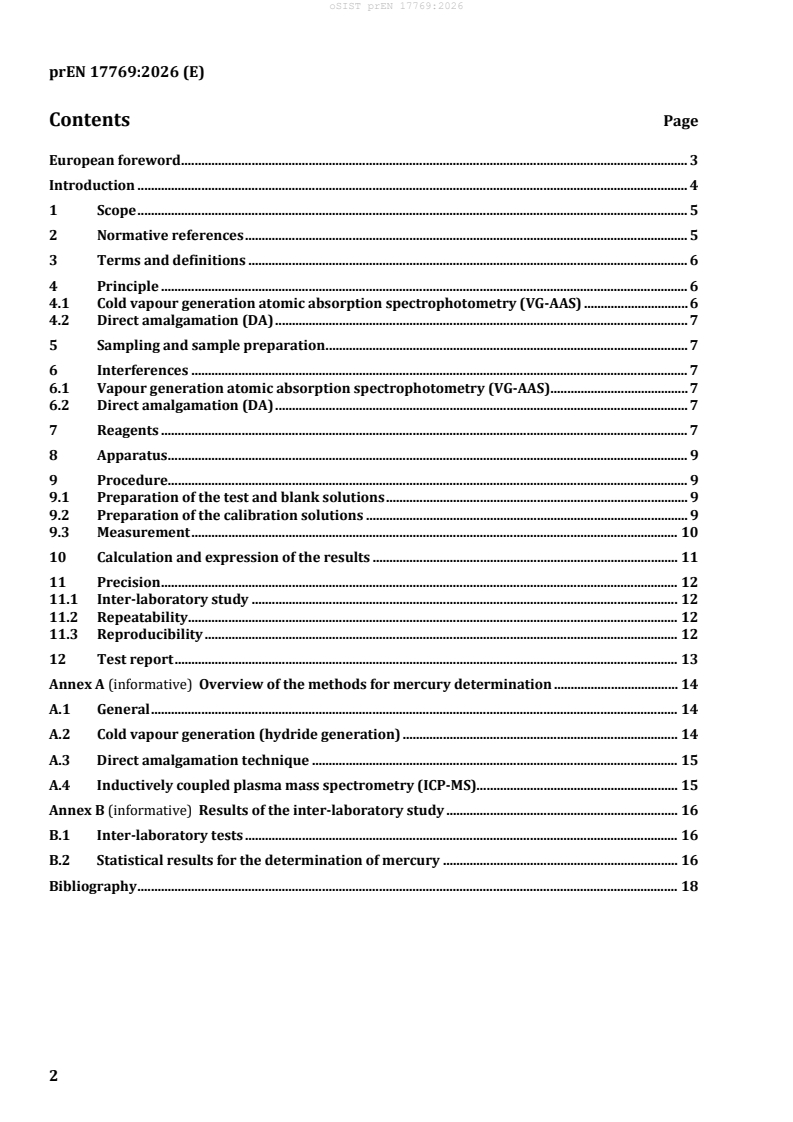
DRAFT
EUROPEAN STANDARD
prEN 17769
NORME EUROPÉENNE
EUROPÄISCHE NORM
January 2026
ICS 65.080 Will supersede CEN/TS 17769:2022
English Version
Organic and organo-mineral fertilizers - Determination of
the mercury content
Engrais organiques et organo-minéraux - Organische und organisch-mineralische Düngemittel -
Détermination de la teneur en mercure Bestimmung des Quecksilbergehaltes
This draft European Standard is submitted to CEN members for enquiry. It has been drawn up by the Technical Committee
CEN/TC 260.
If this draft becomes a European Standard, CEN members are bound to comply with the CEN/CENELEC Internal Regulations
which stipulate the conditions for giving this European Standard the status of a national standard without any alteration.
This draft European Standard was established by CEN in three official versions (English, French, German). A version in any other
language made by translation under the responsibility of a CEN member into its own language and notified to the CEN-CENELEC
Management Centre has the same status as the official versions.
CEN members are the national standards bodies of Austria, Belgium, Bulgaria, Croatia, Cyprus, Czech Republic, Denmark, Estonia,
Finland, France, Germany, Greece, Hungary, Iceland, Ireland, Italy, Latvia, Lithuania, Luxembourg, Malta, Netherlands, Norway,
Poland, Portugal, Republic of North Macedonia, Romania, Serbia, Slovakia, Slovenia, Spain, Sweden, Switzerland, Türkiye and
United Kingdom.
Recipients of this draft are invited to submit, with their comments, notification of any relevant patent rights of which they are
aware and to provide supporting documentation.
Warning : This document is not a European Standard. It is distributed for review and comments. It is subject to change without
notice and shall not be referred to as a European Standard.
EUROPEAN COMMITTEE FOR STANDARDIZATION
COMITÉ EUROPÉEN DE NORMALISATION
EUROPÄISCHES KOMITEE FÜR NORMUNG
CEN-CENELEC Management Centre: Rue de la Science 23, B-1040 Brussels
© 2026 CEN All rights of exploitation in any form and by any means reserved Ref. No. prEN 17769:2026 E
worldwide for CEN national Members.
prEN 17769:2026 (E)
Contents Page
European foreword . 3
Introduction . 4
1 Scope . 5
2 Normative references . 5
3 Terms and definitions . 6
4 Principle . 6
4.1 Cold vapour generation atomic absorption spectrophotometry (VG-AAS) . 6
4.2 Direct amalgamation (DA) . 7
5 Sampling and sample preparation . 7
6 Interferences . 7
6.1 Vapour generation atomic absorption spectrophotometry (VG-AAS) . 7
6.2 Direct amalgamation (DA) . 7
7 Reagents . 7
8 Apparatus . 9
9 Procedure. 9
9.1 Preparation of the test and blank solutions . 9
9.2 Preparation of the calibration solutions . 9
9.3 Measurement . 10
10 Calculation and expression of the results . 11
11 Precision . 12
11.1 Inter-laboratory study . 12
11.2 Repeatability . 12
11.3 Reproducibility . 12
12 Test report . 13
Annex A (informative) Overview of the methods for mercury determination . 14
A.1 General . 14
A.2 Cold vapour generation (hydride generation) . 14
A.3 Direct amalgamation technique . 15
A.4 Inductively coupled plasma mass spectrometry (ICP-MS). 15
Annex B (informative) Results of the inter-laboratory study . 16
B.1 Inter-laboratory tests . 16
B.2 Statistical results for the determination of mercury . 16
Bibliography . 18
prEN 17769:2026 (E)
European foreword
This document (prEN 17769:2026) has been prepared by Technical Committee CEN/TC 260 “Fertilizers
and liming materials”, the secretariat of which is held by DIN.
This document is currently submitted to the CEN Enquiry.
This document will supersede CEN/TS 17769:2022.
Compared to the previous edition, prEN 17769:2026 includes the following significant technical changes:
— the CEN Technical Specification has been adopted as a European Standard;
— Scope (Clause 1) updated including a clarification on fertilizing product blends;
— normative references to the digestion procedure added;
— normative reference to dry matter content determination added;
— normative reference to sampling added;
— terms and definitions revised;
— Bibliography revised;
— Clause 11 (Precision) added;
— Annex B (Results of the inter-laboratory study) added.
This document has been prepared under a Standardization Request given to CEN by the European
Commission. The Standing Committee of the EFTA States subsequently approves these requests for its
Member States.
prEN 17769:2026 (E)
Introduction
This document concerns the analytical measurement step for the determination of mercury in organic
fertilizers and organo-mineral fertilizers after digestion by aqua regia according to prEN 17768. The
document covers cold vapour generation followed by mercury determination using atomic absorption
spectrophotometry (VG-AAS). Different cold vapour generation techniques can be used (flow injection,
segmented flow, batch). The document also includes a method based on a direct amalgamation technique
which is widely used in many analytical laboratories. It is also possible to use other suitable methods of
mercury determination described in Annex A, if users prove that the methods give the same results as
the methods described in this document.
The other standards developed for determination of mercury content in soils, sludges, treated biowaste,
fertilizers and liming materials, plant biostimulants were studied and considered as a basis of the
described method [2], [3], [4], [5], [6].
The inter-laboratory study reflects the final statistical characteristics of the method for the determination
of mercury content in organic and organo-mineral fertilizers including both, the digestion in aqua regia
and the measurement steps.
WARNING — Persons using this document should be familiar with usual laboratory practice. This
document does not purport to address all of the safety issues, if any, associated with its use. It is the
responsibility of the user to establish appropriate health and safety practices and to ensure compliance
with any national regulatory conditions.
IMPORTANT — It is absolutely essential that tests conducted according to this document are carried out
by suitably trained staff.
prEN 17769:2026 (E)
1 Scope
This document specifies a method for determination of the content of mercury (Hg) using (cold) vapour
generation apparatus coupled to an atomic absorption spectrophotometer and a method using a direct
amalgamation technique.
It is applicable to aqua regia digests prepared according to prEN 17768.
It is applicable to organic fertilizers and organo-mineral fertilizers.
This document is applicable to the fertilizing product blends where a blend is a mix of at least two of the
following components: fertilizers, liming materials, soil improvers, growing media, inhibitors, plant
biostimulants and where the following category: organic fertilizers or organo-mineral fertilizers is the
highest % in the blend by mass or volume, or in case of liquid form by dry mass. If organic fertilizers and
organo-mineral fertilizers are not the highest % in the blend, the European Standard for the highest % of
the blend applies. In case a fertilizing product blend is composed of components in equal quantity, the
user decides which standard to apply. Variations in analytical methods for fertilizing product blends can
lead to differing results as some components or matrix interactions can affect the outcome. Validation
procedures have shown that developed standard methods are robust and reliable across diverse product
compositions, but possible interferences and unexpected results when analysing fertilizing product
blends are possible.
NOTE It is also possible to use other suitable methods for the determination of mercury described in Annex A
if users prove that the method gives the same results as the methods described in this document.
2 Normative references
The following documents are referred to in the text in such a way that some or all of their content
constitutes requirements of this document. For dated references, only the edition cited applies. For
undated references, the latest edition of the referenced document (including any amendments) applies.
prEN 17768, Organic and organo-mineral fertilizers — Digestion by aqua regia for subsequent
determination of elements
prEN 17773, Organic and organo-mineral fertilizers — Determination of the dry matter content
EN 12944-1, Fertilizers and liming materials — Vocabulary — Part 1: General terms
EN 12944-2, Fertilizers and liming materials — Vocabulary — Part 2: Terms relating to fertilizers
EN 1482-2, Fertilizers, liming materials and inhibitors — Sampling and sample preparation — Part 2:
General sample preparation provisions
Under preparation.
Under preparation.
prEN 17769:2026 (E)
3 Terms and definitions
For the purposes of this document, the terms and definitions given in EN 12944-1 and EN 12944-2 and
the following apply.
ISO and IEC maintain terminological databases for use in standardization at the following addresses:
— ISO Online browsing platform: available at https://www.iso.org/obp
— IEC Electropedia: available at https://www.electropedia.org/
3.1
analyte
parameter to be determined
3.2
blank calibration solution
solution prepared in the same way as the calibration solution but leaving out the analytes
3.3
blank test solution
solution prepared in the same way as the test sample solution but omitting the test portion
3.4
calibration solution
solution used to calibrate the instrument, prepared from stock solutions by adding acids, buffer, reference
element and salts as needed
3.5
stock solution
solution with accurately known analyte concentration(s), prepared from pure chemicals
3.6
test sample solution
solution prepared after extraction or digestion of the test sample according to appropriate specifications
3.7
digest
solution received after mineralization of the organic matter of a sample and dissolution of its mineral
part, more or less completely, when reacting with a reagent mixture
4 Principle
4.1 Cold vapour generation atomic absorption spectrophotometry (VG-AAS)
Mono - and divalent mercury is reduced to the elemental form by tin(II) chloride or sodium borohydride
in an acid medium. Elemental mercury is stripped off from the solution and determined in the form of an
atomic gas by an atomic absorption spectrophotometer.
prEN 17769:2026 (E)
4.2 Direct amalgamation (DA)
The sample is thermally decomposed in an oxygen rich environment. The decomposition products are
carried to an amalgamator that selectively traps mercury. After the system is flushed with oxygen to
remove any remaining gases or decomposition products, the amalgamator is rapidly heated, releasing
mercury vapour. Flowing oxygen carries the mercury vapour through absorbance cells positioned in the
light path of a single wavelength atomic absorption spectrophotometer. Absorbance is measured at
253,7 nm as a function of mercury concentration.
5 Sampling and sample preparation
Sampling is not part of the method specified in this document. Recommended sampling methods are
given in EN 1482-1 [10] and in EN 1482-3 [11].
It is important that the laboratory receives a sample that is representative of both the product under
consideration and the given analysis. The sample should not have been damaged or changed during
transport or storage.
Sample preparation shall be carried out in accordance with EN 1482-2.
6 Interferences
6.1 Vapour generation atomic absorption spectrophotometry (VG-AAS)
The matrix of the solution analysed is dominated by the acids used in the digestion step. Tin(II) chloride
as a reduction substance is recommended, because sodium borohydride reduces many elements
commonly found in organic fertilizers and organo-mineral fertilizers digests to the elemental state, which
can cause matrix problems under particular circumstances. However, it is still possible to use sodium
borohydride as a reduction agent. The interferences due to the presence of other elements in the matrix
depend on its concentrations. Copper and nickel exceeding a concentration of 500 mg/l can cause a
negative bias.
6.2 Direct amalgamation (DA)
Instruments with an amalgamation technique are very often used for a direct determination of mercury
in samples without a digestion step. Nevertheless, some solid samples (e.g. samples such as silicates or
phosphates) might not be fully thermally decomposed and therefore in this case or if an unknown sample
is analysed, the analysis of aqua regia digests is preferable. For organic fertilizers and organo-mineral
fertilizers usually no difference is observed between the direct determination of mercury and the
determination of mercury after digestion in aqua regia.
7 Reagents
7.1 General
The control of the blank levels of water, acid and other reagents is very important. The reagents shall be
of adequate purity and of recognized analytical grade. The concentration of mercury in the reagents and
water used shall be negligible and low enough not to affect the results of the determination. Generally,
ultra-pure water and acids of minimum p.a. quality are recommended. The concentration of mercury in
the reagents and in water shall be negligible compared to the lowest concentration of mercury to be
determined. Reagents in 7.7 are used only for the VG-AAS method.
7.2 Water with a specific conductivity not higher than 0,2 mS/m at 25 °C, free from mercury.
prEN 17769:2026 (E)
7.3 Carrier gas, argon or nitrogen for VG-AAS, oxygen for DA, purity according to the recommendation
of the manufacturer.
7.4 Hydrochloric acid, substance concentration, c(HCl) ≈ 12 mol/l; mass concentration,
ρ approximately 1,18 g/ml.
7.5 Nitric acid, c(HNO ) ≈ 14,3 mol/l; mass concentration, ρ approximately 1,42 g/ml.
7.6 Mixed acid solution, 0,8 mol/l nitric acid and 1,8 mol/l hydrochloric acid.
Mix 150 ml of hydrochloric acid (7.4) and 50 ml nitric acid (7.5) to 800 ml of water (7.2).
WARNING – For safety reasons the acid has to be poured into the water.
7.7 Reducing agents
7.7.1 General
Tin(II) chloride or sodium borohydride may be used as the reducing agent, but it is not advisable to use
the two reagents alternately. Follow the instructions of the manufacturers of the apparatus. The
concentration by mass of the reducing agent solutions may be varied to suit the system, and the relevant
information provided by the manufacturer of the apparatus shall be observed.
7.7.2 Tin(II) chloride solution, mass concentration, ρ (SnCl ∙ 2 H O) = 100 g/l.
2 2
Dissolve 10 g of SnCl ∙ 2 H O in 30 ml of hydrochloric acid (7.4), transfer to a 100 ml volumetric flask and
2 2
fill to the mark with water (7.2). The blank concentration of mercury can be reduced by bubbling a stream
of nitrogen through the solution for 30 min, if necessary. Prepare this solution on the day of use.
7.7.3 Sodium borohydride solution, NaBH , mass concentration, ρ (NaBH ) = 30 g/l.
4 4
1 g sodium hydroxide, NaOH, is weighed into a 100 ml volumetric flask and dissolved in water (7.2).
Three g sodium borohydride, NaBH , are weighed into a 100 ml volumetric flask, dissolved and diluted
to the mark with the sodium hydroxide solution.
A solution of lower concentration, e.g. 3 g/l may be used with flow systems. Prepare this solution freshly
on the day of use from the more concentrated solution by diluting 10 times with water (7.2). Follow the
recommendations of the manufacturer of the instrument.
WARNING – It is essential to observe the safety instructions for working with sodium borohydride.
Sodium borohydride forms hydrogen with acids and this can result in an explosive air/hydrogen mixture.
A permanent fume extraction system shall be provided at the point where measurements are carried out.
7.8 Standard (stock) solutions
7.8.1 Standard stock solution, mass concentration, ρ = 1 000 mg/l.
Use commercially available mercury stock solution with adequate specification, stating the acid used and
the preparation technique. The solution is considered to be stable for more than one year, but in reference
to guaranteed stability, see the recommendations of the manufacturer. Alternatively, the stock solutions
may be prepared by the dissolution of high purity metal mercury or its salts.
7.8.2 Standard solution I, mass concentration, ρ = 100 mg/l.
Pipette 10 ml of the mercury standard stock solution (7.8.1) into a 100 ml volumetric flask. Add 10 ml of
nitric acid (7.5), fill to the mark with water (7.2) and mix well. This solution is stable for one month.
prEN 17769:2026 (E)
7.8.3 Standard solution II, mass concentration, ρ = 1 mg/l.
Pipette 1 ml of mercury standard solution I (7.8.2) into a 100 ml volumetric flask. Add 10 ml of nitric acid
(7.5) fill to the mark with water (7.2) and mix well. This solution is stable for 7 days.
7.8.4 Standard solution III, mass concentration,
...