


EN 15973:2011
(Main)Rubber- or plastic-coated fabrics - Upholstery fabrics - Resistance to soiling
General Information
- Abstract
This European standard specifies a test method for assessing resistance to soiling and cleanability of coated fabrics for upholstery. This European standard is applicable to upholstery fabrics with a coating on the wear face.
- Status
- Published
- Publication Date
- 01-Mar-2011
- Withdrawal Date
- 29-Sep-2011
- Technical Committee
- CEN/TC 248 - Textiles and textile products
- Drafting Committee
- CEN/TC 248/WG 4 - Coated fabrics
- Current Stage
- 9093 - Decision to confirm - Review Enquiry
- Start Date
- 17-Mar-2023
- Completion Date
- 23-Sep-2026


Overview
EN 15973:2011 provides a standardized test method to assess the resistance to soiling and the cleanability of textile upholstery fabrics that are coated with rubber or plastic. Developed by CEN (European Committee for Standardization), this standard is essential for manufacturers, quality control professionals, and purchasers dealing with coated fabrics for upholstered furniture. It is specifically applied to fabrics with a coating on the wear face, ensuring their suitability for settings where cleanliness and maintenance are major concerns.
By offering a repeatable and objective approach to evaluate how easily soiling occurs and how effectively it can be removed, EN 15973:2011 supports the production and selection of coated upholstery fabrics that meet high performance and durability standards.
Key Topics
Scope and Application: The standard defines clear procedures for coating types and test applicability, focusing only on upholstered textiles with a rubber or plastic coating on the exposed, wear-facing side.
Test Methodology: EN 15973:2011 describes the process of exposing samples of coated fabric to various types of soil, simulating actual use scenarios. The test uses:
- Solid soil (using a soiled cloth)
- Aqueous soil (e.g., coffee solution)
- Oily soil (paraffin-based)
Cleaning Assessment: After soiling and an appropriate conditioning period, fabrics are cleaned with a specified method. Resistance and cleanability are visually evaluated, and the degree of residual soiling is measured using a grey scale as per EN 20105-A03.
Results and Reporting: The standard mandates clear, comprehensive reporting of results, including descriptions of the tested materials, environmental conditions, soiling and cleaning agents, and observation methods.
Applications
EN 15973:2011 is critical for various sectors, including:
Furniture Manufacturing: Ensures finished products, such as sofas and chairs, have reliable and easily maintainable upholstery, enhancing consumer satisfaction and extending product life.
Textile Production: Helps producers of coated textiles verify product performance, maintain consistency, and meet contractual and regulatory requirements.
Quality Assurance and Procurement: Offers buyers and specifiers a robust method for comparing coated upholstered fabrics, supporting informed choices for commercial, residential, healthcare, and hospitality environments.
Research and Development: Facilitates the development of new coatings or fabric treatments that offer improved resistance to common household and commercial soils, supporting innovation in textile engineering.
Compliance and Certification: Adherence to EN 15973:2011 is often required for CE marking and for meeting European and international marketplace expectations.
Related Standards
To ensure comprehensive product evaluation and compatibility, EN 15973:2011 references and is complemented by several related standards:
- EN 20105-A03: Textiles - Tests for colour fastness - Part A03: Grey scale for assessing staining. Used for visual assessment in EN 15973.
- EN ISO 2231: Rubber- or plastics-coated fabrics - Standard atmospheres for conditioning and testing.
- EN ISO 12945-2: Textiles - Determination of fabric propensity to surface fuzzing and to pilling - Modified Martindale method.
- EN ISO 12947-1: Textiles - Determination of the abrasion resistance of fabrics by the Martindale method.
- ISO 105-F09: Textiles - Tests for colour fastness - Specification for cotton rubbing cloth.
- EN 13360: Rubber- or plastics-coated fabrics - Terminology.
These documents collectively form a robust framework for the testing and certification of coated upholstery fabrics, ensuring products are safe, durable, and fit-for-purpose.
Keywords: EN 15973:2011, coated fabrics, upholstery fabrics, soiling resistance, cleaning, cleanability, rubber-coated textiles, plastic-coated textiles, furniture standards, textile testing, CEN standards.
Relations
- Effective Date
- 09-Feb-2026
- Effective Date
- 28-Jan-2026
- Effective Date
- 28-Jan-2026
- Effective Date
- 28-Jan-2026
- Effective Date
- 28-Jan-2026
- Effective Date
- 28-Jan-2026
Get Certified
Connect with accredited certification bodies for this standard

Control Union Certifications
Global certification for agriculture and sustainability.

Hohenstein Institut
Textile testing and certification.

Bureau Veritas Bangladesh
Bureau Veritas certification services in Bangladesh.
Sponsored listings
Frequently Asked Questions
EN 15973:2011 is a standard published by the European Committee for Standardization (CEN). Its full title is "Rubber- or plastic-coated fabrics - Upholstery fabrics - Resistance to soiling". This standard covers: This European standard specifies a test method for assessing resistance to soiling and cleanability of coated fabrics for upholstery. This European standard is applicable to upholstery fabrics with a coating on the wear face.
This European standard specifies a test method for assessing resistance to soiling and cleanability of coated fabrics for upholstery. This European standard is applicable to upholstery fabrics with a coating on the wear face.
EN 15973:2011 is classified under the following ICS (International Classification for Standards) categories: 59.080.40 - Coated fabrics. The ICS classification helps identify the subject area and facilitates finding related standards.
EN 15973:2011 has the following relationships with other standards: It is inter standard links to ISO 105-F09:2009, EN ISO 12945-2:2020, EN ISO 105-A03:2019, EN ISO 12947-1:1998, EN ISO 2231:1995, EN 15618:2022. Understanding these relationships helps ensure you are using the most current and applicable version of the standard.
EN 15973:2011 is available in PDF format for immediate download after purchase. The document can be added to your cart and obtained through the secure checkout process. Digital delivery ensures instant access to the complete standard document.
Standards Content (Sample)
2003-01.Slovenski inštitut za standardizacijo. Razmnoževanje celote ali delov tega standarda ni dovoljeno.Gumirane ali plastificirane tekstilije - Dekorativni in tapetniški materiali - Odpornost proti zamazanjuMit Kautschuk oder Kunststoff beschichtete Textilien - Möbelstoffe - Verhalten gegenüber AnschmutzenSupports textiles revêtus de caoutchouc ou de matière plastique - Étoffes d'ameublement - Résistance à la salissureRubber or plastic-coated fabrics - Upholstery fabrics - Resistance to soiling59.080.40WHNVWLOLMHCoated fabricsICS:Ta slovenski standard je istoveten z:EN 15973:2011SIST EN 15973:2011en,fr,de01-november-2011SIST EN 15973:2011SLOVENSKI
STANDARD
EUROPEAN STANDARD NORME EUROPÉENNE EUROPÄISCHE NORM
EN 15973
March 2011 ICS 59.080.40 English Version
Rubber- or plastic-coated fabrics - Upholstery fabrics - Resistance to soiling
Supports textiles revêtus de caoutchouc ou de plastique - Étoffes d'ameublement - Résistance à la salissure
Mit Kautschuk oder Kunststoff beschichtete Textilien - Möbelstoffe - Verhalten gegenüber Anschmutzen This European Standard was approved by CEN on 15 January 2011.
CEN members are bound to comply with the CEN/CENELEC Internal Regulations which stipulate the conditions for giving this European Standard the status of a national standard without any alteration. Up-to-date lists and bibliographical references concerning such national standards may be obtained on application to the CEN-CENELEC Management Centre or to any CEN member.
This European Standard exists in three official versions (English, French, German). A version in any other language made by translation under the responsibility of a CEN member into its own language and notified to the CEN-CENELEC Management Centre has the same status as the official versions.
CEN members are the national standards bodies of Austria, Belgium, Bulgaria, Croatia, Cyprus, Czech Republic, Denmark, Estonia, Finland, France, Germany, Greece, Hungary, Iceland, Ireland, Italy, Latvia, Lithuania, Luxembourg, Malta, Netherlands, Norway, Poland, Portugal, Romania, Slovakia, Slovenia, Spain, Sweden, Switzerland and United Kingdom.
EUROPEAN COMMITTEE FOR STANDARDIZATION
COMITÉ EUROPÉEN DE NORMALISATION EUROPÄISCHES KOMITEE FÜR NORMUNG
Management Centre:
Avenue Marnix 17,
B-1000 Brussels © 2011 CEN All rights of exploitation in any form and by any means reserved worldwide for CEN national Members. Ref. No. EN 15973:2011: ESIST EN 15973:2011
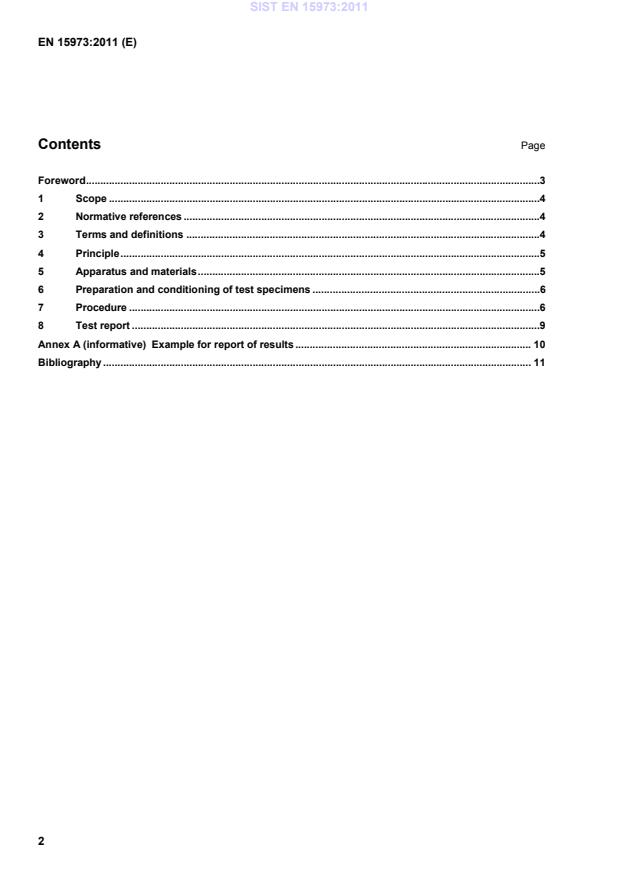
Example for report of results . 10Bibliography . 11 SIST EN 15973:2011
(ISO 105-A03:1993) EN ISO 2231, Rubber- or plastics-coated fabrics — Standard atmospheres for conditioning and testing
(ISO 2231:1989) EN ISO 12945-2, Textiles — Determination of fabric propensity to surface fuzzing and to pilling — Part 2: Modified Martindale method (ISO 12945-2:2000) EN ISO 12947-1, Textiles — Determination of the abrasion resistance of fabrics by the Martindale method — Part 1: Martindale abrasion testing apparatus (ISO 12947-1:1998) ISO 105-F09, Textiles — Tests for colour fastness — Part F09: Specification for cotton rubbing cloth 3 Terms and definitions For the purposes of this document, the following terms and definitions apply. 3.1 coated fabric fabric with an adherent, discrete continuous layer of rubber and/or plastic based material on one or both surfaces (see EN 13360) 3.2 soiling process of transferring one or more unwanted substances to the surface of a material NOTE
The term "staining": a special case of soiling caused by one or more dyes or pigments. 3.3 cleanability property of the coated fabric to be restored to its original appearance after cleaning
a) solid soil and dyes transferred by a soiling cloth;
b) an aqueous soil and
c) an oily soil.
After soiling and a conditioning period the specimens are cleaned. The specimens are visually assessed before and after cleaning. 5 Apparatus and materials 5.1 Martindale apparatus, according to EN ISO 12947-1. 5.2 Pilling specimen holder heads, for the Martindale apparatus (5.1), including the auxiliary mandrel device for specimen mounting, as defined in EN ISO 12945-2. Pilling specimen holder fitted with ring weight and the nominal 12 kPa loading piece (sum of the mass of the applied load and the mass of the specimen holder assembly of (1 010 ± 15) g). NOTE 1 This exerts a nominal pressure of 1,6 kPa on the test specimen during the test. NOTE 2 The use of the mandrel is necessary to correctly mount the soiling cloth on the holder and to avoid contact with the soiling surface of the cloth. Use the option that forms a Lissajous figure with a (60 ± 1) mm stroke. It should be noted that this stroke differs from the standard machine setting for the textile pilling test. WARNING — Some Martindale apparatus have been designed such as the clamping ring is fastened around the abradant table with protuberant screws. Such screws do not allow mechanically the free movement of the pilling specimen holder heads, and then, such apparatus are not available to perform this test method. 5.3 Wool felt underlay, according to EN ISO 12945-2, cut to a diameter of (90 ± 1) mm, for the pilling holder (5.2). 5.4 Wool felt underlay, according to EN ISO 12947-1, cut to a diameter of (140 ± 1) mm, for the abrading table of the Martindale apparatus (5.1). 5.5 Circular sample cutters, for the specimen and soiling cloth, one cutter with a diameter of at least 140 mm. 5.6 Pipettes, for application of the liquids, accurate to at least 0,1 ml. 5.7 Glass plates, size at least 150 mm x 150 m
...