


CEN/TR 16931-9:2025
(Main)Electronic invoicing - Part 9: VAT reporting and gap analysis with current eInvoicing standardization deliverables
General Information
- Abstract
The European Commission will in its project "VAT in the digital age" (ViDA) mandate that VAT reporting on intra-EU transactions is performed in near real-time and based on EN 16931-1. This Technical Report defines the impact of this legislation on the various deliverables of CEN/TC 434, with a focus on the subset to be sent to tax authorities and how EN 16931-1 needs to be changed. The ViDA package applies to all EU member states and specific territories where the VAT legislation applies (e.g. Northern Ireland in respect to goods).
This document does not define the content of the common electronic message based on the electronic invoice to be sent to the authorities. The definition of that common electronic message (DRR message) is a task of the European Commission, possibly with help of CEN. As the DRR message is not an invoice, but a VAT report, it is not to be regarded as a Core Invoice Usage Specification (CIUS). The DRR message therefore needs not to obey the rules for developing a CIUS. For example, not all mandatory elements in the invoice need to be part of the DRR message.
- Status
- Published
- Publication Date
- 16-Dec-2025
- Technical Committee
- CEN/TC 434 - Project Committee - Electronic Invoicing
- Drafting Committee
- CEN/TC 434/WG 1 - Definition
- Current Stage
- 6060 - Definitive text made available (DAV) - Publishing
- Start Date
- 17-Dec-2025
- Due Date
- 04-Nov-2026
- Completion Date
- 17-Dec-2025

Overview
CEN/TR 16931-9:2025 - "Electronic invoicing - Part 9: VAT reporting and gap analysis with current eInvoicing standardization deliverables" - is a Technical Report from CEN/TC 434 that assesses how the European Commission’s ViDA (VAT in the Digital Age) requirements affect the EN 16931 series. It focuses on the near real‑time VAT reporting (Digital Reporting Requirement, DRR) for intra‑EU transactions mandated to be based on EN 16931‑1 and defines impacts, gaps and potential changes required in the current eInvoicing standardization deliverables. The report applies to all EU member states and relevant VAT territories (e.g., Northern Ireland for goods).
Key topics and technical requirements
- Scope and purpose: Defines how ViDA’s DRR requirement uses EN 16931‑1 as a basis and what elements must be adapted or extended for VAT reporting.
- Reporting workflow analysis: Compares present and future workflows for intra‑EU and domestic transactions, including invoice correction, multiple payments, export/import handling, and clearance vs real‑time reporting models.
- Subset for tax authorities (DRR message): Identifies the subset of invoice data to be transmitted to tax authorities; clarifies that the DRR message is a VAT report - not an invoice - and therefore not a CIUS (Core Invoice Usage Specification).
- Gaps in EN 16931‑1: Lists missing information for ViDA DRR use and recommends approaches for filling gaps without redefining the DRR message itself.
- Legal and implementation considerations: Reviews legislative alignment, member‑state situations (clearance systems, SAF‑T, VAT listings), and objectives of ViDA reporting.
- Practical Q&A and annexes: Includes specific questions/answers, correspondence with DG TAXUD, and bibliographic references.
Applications and who should use this standard
- Tax authorities and policymakers - to understand how to implement near real‑time VAT reporting and how EN 16931‑1 should be adapted.
- Software vendors and eInvoicing platform providers - to plan updates to eInvoicing solutions, tax reporting modules, and to ensure compatibility with ViDA requirements.
- Accountancy and compliance teams - to align invoicing and VAT reporting processes with forthcoming EU rules.
- Standards bodies and integrators - to coordinate semantic/syntax updates across the EN 16931 deliverables and contribute to DRR message definition.
Related standards
- EN 16931‑1 (semantic data model of the core invoice) - foundational for ViDA DRR.
- Other EN 16931 series documents (syntax lists, syntax bindings, interoperability and extension guidelines) - all referenced as part of the assessment and update work led by CEN/TC 434.
This Technical Report is a gap‑analysis and impact assessment resource essential for organizations preparing for the EU ViDA rollout and the mandated move toward eInvoicing as the default method for cross‑border B2B VAT reporting.
Relations
- Effective Date
- 18-Jun-2025
Get Certified
Connect with accredited certification bodies for this standard

BSI Group
BSI (British Standards Institution) is the business standards company that helps organizations make excellence a habit.

NYCE
Mexican standards and certification body.
Sponsored listings
Frequently Asked Questions
CEN/TR 16931-9:2025 is a technical report published by the European Committee for Standardization (CEN). Its full title is "Electronic invoicing - Part 9: VAT reporting and gap analysis with current eInvoicing standardization deliverables". This standard covers: The European Commission will in its project "VAT in the digital age" (ViDA) mandate that VAT reporting on intra-EU transactions is performed in near real-time and based on EN 16931-1. This Technical Report defines the impact of this legislation on the various deliverables of CEN/TC 434, with a focus on the subset to be sent to tax authorities and how EN 16931-1 needs to be changed. The ViDA package applies to all EU member states and specific territories where the VAT legislation applies (e.g. Northern Ireland in respect to goods). This document does not define the content of the common electronic message based on the electronic invoice to be sent to the authorities. The definition of that common electronic message (DRR message) is a task of the European Commission, possibly with help of CEN. As the DRR message is not an invoice, but a VAT report, it is not to be regarded as a Core Invoice Usage Specification (CIUS). The DRR message therefore needs not to obey the rules for developing a CIUS. For example, not all mandatory elements in the invoice need to be part of the DRR message.
The European Commission will in its project "VAT in the digital age" (ViDA) mandate that VAT reporting on intra-EU transactions is performed in near real-time and based on EN 16931-1. This Technical Report defines the impact of this legislation on the various deliverables of CEN/TC 434, with a focus on the subset to be sent to tax authorities and how EN 16931-1 needs to be changed. The ViDA package applies to all EU member states and specific territories where the VAT legislation applies (e.g. Northern Ireland in respect to goods). This document does not define the content of the common electronic message based on the electronic invoice to be sent to the authorities. The definition of that common electronic message (DRR message) is a task of the European Commission, possibly with help of CEN. As the DRR message is not an invoice, but a VAT report, it is not to be regarded as a Core Invoice Usage Specification (CIUS). The DRR message therefore needs not to obey the rules for developing a CIUS. For example, not all mandatory elements in the invoice need to be part of the DRR message.
CEN/TR 16931-9:2025 is classified under the following ICS (International Classification for Standards) categories: 35.240.20 - IT applications in office work; 35.240.63 - IT applications in trade. The ICS classification helps identify the subject area and facilitates finding related standards.
CEN/TR 16931-9:2025 has the following relationships with other standards: It is inter standard links to CEN/TR 16931-9:2024. Understanding these relationships helps ensure you are using the most current and applicable version of the standard.
CEN/TR 16931-9:2025 is associated with the following European legislation: EU Directives/Regulations: 2014/55/EU. When a standard is cited in the Official Journal of the European Union, products manufactured in conformity with it benefit from a presumption of conformity with the essential requirements of the corresponding EU directive or regulation.
CEN/TR 16931-9:2025 is available in PDF format for immediate download after purchase. The document can be added to your cart and obtained through the secure checkout process. Digital delivery ensures instant access to the complete standard document.
Standards Content (Sample)
SLOVENSKI STANDARD
01-april-2026
Nadomešča:
SIST-TP CEN/TR 16931-9:2025
Elektronsko izdajanje računov - 9. del: Poročanje o DDV in analiza vrzeli s
trenutnimi rezultati standardizacije e-računov
Electronic invoicing - Part 9: VAT reporting and gap analysis with current eInvoicing
standardization deliverables
Elektronische Rechnungsstellung - Teil 9: Mehrwertsteuer-Berichterstattung und
Lückenanalyse bei der derzeitigen Standardisierung der elektronischen
Rechnungsstellung
Facturation électronique - Partie 9 : déclaration de la TVA et analyse des écarts avec les
livrables actuels relatifs à la normalisation de la facturation électronique
Ta slovenski standard je istoveten z: CEN/TR 16931-9:2025
ICS:
03.100.20 Trgovina. Komercialna Trade. Commercial function.
dejavnost. Trženje Marketing
35.240.20 Uporabniške rešitve IT pri IT applications in office work
pisarniškem delu
35.240.63 Uporabniške rešitve IT v IT applications in trade
trgovini
2003-01.Slovenski inštitut za standardizacijo. Razmnoževanje celote ali delov tega standarda ni dovoljeno.
CEN/TR 16931-9
TECHNICAL REPORT
RAPPORT TECHNIQUE
December 2025
TECHNISCHER REPORT
ICS 35.240.20; 35.240.63 Supersedes CEN/TR 16931-9:2024
English Version
Electronic invoicing - Part 9: VAT reporting and gap
analysis with current eInvoicing standardization
deliverables
Facturation électronique - Partie 9 : déclaration de la Elektronische Rechnungsstellung - Teil 9:
TVA et analyse des écarts avec les livrables actuels Mehrwertsteuer-Berichterstattung und Lückenanalyse
relatifs à la normalisation de la facturation bei der derzeitigen Standardisierung der
électronique elektronischen Rechnungsstellung
This Technical Report was approved by CEN on 7 December 2025. It has been drawn up by the Technical Committee CEN/TC
434.
CEN members are the national standards bodies of Austria, Belgium, Bulgaria, Croatia, Cyprus, Czech Republic, Denmark, Estonia,
Finland, France, Germany, Greece, Hungary, Iceland, Ireland, Italy, Latvia, Lithuania, Luxembourg, Malta, Netherlands, Norway,
Poland, Portugal, Republic of North Macedonia, Romania, Serbia, Slovakia, Slovenia, Spain, Sweden, Switzerland, Türkiye and
United Kingdom.
EUROPEAN COMMITTEE FOR STANDARDIZATION
COMITÉ EUROPÉEN DE NORMALISATION
EUROPÄISCHES KOMITEE FÜR NORMUNG
CEN-CENELEC Management Centre: Rue de la Science 23, B-1040 Brussels
© 2025 CEN All rights of exploitation in any form and by any means reserved Ref. No. CEN/TR 16931-9:2025 E
worldwide for CEN national Members.
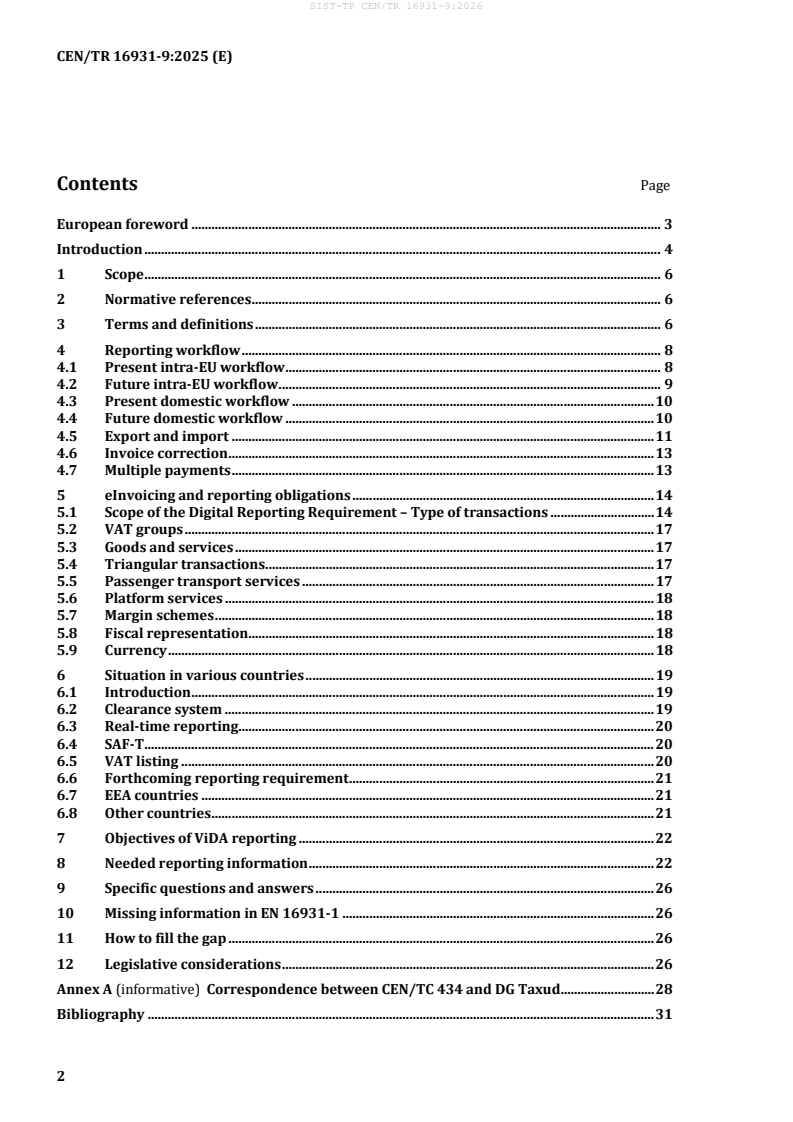
Contents Page
European foreword . 3
Introduction . 4
1 Scope . 6
2 Normative references . 6
3 Terms and definitions . 6
4 Reporting workflow . 8
4.1 Present intra-EU workflow . 8
4.2 Future intra-EU workflow . 9
4.3 Present domestic workflow . 10
4.4 Future domestic workflow . 10
4.5 Export and import . 11
4.6 Invoice correction . 13
4.7 Multiple payments . 13
5 eInvoicing and reporting obligations . 14
5.1 Scope of the Digital Reporting Requirement – Type of transactions . 14
5.2 VAT groups . 17
5.3 Goods and services . 17
5.4 Triangular transactions . 17
5.5 Passenger transport services . 17
5.6 Platform services . 18
5.7 Margin schemes . 18
5.8 Fiscal representation . 18
5.9 Currency . 18
6 Situation in various countries . 19
6.1 Introduction . 19
6.2 Clearance system . 19
6.3 Real-time reporting. 20
6.4 SAF-T . 20
6.5 VAT listing . 20
6.6 Forthcoming reporting requirement . 21
6.7 EEA countries . 21
6.8 Other countries . 21
7 Objectives of ViDA reporting . 22
8 Needed reporting information . 22
9 Specific questions and answers . 26
10 Missing information in EN 16931-1 . 26
11 How to fill the gap . 26
12 Legislative considerations . 26
Annex A (informative) Correspondence between CEN/TC 434 and DG Taxud . 28
Bibliography . 31
European foreword
This document (CEN/TR 16931-9:2025) has been prepared by Technical Committee CEN/TC 434
“Electronic invoicing”, the secretariat of which is held by NEN.
Attention is drawn to the possibility that some of the elements of this document may be the subject of
patent rights. CEN shall not be held responsible for identifying any or all such patent rights.
This document supersedes CEN/TR 16931-9:2024.
This document is part of a series. A list of all the parts in the series, published under the general title
Electronic invoicing, can be found on the CEN website.
Any feedback and questions on this document should be directed to the users’ national standards body.
A complete listing of these bodies can be found on the CEN website.
Introduction
In its Communication, Reaping the benefits of electronic invoicing for Europe , the European Commission
expected electronic invoicing to become the predominant method of invoicing in Europe by 2020. The
communication set out the necessary actions to achieve this objective, such as promoting the
development of an electronic invoicing (eInvoicing) standard, monitoring and setting targets for
eInvoicing adoption.
Directive 2014/55/EU on eInvoicing in public procurement aimed at removing obstacles to cross-
border trade deriving from the co-existence of several legal requirements and technical eInvoicing
formats and from the lack of interoperability.
To achieve this objective, the Commission requested CEN to draft a European standard for the semantic
data model of the core elements of an electronic invoice (the ‘European standard on electronic invoicing’).
In October 2017, the reference to EN 16931-1:2017 and CEN/TS 16931-2:2017 were published in the
Official Journal of the European Union.
Directive 2014/55/EU requires EU member states to ensure that contracting authorities and contracting
entities could receive and process electronic invoices compliant with the European eInvoicing standard
and with the list of syntaxes published in the OJEU. Central contracting authorities had until April 2019
to comply with the provisions of the directive, while member states could delay the implementation until
April 2020 at the latest for sub-central contracting authorities. The directive leaves member states free
to extend the scope of the mandate and addresses legal barriers and interoperability issues, mainly at the
semantic and syntax level.
Technical Committee CEN/TC 434 is responsible for the development and maintenance of the European
eInvoicing standards (16931 series). Regulation (EU) No 1025/2012 on European standardization
establishes rules for the cooperation between European standardization organisations, national
standardization bodies, member states and the Commission. It encourages contact between European
standardization organisations and private forums and consortia, while maintaining the primacy of
European standardization.
In its new mandate, DG GROW has requested CEN/TC 434 to reflect the European Commission’s main
policy priorities in the evolution of EN 16931-1, especially the requirements stemming from the reuse of
EN 16931-1 for Digital VAT Reporting Requirements (DRR) for intra-EU transactions.
Digital reporting requirements as provided for in the VAT in the Digital Age (ViDA) package imply that
taxable persons use electronic invoicing using EN 16931-1. Even though EN 16931-1 has been developed
keeping both B2G (business to government) and B2B (business to business) requirements in mind, the
focus has been on B2G. Therefore, EN 16931-1 needs to be assessed against the requirements of specific
B2B environments. This can result in amendments or in the specification of extensions.
The amendment of Council Directive 2006/112/EC aims at modernising the current EU VAT system and
reducing the EU-27 VAT revenue loss that in 2019 was estimated at EUR 134 billion, with missing trader
intra-community (MTIC) fraud ranging between EUR 40 and 60 billion. To address these issues, the
Commission’s action plan for fair and simple taxation announced a legislative proposal for 2022 on VAT
in the Digital Age. In the related public consultation, DG TAXUD clarified that the problems concern the
application and control of VAT rules in relation to cross-border sales of goods and services, and the need
for a common European solution for digital VAT reporting. The objective is to ensure a quicker, near real-
time, and more detailed exchange of information on VAT intra-EU transactions while streamlining the
mechanisms that can be applied for domestic transactions. The implementation is expected to run until
1 July 2030, the date on which eInvoicing will become the default method to issue invoices. The Council
https://eur-lex.europa.eu/legal-content/EN/TXT/?uri=celex:52010DC0712.
https://eur-lex.europa.eu/legal-content/EN/TXT/?uri=CELEX%3A32014L0055.
https://eur-lex.europa.eu/LexUriServ/LexUriServ.do?uri=OJ:L:2012:316:0012:0033:EN:PDF.
https://eur-lex.europa.eu/legal-content/EN/TXT/?uri=OJ:L_202500516.
reached a general approach at 5 November 2024 ECOFIN on the different elements of the ViDA package.
The ViDA package was adopted on 11 March 2025 and published on the OJEU on 25 March 2025.
The ViDA package provides for the introduction of a mandatory use of eInvoicing between businesses for
cross-border transactions and the implementation of digital VAT reporting requirements (DRR) for B2B
intra-EU transactions using eInvoicing. In particular, a subset of the European eInvoicing standard is to
be defined and used for VAT DRR. Member states are to allow taxable persons (or third parties) to reuse
the solution implemented for B2B cross-border eInvoicing also for B2B at the domestic level, even if a
national solution is already in place. Member States will also be allowed to impose the use of eInvoicing
for B2C.
The successful deployment of an EU-solution for VAT DRR will require rules at the semantic and syntax
level (as foreseen by EN 16931-1). This will ensure coherence of the EU policy and technical framework,
contributing to the establishment of the digital single market.
The current reporting system of intra-Community transactions (referred to in the VAT Directive as
‘recapitulative statements’) does not allow member states to effectively tackle VAT fraud linked to these
transactions. The current recapitulative statements date from 1993 and have not substantially changed
since then. They are ill-prepared for the digital economy and can hardly be compared to the much more
modern digital reporting systems implemented by some member states for domestic transactions.
Among other shortcomings, recapitulative statements only provide aggregated data for each taxable
person, and not transaction-by-transaction data. Moreover, they do not allow data from supplies to be
cross-matched with that of acquisitions, as the VAT Directive leaves the reporting of intra-Community
acquisitions optional for member states and fewer than half of the member states have introduced this
obligation. Further, this data may not be available to tax authorities in other member states at the right
time, because of the time it takes for local tax authorities to upload data onto the system.
The information on intra-Community transactions will feed into the risk analysis systems of the member
states to help them counter the VAT fraud linked with the intra-Community trade, in particular Missing
Trader Intra-Community fraud.
1 Scope
The European Commission will in its project “VAT in the digital age” (ViDA) mandate that VAT reporting
on intra-EU transactions is performed in near real-time and based on EN 16931-1. This Technical Report
defines the impact of this legislation on the various deliverables of CEN/TC 434, with a focus on the subset
to be sent to tax authorities and how EN 16931-1 needs to be changed. The ViDA package applies to all
EU member states and specific territories where the VAT legislation applies (e.g. Northern Ireland in
respect to goods).
This document does not define the content of the common electronic message based on the electronic
invoice to be sent to the authorities. The definition of that common electronic message (DRR message) is
a task of the European Commission, possibly with help of CEN. As the DRR message is not an invoice, but
a VAT report, it is not to be regarded as a Core Invoice Usage Specification (CIUS). The DRR message
therefore needs not to obey the rules for developing a CIUS. For example, not all mandatory elements in
the invoice need to be part of the DRR message.
2 Normative references
There are no normative references in this document.
3 Terms and definitions
For the purposes of this document, the terms and definitions given in EN 16931-1 and the following apply.
ISO and IEC maintain terminology databases for use in standardization at the following addresses:
— ISO Online browsing platform: available at https://www.iso.org/obp/
— IEC Electropedia: available at https://www.electropedia.org/
3.1
B2B
business to business
transactions between businesses
3.2
B2C
business to consumer
transactions between businesses and non-taxable persons
3.3
B2G
business to government
transactions between businesses and public institutions
3.4
compliant
including some or all features of the core invoice model and respecting all rules of the core invoice model
Note 1 to entry: This definition is based on TOGAF definition of a compliant specification [6].
3.5
conformant
respecting all rules of the core invoice model and including some additional features not defined in the
core invoice model
Note 1 to entry: This definition is based on TOGAF definition of a conformant specification [6].
3.6
DRR
digital reporting requirement
requirement of a business to report digitally transactions subject to VAT
3.7
eInvoicing
electronic invoicing
exchanging of invoices in a way that they can automatically be interpreted by computer systems
3.8
eReceipt
receipt that has been issued in a structured electronic format which allows for its automatic and
electronic processing to be transmitted and received by the customer
3.9
intra-EU transaction
sales of goods and/or services from one EU member state to another EU member state (or specific
territories where the VAT legislation applies e.g. Northern Ireland in respect to goods)
3.10
OSS
One Stop Shop
procedure whereby a taxable person can pay VAT due in another EU member state under their own VAT
number
Note 1 to entry: See https://vat-one-stop-shop.ec.europa.eu/one-stop-shop_en.
3.11
simplified invoice
invoice with a reduced number of data elements that can be issued under certain conditions
Note 1 to entry: These conditions are notably Art. 220, 226 and 238 of Council Directive 2006/112/EC.
3.12
transfer of own goods
TOOG
transfer of own goods to another EU member state that were not yet sold, usually closer to the intended
customer
3.13
VAT in the Digital Age
ViDA
set of amendments to the VAT Directive to harmonise VAT reporting of intra-EU transactions, VAT
registration and VAT rules for platform businesses
Note 1 to entry: See https://eur-lex.europa.eu/legal-content/EN/TXT/?uri=OJ:L_202500516.
3.14
VIES
VAT information exchange system covering information on VAT registrations and cross-border
transactions
3.15
DRR message
Common electronic message used for VAT reporting to tax authorities
4 Reporting workflow
4.1 Present intra-EU workflow
The present invoice and VAT workflow of intra-EU transactions is depicted in the following sequence
diagram (Figure 1):
Figure 1 — Present Intra-EU workflow
The recapitulative statement is sent by the seller monthly (or quarterly in some cases) to their tax
authorities. It contains an aggregation of the net amounts invoiced per trading partner in other EU
countries. The seller and their trading partners are identified by their VAT numbers (with a MS prefix).
The statement is forwarded by the tax authorities (through the VIES system) to the tax authorities of the
buyer. In most EU member states, however, the buyer is not obliged to send such a statement. Seller and
buyer information therefore cannot be matched.
The buyer that receives the goods/services from another EU member state is required to self-account for
VAT on their VAT return. Under this mechanism, the buyer company must account for VAT on the
purchase of goods/services from other member states. This means that they calculate the VAT due on the
intra-EU acquisition or the reception of the services and enter this amount in their VAT return. However,
if specific conditions are fulfilled, they are also entitled to a VAT deduction, which is also entered in their
VAT return. This means that they can often reclaim the same amount of VAT, effectively paying no net
VAT.
However, there are exceptions. Taxable persons without the right to deduct VAT (e.g. schools and
hospitals) or with partial right to deduct will have to pay the VAT over the goods and services acquired
from other member states without the possibility to deduct it or at least not fully.
4.2 Future intra-EU workflow
The workflow as foreseen in the ViDA package is as follows (Figure 2):
Figure 2 — Future intra-EU workflow
In this scenario, no recapitulative statements are sent by the seller to the tax authorities. Instead, a subset
of the electronic invoice, is sent to the tax authorities at the time when the invoice is issued. The tax
authorities then forward the subset to the central VIES system. The buyer does the same, within a five-
day deadline after receiving the invoice. The VIES system matches the invoices and alerts the tax
authorities if no match occurs. However, Member States can exclude buyers from the obligation to submit
the data to the tax administration. In these cases, seller and buyer information cannot be matched.
In intra-EU transactions the VAT is reverse charged to the buyer. From the buyer’s perspective, they are
liable to pay the VAT, but deducts it from the VAT over the products sold, if they have the right to do so.
In exceptional cases, however, VAT is to be paid by the buyer. Note that the invoice does not contain the
VAT amount, otherwise the seller would need to know the VAT rate in the buyer’s country.
The DRR message to be sent to the tax authorities is to be sent in real-time upon sending the invoice and
in near real-time (i.e. within five days) upon receiving of the invoice. The DRR message sent by the buyer
need to be aligned with the subset sent by the seller for a match to be made. Small deviations could in
theory be acceptable – the exact matching mechanism is still to be defined. This means that the subset is
not derived from the accounting systems but directly drawn from the raw invoice as issued.
As with electronic invoices, invoice subsets are to be validated by both senders and receivers. Especially
code values and in particular VAT exemption codes need to be checked. However, it is not yet clear what
the consequences will be for subsets that fail validation.
4.3 Present domestic workflow
The present workflow for VAT administration in most EU member states is as follows (Figure 3):
Figure 3 — Present domestic workflow
4.4 Future domestic workflow
ViDA provides that eInvoices will be the default method for domestic invoices and foresees the option for
EU member states to implement DRR for domestic transactions but in such case frames the conditions.
Member states are not obliged to implement a domestic DRR system, but if member states are to mandate
DRR, they have to organize such a workflow similarly to the intra-EU DRR workflow, i.e. based on
eInvoicing. EN 16931-1 is the default for electronic invoicing that is used for VAT administration in such
cases.
Such a workflow is then shaped according to Figure 4.
Figure 4 — Future domestic workflow
In Figure 4 the invoice is sent directly from seller to buyer. In some countries the invoice is sent to the tax
authorities instead and forwarded to the buyer, this, however, is not allowed as a mandatory system
according to ViDA. The invoice subset can be the same as the subset sent in intra-EU transactions. In some
EU member states, the buyer also has to report the invoice subset.
4.5 Export and import
The workflow for exports outside the EU is as follows (Figure 5):
Figure 5 — Export
Export is exempt from VAT. Yet exporters periodically have to send to their tax authorities a VAT return
mentioning the amount invoiced to buyers outside the EU. In the future, EU member states can require
that the invoice or a subset is sent to the tax authorities.
Figure 6 — Import of goods or reception of services
For import the importer pays VAT over the imported goods or the received services (see Figure 6). VAT
over import is usually collected by the customs authorities. In most cases the importer can deduct this
amount from the VAT they paid over their sales.
Under specific conditions, the importer can be exempt from paying VAT when the importation of goods
is followed by an exempt supply of goods to another Member State, i.e. different from the Member State
of importation.
4.6 Invoice correction
The workflow for invoice correction in intra-EU transactions, by means of a credit note or a corrective
invoice, is as follows (Figure 7):
Figure 7 — Invoice correction
For invoice correction, VIES does not only match the subsets received from buyer and seller, but also
matches the subsets of the corrective invoices and credit notes with the original subset.
In principle there are two methods for correcting:
— The original invoice is cancelled by means of a credit note with the same amounts, followed by an
invoice with the correct amounts.
— The difference between the original and the final invoice is stated in a corrective invoice or credit
note.
It is important to realize that each invoice and credit note is an invoice in its own right and stays valid.
4.7 Multiple payments
In case of multiple payments, e.g. instalments, the present workflow is as depicted in Figure 8.
Figure 8 — Multiple payments
For a large majority of transactions, the VAT returns are calculated over the amounts stated in the invoice,
not over the paid amounts. In the future, however, the tax authorities need to be able to match invoices
and payments when investigating risky transactions. So, the information of the instalments need to be
specified on the invoice.
5 eInvoicing and reporting obligations
5.1 Scope of the Digital Reporting Requirement – Type of transactions
5.1.1 Introduction
The key requirement for Digital Reporting Requirement (DRR) is to detect unreported zero-rated goods
between EU member states. If the buyer is registered for VAT and registered on the VIES database , the
invoice is zero rated (when certain conditions are fulfilled). The buyer is then responsible for accounting
for the VAT on their intra-community acquisition using a legal mechanism similar to the reverse charge.
This applies to both B2B and B2G transactions (insofar the G is above the threshold or has opted for it).
In the member state of origin, the supply is VAT exempt. On the invoice reference to the exemption must
be made. A similar treatment is applicable to the cross -border supply of services.
The DRR provided for in ViDA will impose a digital reporting requirement on cross-border (intra-EU)
supplies of goods and services between taxable persons (B2B and B2G). A taxable person is usually a
business, but a public entity can also be liable for VAT if they receive supplies of intra-EU goods or
services. DRR implies standardized electronic invoicing. This will greatly enhance efficiency in
transaction processing between companies.
https://ec.europa.eu/taxation_customs/vies/
The DRR will greatly enhance the ability of member states to fight VAT fraud associated with the zero-
rating of intra-EU trade. The DRR will require both parties to submit details of all intra-EU sales and
purchases on a transactional basis in real-time to their national tax administration. This information in
turn will be sent on to a new central VIES portal which will be maintained by the European Commission.
The central VIES system will crosscheck the data reported by the individual member states together with
other information to identify risky transactions. Details of the risky transactions will be provided to the
national tax administrations to enable them to act quickly in the case of possible frauds.
The transactions discussed in 5.1.2 through 5.1.9 are not subject to a mandatory DRR (i.e. it is optional
for Member States), with the exception of the ones in 5.1.8. However, the transfers of own goods to
another Member State will have to be declared in the intra-Community DRR when the new OSS Transfer
of Own Good (TOOG) module is not used.
5.1.2 Business to Consumer (B2C)
The DRR part of the ViDA package does not mandate Member States to transition the intra-EU DRR to a
B2C regime. The requirement to issue an invoice (hence an eInvoice) in a B2C transaction is not
mandatory.
Directive 2025/516 refers to “digital reporting requirements for cross-border supplies of goods and
services for consideration made between taxable persons”. As B2C does not involve supplies between
“taxable persons” the Directive does not cover these supplies. Nevertheless, the Directive allows Member
States to implement a reporting system for B2C transactions based on eInvoicing.
5.1.3 eCommerce OSS (One Stop Shop)
For eCommerce transactions the seller is likely to be using the OSS (One Stop Shop) system. The seller
has the choice to declare the VAT amount to the local tax authorities as part of their normal VAT return
for local B2C supplies or register in the OSS and declare the VAT via the OSS VAT return for all his B2C
supplies in other EU member states. The same system exists for imported goods that are then sold B2C
(the I(import)OSS).
The eCommerce OSS or B2C procedure only applies to sales to non-taxable persons or persons who are
treated as non-taxable persons. This is out of scope for the ViDA DRR. There is also another type of OSS
procedure: the transfer of own goods OSS (see 5.1.5).
For cross-border B2C supplies (in excess of the EUR 10 000 threshold) the business supplier can either
register and account for VAT in each of the member states supplied or can register and use the Union OSS
in their country of establishment (or non-Union OSS if they are not established within the EU).
If the sales are below the €10 000 threshold, the business can charge the customer the VAT in the
business’ country of establishment. This is then to be returned on its own VAT return. As an alternative,
the business is free to charge VAT of the member states of destination on a voluntary basis instead of
domestic VAT and use the OSS.
5.1.4 Simplified invoices and eReceipts
The DRR only allow for the use of structured electronic invoices in intra-EU transactions which are
EN 16931-1 compliant (supplies between taxable persons). Therefore simplified invoices and eReceipts
are not allowed intra-EU. In simplified invoices the identification of the buyer is not mandatory and
therefore reverse charge is not possible with simplified invoices.
5.1.5 Transfer of own goods intra-EU (TOOG)
According to a survey on OSS, 60 % of respondents assessed the transfer of own goods intra-EU as a
widespread transaction, representing one of the main reasons requiring them to register for VAT in the
country of arrival of the goods.
Transfer of own goods is a means for a supplier to move stock closer to their customers in another
Member State. For example, today a transfer of goods into Germany is assimilated to an intra-community
acquisition in that Member State where the supplier is required to have a German VAT number and must
account for German VAT on that acquisition.
The transfer of own goods within the Union will be covered under a new special module of the OSS
scheme following ViDA in order to reduce the need for VAT registration in multiple Member States. This
will also encompass cross-border movements of goods that are currently covered by call-off stock
arrangements under Article 17a of the VAT Directive.
In relation to the transfers of own goods, when the special scheme is used:
— A special module is being created for transfers of own goods (TOOG scheme).
— The scheme is optional.
— Registration is not required in the member state of departure and of arrival of the goods.
— When the transfer of own goods to another member state takes place, the supplier will declare this
in the new module of the OSS and does not have to make a DRR.
— Where the goods are later supplied to a business in another member state, the transaction has to be
declared in the DRR.
— Where the goods are later supplied to a customer (in the same member state or in another member
state), the OSS can be used to the declare and remit the VAT on this B2C sales.
In practice a VAT invoice not showing VAT still needs to be issued purely from a bookkeeping viewpoint,
or also be dealt with as a stock transfer document if the accounting system supports this. The invoice will
only be necessary once there is a sale to the customer. Of course, if the special scheme is not used the
transfer of goods is taxed and an invoice will need to be issued.
Two types of movement of goods are usually defined: call-off stocks and consignment stocks. For the
former the buyer is known, whereas for the latter there is no specific buyer.
5.1.6 Call-off stocks
For call-off stocks, the goods can be shipped to the buyer’s warehouse, but they remain the property of
the seller until call-off. The scheme can only apply, provided that the seller is not established and not
identified in the Member State of the warehouse, but the buyer is already identified in the member state
of destination. At the time of transport or dispatch of the goods, no intra-community supply or acquisition
is taking place, but an exempt intra-Community supply in the Member State of departure and a taxed
intra-Community acquisition in the Member State where the stock is situated will take place at a later
stage when the acquirer takes ownership of the goods.
As a consequence of the changes to the OSS and the introduction of the new TOOG scheme, the current
call-off stock simplification will become obsolete. Therefore, the ViDA Directive provides for the end of
the application of this simplification from 30 June 2029.
5.1.7 Consignment stocks
Consignment stocks are similar to call-off stocks, except there is no known or reserved buyer. Where the
goods are transferred from one Member State to a stock located in another Member State with a view to
supplying them at a later stage to a customer, the business transferring and later supplying these goods,
apart from declaring an intra-Community acquisition of goods, normally also has to account for the VAT
on the (domestic) supply in the Member State where the stock is located (unless the reverse charge
mechanism is applicable, normally on the basis of Article 194). These movements of goods can be covered
by the new TOOG scheme.
5.1.8 Transfer of own goods without using the OSS TOOG scheme
The TOOG scheme remains a voluntary scheme and therefore the supplier of goods continues using the
current process if he does not opt for it.
Under the current process, DRR reporting applies on the actual transfer of goods where the supplier will
also act as the buyer and have a VAT number for both jurisdictions. For the subsequent supply, if
domestically, currently, in some countries, such as in Germany, domestic VAT will be charged on the
invoice, whereas in other countries reverse charge rules apply. This is in contrast to TOOG, where the
DRR will be reported on the actual B2B sale of the goods that followed the transfer. This will no longer be
the case under ViDA, as reverse charge will always apply.
5.1.9 Gifts to business partner or staff
Another situation where a business issues a deemed invoice to itself is when something is given for free
to a business partner or staff. A business must then pay VAT to the authorities on that self-supply (for the
free gift), often an invoice is issued only for bookkeeping purposes to get the VAT paid to the authorities.
5.2 VAT groups
A VAT group is a group of companies that operate under a single VAT number. Once different companies
enter a VAT group, they can no longer use their individual VAT numbers. They can only use the VAT
number of the group. This also applies to invoicing, recapitulative statements, etc. and will be applicable
to DRR in a similar way.
5.3 Goods and services
In the recapitulative statement a distinction is made between goods and services. This distinction is to be
retained in the DRR. In the invoice model a (mandatory) goods/service indicator is not present.
5.4 Triangular transactions
With triangular transactions no VAT is charged by the supplier, but VAT is to be paid by the buyer (under
reverse charge). Today it is reported in the recapitulative statement with a specific indicator. On top of
the mention “reverse charge”, ViDA provides for the inclusion in the invoice of the mention “triangular
transaction” when this type of transaction takes place. A specific VAT exemption code should be used.
5.5 Passenger transport services
Presently, the VAT on passenger transport services is to be declared and paid to each member state in
which the transport takes place. For ViDA this means that for each of those countries an invoice is to be
issued. A subset is then to be sent to each of the authorities in the member states where the transport
takes place.
5.6 Platform services
5.6.1 Introduction
Under the ViDA package, there are specific changes for both short-term accommodation rental and
passenger transport services.
5.6.2 Deemed supplier regime, and related changes
A “deemed supplier regime,” will be applicable for sales of short-term accommodation rental and
passenger transport services via a platform. In short, it means that in certain circumstances the platform
will be responsible for collecting VAT from the customer and remitting it to the tax authorities.
This regime applies when a supply of short-term accommodation rental or passenger transport is made
via an electronic interface such as a platform, and the underlying supplier does not charge VAT (because
they are, for example, a private individual). For the platform to know whether it is covered by the deemed
supplier rule, it can rely on the deemed supplier rule not to be applicable when the underlying supplier
has provided its VAT number and communicated to the platform that it will charge the VAT due on the
supply.
In technical terms, the deemed supply between a seller and a customer will be split into two transactions:
the underlying seller is deemed to have sold the short-term accommodation rental to the platform,
exempt from VAT, and the platform is deemed to have sold it to the customer, with VAT.
In addition, Member States will have the option of excluding SMEs (i.e. those using the special scheme for
small enterprises) from the deemed supplier regime.
Further, the EU has clarified that the uninterrupted rental of accommodation for a maximum of 30 nights
will be treated similarly to the hotel sector and, as such, cannot be exempt from VAT. However, this is
subject to criteria, limitations and conditions to be laid down by Member States.
5.7 Margin schemes
Margin schemes are a specific VAT scheme that applies in some cases (travel agents, works of art,
antiques, collector items, second hand goods). It is neither an exemption, nor a reverse charge. The base
amount for the VAT calculation is calculated in deviation from the general rules. It cannot be coded in the
present invoice, but it is to be reported in the subset.
Depending on the circumstances of the individual case, the invoice must contain the mention “Margin
scheme – Travel agents”, “Margin scheme – Works of art”, “Margin scheme – Collector’s items and
antiques” or “Margin scheme – Second-hand goods” (Article 226(14) VAT Directive). These data are not
part of the subset to be sent to the DRR (see Clause 8).
In some countries there are also other specific VAT schemes, such as the ‘recargo de equivalencia’ in
Spain. This is also not supported by the current version of EN 16931-1.
5.8 Fiscal representation
Sellers can assign a tax representative in another member state. This tax representative will be
responsible for VAT payments and consequently for VAT reporting. The invoice must show the VAT
identification number of the tax representative together with their full name and address
(Article 226(15) VAT Directive, see Clause 8).
5.9 Currency
In some cases, the invoice currency is different from the accounting currency of the VAT amounts. The
total VAT amount is to be stated in both currencies. As for intra-EU transactions, usually no VAT is
applicable on the sale invoice, which means that no statistics can be collected in reporting currency by
member states from the VAT reporting.
6 Situation in various countries
6.1 Introduction
Various EU member states have already introduced mandatory B2B eInvoicing in relation to VAT
reporting. Other member states are preparing legislation with that objective. By 2030 all member states
are to have legislation in place that mandates, in a uniform way, all intra-EU invoices to be electronic and
that VAT reporting to the central VIES system is performed based on those invoices.
A high-level overview is depicted in Figure 9 (situation in 2023).
Figure 9 — Situation in EU member states
Several
...