


EN 13631-7:2003
(Main)Explosives for civil uses - High explosives - Part 7: Determination of safety and reliability at extreme temperatures
General Information
- Abstract
This European Standard specifies the special conditions and procedures permitting the extension to wider ranges of applicability of the following test methods:
- determination of resistance to hydrostatic pressure;
- verification of the means of initiation;
- determination of transmission of detonation.
Standardised test methods at extreme temperatures for the following purposes are not given:
- determination of sensitiveness to friction;
- determination of sensitiveness to impact;
- determination of resistance to water;
- determination of the initiating capability of boosters;
- determination of velocity of detonation.
NOTE In these cases, the manufacturer of the explosive should provide a suitable test method and, in cases where the results should be checked by an independent institution or authority, the manufacturer and the institution or authority should agree upon a suitable test method.
- Status
- Published
- Publication Date
- 04-Nov-2003
- Withdrawal Date
- 30-May-2004
- Technical Committee
- CEN/TC 321 - Explosives for civil uses
- Drafting Committee
- CEN/TC 321/WG 2 - High Explosives
- Current Stage
- 9093 - Decision to confirm - Review Enquiry
- Start Date
- 30-Jul-2015
- Completion Date
- 23-Sep-2026
- Directive
- Harmonized Standard2014/28/EU - Directive 2014/28/EU of the European Parliament and of the Council of 26 February 2014 on the harmonisation of the laws of the Member States relating to the making available on the market and supervision of explosives for civil usesOJ Ref: C 118, C 118/2 OJ Date: 12-Apr-2017
Not Harmonized93/15/EEC - Explosives for civil usesOJ Ref: C 219, C 70, C 90 OJ Date: 22-Mar-2005


Overview
EN 13631-7:2003 - "Explosives for civil uses - High explosives - Part 7: Determination of safety and reliability at extreme temperatures" (CEN) defines special conditions and procedures to extend established high-explosive test methods to extreme temperature ranges. It does not replace the base test methods but specifies how to condition test pieces, measure temperatures and report results when verifying performance outside the normal temperature range of applicability.
Keywords: EN 13631-7:2003, explosives for civil uses, high explosives, extreme temperatures, testing, CEN
Key topics and technical requirements
- Scope: extends applicability of three standardized test methods to extreme temperatures:
- Resistance to hydrostatic pressure (see EN 13631-6)
- Verification of the means of initiation (see EN 13631-10)
- Determination of transmission of detonation (see EN 13631-11)
- Conditioning and measurement:
- Use of a thermostatically controlled conditioning chamber (oven or refrigerator) with ±2 °C accuracy and thermocouples to monitor test-piece temperature.
- Test temperature set to 5 °C below the minimum or 5 °C above the maximum stated range of a test method, maintained for at least 1 hour.
- Immediate insulated transfer to firing and firing within defined time limits; test repetition (normally three times) to confirm results.
- Special procedures for hydrostatic-pressure tests:
- For temperatures ≤100 °C: water circulation in a watertight container with thermocouple monitoring.
- For temperatures >100 °C: immersion in water inside the test tube, consideration of vapour pressure, and use of external heating (electric heating ribbon, thermal insulation) with controlled heating rate.
- Reporting: test reports must comply with EN ISO/IEC 17025 and include specific data (test temperatures, means of initiation, cartridge dimensions, density, time at temperature, maximum air gap for transmission tests, pressure/time to raise temperature, etc.).
Applications and users
- Primary users:
- Explosive manufacturers validating product safety and performance at extreme temperatures.
- Accredited test laboratories performing qualification and acceptance testing.
- Regulatory authorities and independent institutions verifying manufacturer claims.
- Safety engineers and procurement specialists specifying explosives for extreme-environment operations (storage, transport, arctic/desert use, high-temperature processing).
- Practical uses:
- Certifying initiating systems and transmission reliability under cold/heat stress.
- Assessing containment integrity and detonation behavior in pressurized or high-temperature environments.
- Providing documented evidence for conformity with EU Directive requirements referenced in the standard.
Related standards
- EN 13631 series (relevant parts): EN 13631-6, EN 13631-10, EN 13631-11
- EN 13857-1 (terminology)
- EN ISO/IEC 17025 (laboratory competence)
This standard is essential when qualifying high explosives for safe and reliable civil use where extreme temperatures could affect initiation, detonation transmission, or hydrostatic containment.
Relations
- Effective Date
- 28-Jan-2026
- Effective Date
- 28-Jan-2026
- Effective Date
- 28-Jan-2026
- Effective Date
- 28-Jan-2026
- Effective Date
- 28-Jan-2026
- Effective Date
- 28-Jan-2026
- Effective Date
- 28-Jan-2026
- Effective Date
- 28-Jan-2026
- Effective Date
- 28-Jan-2026
- Effective Date
- 28-Jan-2026
- Effective Date
- 28-Jan-2026
- Effective Date
- 28-Jan-2026
- Effective Date
- 18-Jan-2023
Get Certified
Connect with accredited certification bodies for this standard

ECOCERT
Organic and sustainability certification.

Eurofins Food Testing Global
Global leader in food, environment, and pharmaceutical product testing.

Intertek Bangladesh
Intertek certification and testing services in Bangladesh.
Sponsored listings
Frequently Asked Questions
EN 13631-7:2003 is a standard published by the European Committee for Standardization (CEN). Its full title is "Explosives for civil uses - High explosives - Part 7: Determination of safety and reliability at extreme temperatures". This standard covers: This European Standard specifies the special conditions and procedures permitting the extension to wider ranges of applicability of the following test methods: - determination of resistance to hydrostatic pressure; - verification of the means of initiation; - determination of transmission of detonation. Standardised test methods at extreme temperatures for the following purposes are not given: - determination of sensitiveness to friction; - determination of sensitiveness to impact; - determination of resistance to water; - determination of the initiating capability of boosters; - determination of velocity of detonation. NOTE In these cases, the manufacturer of the explosive should provide a suitable test method and, in cases where the results should be checked by an independent institution or authority, the manufacturer and the institution or authority should agree upon a suitable test method.
This European Standard specifies the special conditions and procedures permitting the extension to wider ranges of applicability of the following test methods: - determination of resistance to hydrostatic pressure; - verification of the means of initiation; - determination of transmission of detonation. Standardised test methods at extreme temperatures for the following purposes are not given: - determination of sensitiveness to friction; - determination of sensitiveness to impact; - determination of resistance to water; - determination of the initiating capability of boosters; - determination of velocity of detonation. NOTE In these cases, the manufacturer of the explosive should provide a suitable test method and, in cases where the results should be checked by an independent institution or authority, the manufacturer and the institution or authority should agree upon a suitable test method.
EN 13631-7:2003 is classified under the following ICS (International Classification for Standards) categories: 71.100.30 - Explosives. Pyrotechnics and fireworks. The ICS classification helps identify the subject area and facilitates finding related standards.
EN 13631-7:2003 has the following relationships with other standards: It is inter standard links to EN ISO/IEC 17025:2017, EN 13857-1:2003, EN 13631-6:2025, EN 13631-11:2003, EN 13631-10:2025, EN ISO 80601-2-61:2011, EN ISO 23450:2021, EN ISO 13482:2014, EN 13631-1:2005, EN ISO 9680:2014, EN ISO 80601-2-85:2021, EN ISO 9680:2021, prEN 13631-7. Understanding these relationships helps ensure you are using the most current and applicable version of the standard.
EN 13631-7:2003 is associated with the following European legislation: EU Directives/Regulations: 2014/28/EU, 93/15/EEC; Standardization Mandates: M/055. When a standard is cited in the Official Journal of the European Union, products manufactured in conformity with it benefit from a presumption of conformity with the essential requirements of the corresponding EU directive or regulation.
EN 13631-7:2003 is available in PDF format for immediate download after purchase. The document can be added to your cart and obtained through the secure checkout process. Digital delivery ensures instant access to the complete standard document.
Standards Content (Sample)
2003-01.Slovenski inštitut za standardizacijo. Razmnoževanje celote ali delov tega standarda ni dovoljeno.Explosives for civil uses - High explosives - Part 7: Determination of safety and reliability at extreme temperaturesEksplozivi za civilno uporabo – Razstreliva – 7. del: Ugotavljanje varnosti in zanesljivosti pri ekstremnih temperaturahExplosifs a usage civil - Explosifs - Partie 7: Détermination de la sécurité et de la fiabilité aux températures extremesExplosivstoffe für zivile Zwecke - Sprengstoffe - Teil 7: Bestimmung der Sicherheit und Zuverlässigkeit bei extremen TemperaturenTa slovenski standard je istoveten z:EN 13631-7:2003SIST EN 13631-7:2004en71.100.30ICS:SLOVENSKI
STANDARDSIST EN 13631-7:200401-januar-2004
EUROPEAN STANDARDNORME EUROPÉENNEEUROPÄISCHE NORMEN 13631-7November 2003ICS 71.100.30English versionExplosives for civil uses - High explosives - Part 7:Determination of safety and reliability at extreme temperaturesExplosifs à usage civil - Explosifs - Partie 7: Déterminationde la sécurité et de la fiabilité aux températures extrêmesExplosivstoffe für zivile Zwecke - Sprengstoffe - Teil 7:Bestimmung der Sicherheit und Zuverlässigkeit beiextremen TemperaturenThis European Standard was approved by CEN on 1 September 2003.CEN members are bound to comply with the CEN/CENELEC Internal Regulations which stipulate the conditions for giving this EuropeanStandard the status of a national standard without any alteration. Up-to-date lists and bibliographical references concerning such nationalstandards may be obtained on application to the Management Centre or to any CEN member.This European Standard exists in three official versions (English, French, German). A version in any other language made by translationunder the responsibility of a CEN member into its own language and notified to the Management Centre has the same status as the officialversions.CEN members are the national standards bodies of Austria, Belgium, Czech Republic, Denmark, Finland, France, Germany, Greece,Hungary, Iceland, Ireland, Italy, Luxembourg, Malta, Netherlands, Norway, Portugal, Slovakia, Spain, Sweden, Switzerland and UnitedKingdom.EUROPEAN COMMITTEE FOR STANDARDIZATIONCOMITÉ EUROPÉEN DE NORMALISATIONEUROPÄISCHES KOMITEE FÜR NORMUNGManagement Centre: rue de Stassart, 36
B-1050 Brussels© 2003 CENAll rights of exploitation in any form and by any means reservedworldwide for CEN national Members.Ref. No. EN 13631-7:2003 E
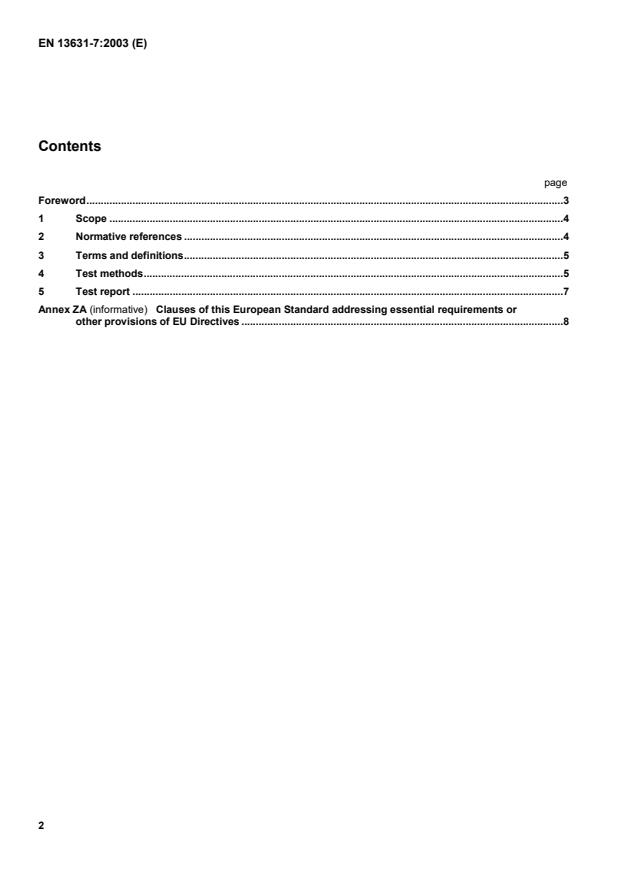
Clauses of this European Standard addressing essential requirements orother provisions of EU Directives.8
...