


EN 17942:2024
(Main)Welding and allied processes - Gas welding equipment - Safety requirements for thermoprocess equipment with open firing oxy-fuel gas welding equipment
General Information
- Abstract
This document, together with EN 746-1, EN 746-2 and EN 746-11, specifies the safety requirements for industrial thermoprocessing equipment ( IThE) with "Open firing oxy-fuel gas welding equipment", as well as the relevant gas distribution and protective systems. This document applies to IThE supplied with fuel gases. IThE in the scope of application of this document shall be able to be operated under the following ambient conditions:
- temperature range;
- during operation: +5°C to +40°C;
- during transportation and storage: -5°C to +55°C;
- relative humidity: up to 90% at 20°C, non-condensing.
This document covers the significant hazards, hazardous situations and events listed in Appendix A for oxy-fuel IThE, associated gas supply systems and protective systems on the basis that they are used as intended and under the conditions specified by the manufacturer.
This document applies to:
- gas distribution system, beginning in the direction of flow with the manually isolation main shut-off valve at the inlet of the thermoprocessing equipment;
- burner, burner assembly and ignition devices, open firing;
- Safety control system (protective system).
This document is applicable to all types of combustion of fuel gases with atmospheric air, compressed air or oxygen. This document also includes necessary requirements for user information. This document does not apply to manual burners, systems for flame spraying and micro soldering torches.
This document does not apply to systems for welding, cutting and associated processes using plasma and laser technology. This document does not cover the hazards arising as a result of the release of flammable substances from the products processed in the IThE.
This document is not applicable to electrical wiring and heavy-current wiring connected upstream of the IThE control cabinet/control panel/protective system.
Noise and optical radiation can cause significant hazards when using gas welding equipment. These are not covered in this document.
This document is not applicable to oxy-fuel IThE, associated gas supply systems and protective systems manufactured before the date of publication of this document in the Official Journal of the EU.
- Status
- Published
- Publication Date
- 10-Sep-2024
- Technical Committee
- CEN/TC 121 - Welding
- Current Stage
- 6060 - Definitive text made available (DAV) - Publishing
- Start Date
- 11-Sep-2024
- Due Date
- 05-Apr-2023
- Completion Date
- 11-Sep-2024
- Directive
- Harmonized Standard2006/42/EC - Directive 2006/42/EC of the European Parliament and of the Council of 17 May 2006 on machinery, and amending Directive 95/16/EC (recast)OJ Ref: 2025/1740, OJ L, OJ L, 2025/1740 OJ Date: 14-Aug-2025

Overview
EN 17942:2024 - published by CEN - defines safety requirements for thermoprocess equipment with open firing oxy‑fuel gas welding equipment (Industrial Thermoprocessing Equipment, IThE). It is a Type‑C machinery standard (EN ISO 12100:2010) that complements EN 746-1, EN 746-2 and ISO 13577‑4:2022. The standard covers IThE supplied with fuel gases and the associated gas distribution and protective systems under the manufacturer‑specified ambient conditions:
- Operation: +5 °C to +40 °C
- Transportation/storage: -5 °C to +55 °C
- Relative humidity: up to 90% at 20 °C, non‑condensing
EN 17942:2024 addresses significant hazards for oxy‑fuel IThE used as intended and lists exclusions such as manual torches, flame‑spraying systems, plasma/laser processes, certain mobile trolleys, upstream heavy‑current wiring and noise/optical radiation hazards.
Key topics and requirements
The standard details safety design, measures and verification for components and systems including:
- Gas distribution system starting from the manually operated main shut‑off valve
- Burner, burner assembly and ignition devices (open firing)
- Safety control systems (protective systems) including electrical/electronic control design requirements
- Flame monitoring and flame failure protection
- Gas pressure regulators, pressure and flow monitors
- Safety devices to prevent backflow and flashback
- Valve monitoring systems and mandatory safety device provisions
- Hoses, couplings, purge points, condensate drains and filters/strainers
- Stationary gas detection and alarm integration
- User information: labelling, operating instructions, commissioning, maintenance, shutdown and documentation requirements
Topics explicitly addressed in the standard include inspection/testing, labelling, start‑up/ignition procedures, safety time intervals and typical piping examples (Annexes B and C). Annex A lists relevant hazards.
Practical applications
EN 17942:2024 is used to:
- Guide the design and safe manufacture of industrial oxy‑fuel thermoprocessing systems
- Define installation and commissioning checks for production furnaces, burners and gas distribution in workshops and process plants
- Specify protective system requirements for automation and safety interlocks
- Provide required user documentation and maintenance procedures to meet regulatory compliance
Who should use this standard
- Machine and burner manufacturers
- System integrators and gas system designers
- Plant safety engineers and maintenance teams
- Regulators, notified bodies and health & safety organizations
- Procurement/specification authors for industrial heating equipment
Related standards
- EN 746‑1, EN 746‑2 (thermoprocessing safety series)
- ISO 13577‑4:2022
- EN 437 (gas test pressures and compositions) - referenced for gases
EN 17942:2024 is essential when specifying, building or certifying oxy‑fuel IThE to ensure compliant gas distribution, protective systems and safe operation.
Relations
- Effective Date
- 25-Aug-2026
- Effective Date
- 09-Feb-2026
- Effective Date
- 09-Feb-2026
- Effective Date
- 09-Feb-2026
- Effective Date
- 09-Feb-2026
- Effective Date
- 09-Feb-2026
- Effective Date
- 09-Feb-2026
- Effective Date
- 09-Feb-2026
- Effective Date
- 09-Feb-2026
- Effective Date
- 09-Feb-2026
- Effective Date
- 09-Feb-2026
- Effective Date
- 09-Feb-2026
- Effective Date
- 09-Feb-2026
- Effective Date
- 09-Feb-2026
- Effective Date
- 09-Feb-2026
Get Certified
Connect with accredited certification bodies for this standard

DVS-ZERT GmbH
German welding certification society.
CARES (UK Certification Authority for Reinforcing Steels)
UK certification for reinforcing steels and construction.
EWF/IIW (European/International Welding Federation)
International welding personnel certification.
Sponsored listings
Frequently Asked Questions
EN 17942:2024 is a standard published by the European Committee for Standardization (CEN). Its full title is "Welding and allied processes - Gas welding equipment - Safety requirements for thermoprocess equipment with open firing oxy-fuel gas welding equipment". This standard covers: This document, together with EN 746-1, EN 746-2 and EN 746-11, specifies the safety requirements for industrial thermoprocessing equipment ( IThE) with "Open firing oxy-fuel gas welding equipment", as well as the relevant gas distribution and protective systems. This document applies to IThE supplied with fuel gases. IThE in the scope of application of this document shall be able to be operated under the following ambient conditions: - temperature range; - during operation: +5°C to +40°C; - during transportation and storage: -5°C to +55°C; - relative humidity: up to 90% at 20°C, non-condensing. This document covers the significant hazards, hazardous situations and events listed in Appendix A for oxy-fuel IThE, associated gas supply systems and protective systems on the basis that they are used as intended and under the conditions specified by the manufacturer. This document applies to: - gas distribution system, beginning in the direction of flow with the manually isolation main shut-off valve at the inlet of the thermoprocessing equipment; - burner, burner assembly and ignition devices, open firing; - Safety control system (protective system). This document is applicable to all types of combustion of fuel gases with atmospheric air, compressed air or oxygen. This document also includes necessary requirements for user information. This document does not apply to manual burners, systems for flame spraying and micro soldering torches. This document does not apply to systems for welding, cutting and associated processes using plasma and laser technology. This document does not cover the hazards arising as a result of the release of flammable substances from the products processed in the IThE. This document is not applicable to electrical wiring and heavy-current wiring connected upstream of the IThE control cabinet/control panel/protective system. Noise and optical radiation can cause significant hazards when using gas welding equipment. These are not covered in this document. This document is not applicable to oxy-fuel IThE, associated gas supply systems and protective systems manufactured before the date of publication of this document in the Official Journal of the EU.
This document, together with EN 746-1, EN 746-2 and EN 746-11, specifies the safety requirements for industrial thermoprocessing equipment ( IThE) with "Open firing oxy-fuel gas welding equipment", as well as the relevant gas distribution and protective systems. This document applies to IThE supplied with fuel gases. IThE in the scope of application of this document shall be able to be operated under the following ambient conditions: - temperature range; - during operation: +5°C to +40°C; - during transportation and storage: -5°C to +55°C; - relative humidity: up to 90% at 20°C, non-condensing. This document covers the significant hazards, hazardous situations and events listed in Appendix A for oxy-fuel IThE, associated gas supply systems and protective systems on the basis that they are used as intended and under the conditions specified by the manufacturer. This document applies to: - gas distribution system, beginning in the direction of flow with the manually isolation main shut-off valve at the inlet of the thermoprocessing equipment; - burner, burner assembly and ignition devices, open firing; - Safety control system (protective system). This document is applicable to all types of combustion of fuel gases with atmospheric air, compressed air or oxygen. This document also includes necessary requirements for user information. This document does not apply to manual burners, systems for flame spraying and micro soldering torches. This document does not apply to systems for welding, cutting and associated processes using plasma and laser technology. This document does not cover the hazards arising as a result of the release of flammable substances from the products processed in the IThE. This document is not applicable to electrical wiring and heavy-current wiring connected upstream of the IThE control cabinet/control panel/protective system. Noise and optical radiation can cause significant hazards when using gas welding equipment. These are not covered in this document. This document is not applicable to oxy-fuel IThE, associated gas supply systems and protective systems manufactured before the date of publication of this document in the Official Journal of the EU.
EN 17942:2024 is classified under the following ICS (International Classification for Standards) categories: 25.160.30 - Welding equipment. The ICS classification helps identify the subject area and facilitates finding related standards.
EN 17942:2024 has the following relationships with other standards: It is inter standard links to ISO 13577-4:2022, EN 61508-6:2010, EN 60079-29-1:2016, EN 61508-3:2010, EN 61508-2:2010, EN 61508-5:2010, EN 61511-1:2017/A1:2017, EN 60204-1:2018, EN 61439-3:2012, EN 61511-3:2017, EN 62061:2005/A1:2013, EN 61508-7:2010, EN 61439-6:2012, EN 61511-1:2017, EN 61511-2:2017. Understanding these relationships helps ensure you are using the most current and applicable version of the standard.
EN 17942:2024 is associated with the following European legislation: EU Directives/Regulations: 2006/42/EC, 2014/68/EU; Standardization Mandates: M/071, M/396. When a standard is cited in the Official Journal of the European Union, products manufactured in conformity with it benefit from a presumption of conformity with the essential requirements of the corresponding EU directive or regulation.
EN 17942:2024 is available in PDF format for immediate download after purchase. The document can be added to your cart and obtained through the secure checkout process. Digital delivery ensures instant access to the complete standard document.
Standards Content (Sample)
SLOVENSKI STANDARD
01-december-2024
Varjenje in sorodni postopki - Oprema za plamensko varjenje - Varnostne zahteve
za opremo za toplotne procese z odprtim plamenom
Welding and allied processes - Gas welding equipment - Safety requirements for
thermoprocess equipment with open firing oxy-fuel gas welding equipment
Schweißen und verwandte Prozesse - Gasschweißgeräte - Sicherheitsanforderungen an
industrielle Thermoprozessanlagen mit freibrennenden Gasschweißgeräten der
Autogentechnik
Soudage et techniques connexes - Matériel de soudage aux gaz - Prescriptions de
sécurité pour les équipements thermiques avec matériel de soudage oxygaz à flamme
nue
Ta slovenski standard je istoveten z: EN 17942:2024
ICS:
25.160.30 Varilna oprema Welding equipment
2003-01.Slovenski inštitut za standardizacijo. Razmnoževanje celote ali delov tega standarda ni dovoljeno.
EN 17942
EUROPEAN STANDARD
NORME EUROPÉENNE
September 2024
EUROPÄISCHE NORM
ICS 25.160.30
English Version
Welding and allied processes - Gas welding equipment -
Safety requirements for thermoprocess equipment with
open firing oxy-fuel gas welding equipment
Soudage et techniques connexes - Matériel de soudage Schweißen und verwandte Prozesse -
aux gaz - Prescriptions de sécurité pour les Gasschweißgeräte - Sicherheitsanforderungen an
équipements thermiques avec matériel de soudage industrielle Thermoprozessanlagen mit
oxygaz à flamme nue freibrennenden Gasschweißgeräten der
Autogentechnik
This European Standard was approved by CEN on 21 July 2024.
CEN members are bound to comply with the CEN/CENELEC Internal Regulations which stipulate the conditions for giving this
European Standard the status of a national standard without any alteration. Up-to-date lists and bibliographical references
concerning such national standards may be obtained on application to the CEN-CENELEC Management Centre or to any CEN
member.
This European Standard exists in three official versions (English, French, German). A version in any other language made by
translation under the responsibility of a CEN member into its own language and notified to the CEN-CENELEC Management
Centre has the same status as the official versions.
CEN members are the national standards bodies of Austria, Belgium, Bulgaria, Croatia, Cyprus, Czech Republic, Denmark, Estonia,
Finland, France, Germany, Greece, Hungary, Iceland, Ireland, Italy, Latvia, Lithuania, Luxembourg, Malta, Netherlands, Norway,
Poland, Portugal, Republic of North Macedonia, Romania, Serbia, Slovakia, Slovenia, Spain, Sweden, Switzerland, Türkiye and
United Kingdom.
EUROPEAN COMMITTEE FOR STANDARDIZATION
COMITÉ EUROPÉEN DE NORMALISATION
EUROPÄISCHES KOMITEE FÜR NORMUNG
CEN-CENELEC Management Centre: Rue de la Science 23, B-1040 Brussels
© 2024 CEN All rights of exploitation in any form and by any means reserved Ref. No. EN 17942:2024 E
worldwide for CEN national Members.
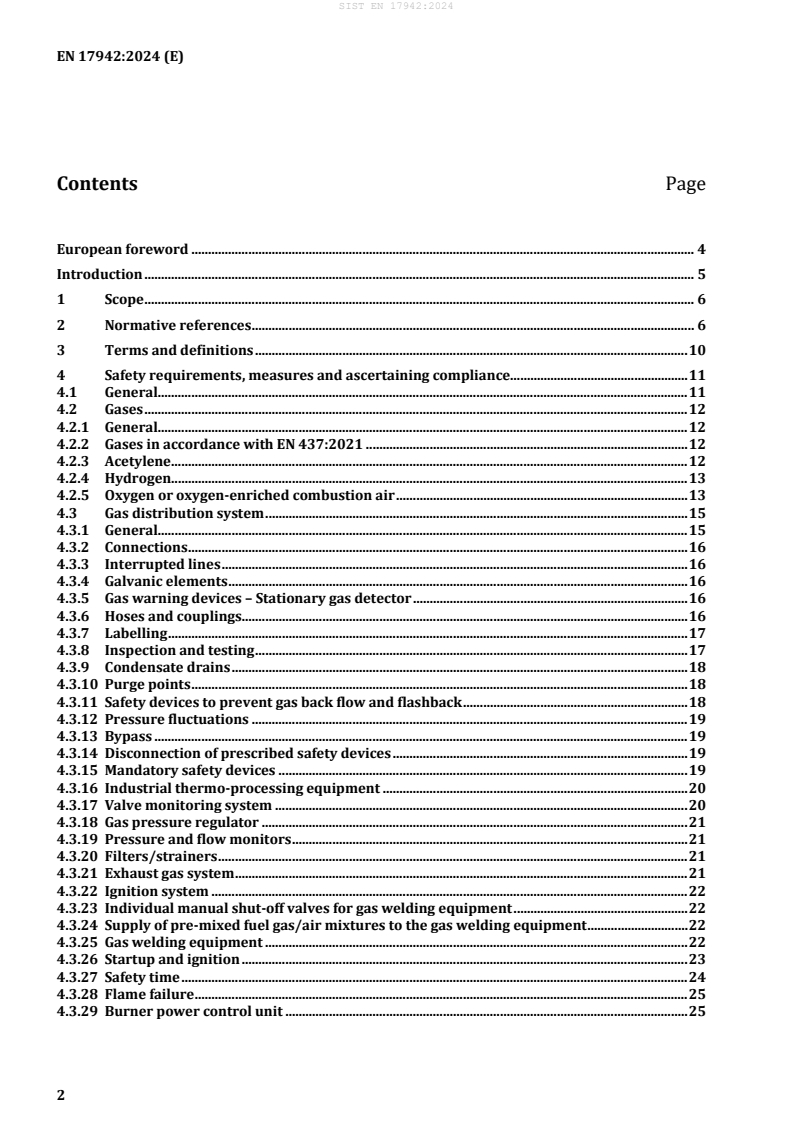
Contents Page
European foreword . 4
Introduction . 5
1 Scope . 6
2 Normative references . 6
3 Terms and definitions . 10
4 Safety requirements, measures and ascertaining compliance . 11
4.1 General. 11
4.2 Gases . 12
4.2.1 General. 12
4.2.2 Gases in accordance with EN 437:2021 . 12
4.2.3 Acetylene . 12
4.2.4 Hydrogen. 13
4.2.5 Oxygen or oxygen-enriched combustion air . 13
4.3 Gas distribution system . 15
4.3.1 General. 15
4.3.2 Connections . 16
4.3.3 Interrupted lines . 16
4.3.4 Galvanic elements . 16
4.3.5 Gas warning devices – Stationary gas detector . 16
4.3.6 Hoses and couplings. 16
4.3.7 Labelling . 17
4.3.8 Inspection and testing . 17
4.3.9 Condensate drains . 18
4.3.10 Purge points . 18
4.3.11 Safety devices to prevent gas back flow and flashback . 18
4.3.12 Pressure fluctuations . 19
4.3.13 Bypass . 19
4.3.14 Disconnection of prescribed safety devices . 19
4.3.15 Mandatory safety devices . 19
4.3.16 Industrial thermo-processing equipment . 20
4.3.17 Valve monitoring system . 20
4.3.18 Gas pressure regulator . 21
4.3.19 Pressure and flow monitors . 21
4.3.20 Filters/strainers . 21
4.3.21 Exhaust gas system . 21
4.3.22 Ignition system . 22
4.3.23 Individual manual shut-off valves for gas welding equipment . 22
4.3.24 Supply of pre-mixed fuel gas/air mixtures to the gas welding equipment . 22
4.3.25 Gas welding equipment . 22
4.3.26 Startup and ignition . 23
4.3.27 Safety time . 24
4.3.28 Flame failure . 25
4.3.29 Burner power control unit . 25
4.3.30 Flame monitoring . 26
5 Requirements to the design of electrical and electronic equipment for control and
protective systems . 26
6 Checking of safety requirements and/or measures . 27
7 User information . 30
7.1 Labelling . 30
7.2 Operating instructions . 30
7.3 Description of the IThE . 31
7.4 Checking procedure . 31
7.5 Commissioning . 31
7.6 Shutdown procedure . 32
7.7 Maintenance procedure . 32
7.8 Documentation . 32
Annex A (informative) List of hazards . 33
Annex B (informative) Typical examples of industrial thermoprocessing equipment, gas welding
equipment . 35
Annex C (informative) Typical examples of piping diagrams . 36
Annex ZA (informative) Relationship between this European Standard and the essential
requirements of EU Directive 2006/42/EC aimed to be covered . 41
Bibliography . 43
European foreword
This document (EN 17942:2024) has been prepared by Technical Committee CEN/TC 121 “Welding and
allied processes”, the secretariat of which is held by AFNOR.
This European Standard shall be given the status of a national standard, either by publication of an
identical text or by endorsement, at the latest by March 2025, and conflicting national standards shall be
withdrawn at the latest by March 2025.
Attention is drawn to the possibility that some of the elements of this document may be the subject of
patent rights. CEN shall not be held responsible for identifying any or all such patent rights.
This document has been prepared under a standardization request addressed to CEN by the European
Commission. The Standing Committee of the EFTA States subsequently approves these requests for its
Member States.
For relationship with EU Legislation, see informative Annex ZA, which is an integral part of this document.
Any feedback and questions on this document should be directed to the users’ national standards body.
A complete listing of these bodies can be found on the CEN website.
According to the CEN-CENELEC Internal Regulations, the national standards organisations of the
following countries are bound to implement this European Standard: Austria, Belgium, Bulgaria, Croatia,
Cyprus, Czech Republic, Denmark, Estonia, Finland, France, Germany, Greece, Hungary, Iceland, Ireland,
Italy, Latvia, Lithuania, Luxembourg, Malta, Netherlands, Norway, Poland, Portugal, Republic of North
Macedonia, Romania, Serbia, Slovakia, Slovenia, Spain, Sweden, Switzerland, Türkiye and the United
Kingdom.
Introduction
This document is a type-C standard as stated in EN ISO 12100:2010.
This document is of relevance, in particular, for the following stakeholder groups representing the market
players with regard to machinery safety:
— machine manufacturers (small, medium and large enterprises);
— health and safety bodies (regulators, accident prevention organizations, market surveillance etc.).
Others can be affected by the level of machinery safety achieved with the means of the document by the
above-mentioned stakeholder groups:
— machine users/employers (small, medium and large enterprises);
— machine users/employees (e.g. trade unions, organizations for people with special needs);
— service providers, e.g. for maintenance (small, medium and large enterprises);
— consumers (in case of machinery intended for use by consumers).
The above-mentioned stakeholder groups have been given the possibility to participate at the drafting
process of this document.
The machinery concerned and the extent to which hazards, hazardous situations or hazardous events are
covered are indicated in the scope of this document.
When requirements of this type-C standard are different from those which are stated in type-A or type-B
standards, the requirements of this type-C standard take precedence over the requirements of the other
standards for machines that have been designed and built according to the requirements of this type-C
standard.
This document assumes that the equipment does not generate a potentially explosive atmosphere and is
located in an area with normal ventilation.
Even in the case of compliance with European product standards, e.g. EN 267, EN 12952-8, EN 12953-7
or EN 676, it is possible that the minimum safety requirements for IThE are not met. This document is
intended to be applied to Industrial Thermoprocessing Equipment with open firing oxy-fuel gas welding
equipment.
Thermoprocessing equipment (IThE) generally comprises the following components:
• gas distribution system, beginning in the direction of flow with the manually isolation main shut-off
valve at the inlet of the thermoprocessing equipment;
• burner, burner assembly and ignition system, open firing;
• safety control system (protective system).
1 Scope
This document, together with EN 746-1:1997+A1:2009, EN 746-2:2010 and ISO 13577-4:2022, specifies
the safety requirements for industrial thermoprocessing equipment “Open firing oxy-fuel gas welding
equipment”, as well as the relevant gas distribution and protective systems. (Industrial thermoprocessing
equipment is referred below as “IThE”).
This document applies to IThE supplied with fuel gases. Annex B contains examples of typical IThE.
This document covers the significant hazards, hazardous situations and events listed in Annex A for oxy-
fuel IThE, associated gas supply systems and protective systems on the basis that they are used as
intended and under the conditions specified by the manufacturer.
This document applies to:
• gas distribution system, beginning in the direction of flow with the manually isolation main shut-off
valve at the inlet of the thermoprocessing equipment;
• burner, burner assembly and ignition devices, open firing;
• safety control system (protective system).
This document is applicable to all types of combustion of fuel gases with atmospheric air, compressed air
or oxygen.
This document also includes necessary requirements for user information.
This document does not apply to manual burners, systems for flame spraying and micro soldering
torches.
This document does not apply to systems for welding, cutting and associated processes using plasma and
laser technology. This document does not cover the hazards arising as a result of the release of flammable
substances from the products processed in the IThE.
This document does not apply to equipped mobile trolleys which include oxygen and fuel gas cylinders
with pressure regulators and welding or cutting torches.
This document is not applicable to electrical wiring and heavy-current wiring connected upstream of the
IThE control cabinet/control panel/protective system.
Noise and optical radiation can cause significant hazards when using gas welding equipment. These are
not covered in this document.
This document is applicable to oxy-fuel IThE, associated gas supply systems and protective systems
manufactured after the date of publication of this document in the Official Journal of the EU.
2 Normative references
The following documents are referred to in the text in such a way that some or all of their content
constitutes requirements of this document. For dated references, only the edition cited applies. For
undated references, the latest edition of the referenced document (including any amendments) applies.
EN 88-1:2022+A1:2023, Safety and control devices for gas burners and gas burning appliances - Part 1:
Pressure regulators for inlet pressures up to and including 50 kPa
EN 88-2:2022, Safety and control devices for gas burners and gas burning appliances - Part 2: Pressure
regulators for inlet pressures above 50 kPa up to and including 500 kPa
EN 88-3:2022, Safety and control devices for gas burners and gas burning appliances - Part 3: Pressure
and/or flow rate regulators for inlet pressures up to and including 500 kPa, electronic types
EN 125:2022, Flame supervision devices for gas burning appliances - Thermoelectric flame supervision
devices
EN 161:2022, Automatic shut-off valves for gas burners and gas appliances
EN 298:2022, Automatic burner control systems for burners and appliances burning gaseous or liquid fuels
EN 331:2015, Manually operated ball valves and closed bottom taper plug valves for gas installations for
buildings
EN 334:2019, Gas pressure regulators for inlet pressure up to 10 MPa (100 bar)
EN 437:2021, Test gases - Test pressures - Appliance categories
EN 560:2018, Gas welding equipment - Hose connections for equipment for welding, cutting and allied
processes
EN 561:2002, Gas welding equipment - Quick-action coupling with shut-off valves for welding, cutting and
allied processes
EN 746-1:1997+A1:2009, Industrial thermoprocessing equipment - Part 1: Common safety requirements
for industrial thermoprocessing equipment
EN 746-2:2010, Industrial thermoprocessing equipment — Part 2: Safety requirements for combustion and
fuel handling systems
EN 1256:2006, Gas welding equipment - Specification for hose assemblies for equipment for welding, cutting
and allied processes
EN 1643:2022, Safety and control devices for burners and appliances burning gaseous and/or liquid fuels -
Valve proving systems for automatic shut-off valves
EN 1854:2022+A1:2023, Safety and control devices for burners and appliances burning gaseous and/or
liquid fuels - Pressure sensing devices for gas burners and gas burning appliances
EN 60079-29-1:2016, Explosive atmospheres - Part 29-1: Gas detectors - Performance requirements of
detectors for flammable gases
EN 60204-1:2018, Safety of machinery - Electrical equipment of machines - Part 1: General requirements
EN IEC 61439-1:2021, Low-voltage switchgear and controlgear assemblies - Part 1: General rules
EN IEC 61439-2:2021, Low-voltage switchgear and controlgear assemblies - Part 2: Power switchgear and
controlgear assemblies
EN 61439-3:2012, Low-voltage switchgear and controlgear assemblies — Part 3: Distribution boards
intended to be operated by ordinary persons (DBO) (IEC 61439-3:2012)
EN 61439-4:2013, Low-voltage switchgear and controlgear assemblies - Part 4: Particular requirements
for assemblies for construction sites (ACS)
Document impacted by AC:2019.
EN 61439-5:2015, Low-voltage switchgear and controlgear assemblies - Part 5: Assemblies for power
distribution in public networks
EN 61439-6:2012, Low-voltage switchgear and controlgear assemblies - Part 6: Busbar trunking systems
(busways)
EN 61508-1:2010, Functional safety of electrical/electronic/programmable electronic safety-related
systems - Part 1: General requirements
EN 61508-2:2010, Functional safety of electrical/electronic/programmable electronic safety-related
systems - Part 2: Requirements for electrical/electronic/programmable electronic safety-related systems
EN 61508-3:2010, Functional safety of electrical/electronic/programmable electronic safety-related
systems - Part 3: Software requirements
EN 61508-4:2010, Functional safety of electrical/electronic/programmable electronic safety-related
systems - Part 4: Definitions and abbreviations
EN 61508-5:2010, Functional safety of electrical/electronic/programmable electronic safety-related
systems - Part 5: Examples of methods for the determination of safety integrity levels
EN 61508-6:2010, Functional safety of electrical/electronic/programmable electronic safety-related
systems - Part 6: Guidelines on the application of IEC 61508-2 and IEC 61508-3
EN 61508-7:2010, Functional safety of electrical/electronic/programmable electronic safety-related
systems - Part 7: Overview of techniques and measures
EN 61511-1:2017, Functional safety — Safety instrumented systems for the process industry sector —
Part 1: Framework, definitions, system, hardware and application programming Requirements
(IEC 61511-1:2016)
EN 61511-2:2017, Functional safety - Safety instrumented systems for the process industry sector - Part 2:
Guidelines for the application of IEC 61511-1
EN 61511-3:2017, Functional safety - Safety instrumented systems for the process industry sector - Part 3:
Guidance for the determination of the required safety integrity levels
EN 62061:2005, Safety of machinery — Functional safety of safety-related electrical, electronic and
programmable electronic control systems (IEC 62061:2005)
EN IEC/IEEE 82079-1:2020, Preparation of information for use (instructions for use) of products — Part 1:
Principles and general requirements (IEC/IEEE 82079-1:2019)
EN ISO 2503:2009, Gas welding equipment — Pressure regulators and pressure regulators with flow-
metering devices for gas cylinders used in welding, cutting and allied processes up to 300 bar (30 MPa)
(ISO 2503:2009)
EN ISO 3821:2019, Gas welding equipment - Rubber hoses for welding, cutting and allied processes (ISO
3821:2019, Corrected version 2021-05)
Document impacted by A1:2017.
Document impacted by Cor.:2010, A1:2013 and A2:2015.
Document impacted by A1:2015.
EN ISO 4126-1:2013, Safety devices for protection against excessive pressure — Part 1: Safety valves
(ISO 4126-1:2013)
EN ISO 5171:2019, Gas welding equipment - Pressure gauges used in welding, cutting and allied processes
(ISO 5171:2019)
EN ISO 5172:2006, Gas welding equipment — Blowpipes for gas welding, heating and cutting —
Specifications and tests (ISO 5172:2006)
EN ISO 5175-1:2017, Gas welding equipment - Safety devices - Part 1: Devices incorporating a flame
(flashback) arrestor (ISO 5175-1:2017)
EN ISO 5175-2:2017, Gas welding equipment - Safety devices - Part 2: Devices not incorporating a flame
(flashback) arrestor (ISO 5175-2:2017, Corrected version 2019-01)
EN ISO 7291:2010, Gas welding equipment — Pressure regulators for manifold systems used in welding,
cutting and allied processes up to 30 MPa (300 bar) (ISO 7291:2010)
EN ISO 9012:2023, Gas welding equipment - Air-aspirated hand blowpipes - Specifications and tests (ISO
9012:2023)
EN ISO 9090:2019, Gas tightness of equipment for gas welding and allied processes (ISO 9090:2019)
EN ISO 9539:2010, Gas welding equipment — Materials for equipment used in gas welding, cutting and
allied processes (ISO 9539:2010)
EN ISO 9606-1:2017, Qualification testing of welders - Fusion welding - Part 1: Steels (ISO 9606-1:2012
including Cor 1:2012 and Cor 2:2013)
EN ISO 11114-1:2020, Gas cylinders - Compatibility of cylinder and valve materials with gas contents - Part
1: Metallic materials (ISO 11114-1:2020)
EN ISO 11114-2:2021, Gas cylinders - Compatibility of cylinder and valve materials with gas contents - Part
2: Non-metallic materials (ISO 11114-2:2021)
EN ISO 12100:2010, Safety of machinery - General principles for design - Risk assessment and risk reduction
(ISO 12100:2010)
EN ISO 13585:2012, Brazing - Qualification test of brazers and brazing operators (ISO 13585:2012)
EN ISO 13849-1:2023, Safety of machinery - Safety-related parts of control systems - Part 1: General
principles for design (ISO 13849-1:2023)
EN ISO 13849-2:2012, Safety of machinery - Safety-related parts of control systems - Part 2: Validation (ISO
13849-2:2012)
EN ISO 14114:2018, Gas welding equipment - Acetylene manifold systems for welding, cutting and allied
processes - General requirements (ISO 14114:2017)
Document impacted by A1:2016.
Document impacted by A1:2012 and A2:2015.
Document impacted by A1:2015.
Document impacted by A1:2013.
EN ISO 14731:2019, Welding coordination - Tasks and responsibilities (ISO 14731:2019)
EN ISO 15296:2018, Gas welding equipment - Vocabulary (ISO 15296:2017)
ISO 13574:2015, Industrial furnaces and associated processing equipment — Vocabulary
ISO 13577-4:2022, Industrial furnaces and associated processing equipment — Safety — Part 4: Protective
systems
3 Terms and definitions
For the purposes of this document, the terms and definitions given in EN ISO 12100:2010,
ISO 13574:2015, EN ISO 15296:2018, EN 746-1:1997+A1:2009, EN 746-2:2010 and the following apply.
ISO and IEC maintain terminological databases for use in standardization at the following addresses:
• ISO Online browsing platform: available at https://www.iso.org/obp
• IEC Electropedia: available at http://www.electropedia.org/
3.1
open firing oxy-fuel gas welding equipment
equipment in accordance with EN ISO 5172:2006 or EN ISO 9012:2023 for heating and processing
materials or workpieces via open firing burning using a fuel gas/oxygen mixture or fuel gas/air mixture
Note 1 to entry: The addition of “open firing” is dropped in the following part of the document.
3.2
automated industrial thermoprocessing equipment
IThE
IThE where all thermal, mechanical and control-related processes can be controlled via PLC, NC or CNC
Note 1 to entry: The entire process is self-monitoring. The thermal power of the IThE can be controlled
automatically or manually. Otherwise, the IThE includes the majority of gas distribution systems, gas welding
equipment, ignition devices and safety-related control systems listed in the scope of application.
3.3
gas warning device
device that uses sensors to detect and indicate the presence of a fuel gas/air mixture and initiates a safety
shutdown at or before 25 % of the lower explosion limit (LEL)
3.4
air/fuel gas ratio; oxygen/fuel gas ratio
ratio of the masses/flow rates of combustion air/oxygen and fuel gas
3.5
safety shut-down
establishing of a safe state of the IThE in the shortest possible time without compromising the safety of
the IThE or the environment
3.6
PS
maximum allowable pressure
3.7
blowpipe with external mixing
blowpipe in which oxygen and fuel gas are separately passed through the blowpipe head
3.8
ignition device
separate energy source inside or at the blowpipe ensuring the safe ignition of fuel gas mixtures escaping
from the orifice outlets
4 Safety requirements, measures and ascertaining compliance
4.1 General
EN 746-1:1997+A1:2009 provides the general safety requirements common to automated industrial
thermoprocessing equipment (IThE). This document details in addition specific safety requirements for
industrial thermoprocessing equipment with “open firing oxy-fuel gas welding equipment”, as well as the
relevant gas distribution and protective systems. A list of hazards is given in Annex A, Table A.1. Annex C,
Figures C.1 to C.4 show typical examples of piping diagrams for the IThEs under the scope of this
document.
IThE in the scope of application of this document shall be able to be operated under the following ambient
conditions:
— temperature range:
— during operation: +5 °C to +40 °C;
— during transportation and storage: −5 °C to +55 °C;
— relative humidity: up to 90 % at 20 °C, non-condensing.
The safety objectives of this document include:
a) selection of materials so that the design and operation of the system is not compromised.
All components of the fuel gas piping in particular shall withstand the mechanical, chemical and
thermal loads to which they may be exposed during normal operation and any foreseeable abnormal
operation (e.g. ascertained during a safety assessment);
b) the equipment (IThE) shall only be operated and maintained by instructed personnel;
c) reliable and correct time for ignition of the oxygen (air)/fuel gas mixture at the burner(s);
d) prevention of unintentional release of unburned fuel gases;
e) fuel gas, air and oxygen shut-off in the event of a relevant malfunction;
f) protection of the piping to prevent flame propagation in the reverse direction to the direction of flow;
g) prevention of ignition if the extraction of exhaust gas/combustion products is not ensured;
h) prevention of ignition if the process conditions are not in a safe state;
i) electrical circuits shall be designed in accordance with EN 60204-1:2018.
A risk assessment shall be carried out in accordance with EN ISO 12100:2010.
The safety control system shall be designed in accordance with ISO 13577-4:2022, including the
application of the standards for functional safety EN 62061:2005, EN ISO 13849-1:2023,
EN ISO 13849-2:2012, EN 61511-1:2017, EN 61511-2:2017, EN 61511-3:2017 and EN 61508-1:2010,
EN 61508-2:2010, EN 61508-3:2010, EN 61508-4:2010, EN 61508-5:2010, EN 61508-6:2010 and
EN 61508-7:2010. ISO 13577-4:2022, Annex C provides information about determining the Safety
Integrity Level (SIL) or Performance Level (PL) of safety-related functions specified in this document.
4.2 Gases
4.2.1 General
Compatibility of the materials used shall be checked in accordance with EN ISO 11114-1:2020,
EN ISO 11114-2:2021, and EN ISO 9539:2010.
4.2.2 Gases in accordance with EN 437:2021
For gases in accordance with EN 437:2021, the specifications in accordance with EN 746-2:2010, 5.2.1.1
and EN ISO 9539:2010 apply.
4.2.3 Acetylene
4.2.3.1 General
When using acetylene as a fuel gas, additional safety requirements shall be taken into consideration. The
maximum allowable pressure PS in distribution systems shall not exceed 1,5 bar (0,15 MPa).
As acetylene is an unstable gas, piping that falls into Category I and II in accordance with
PED 2014/68/EU Annex II, Table 6 shall be classified as Category III.
4.2.3.2 Suitability for use of acetylene
If acetylene is used as a fuel gas for IThE, the components and non-metallic and metallic materials used
shall meet the special requirements in accordance with EN ISO 9539:2010. Materials made from copper
alloys with a copper content of more than 70 % shall not be used, as copper acetylide can form, which is
highly explosive. For filters, strainers and other parts with large surfaces in contact with acetylene, even
copper alloys with less than 70 % copper content shall not be used.
4.2.3.3 Sealing materials for acetylene distribution systems
Sealing materials shall be sufficiently resistant to the solvents acetone and dimethylformamide (DMF) for
the use of acetylene in accordance with EN ISO 9539:2010.
4.2.3.4 Pipe systems
Piping for acetylene shall be designed for the occurring pressure loads. Special design and sizing
requirements for acetylene as an unstable gas shall be observed.
The test pressure for the strength test prior to initial commissioning is at least 24 bar (2,4 MPa) in
accordance with EN ISO 14114:2018, 5.1 for acetylene distribution lines. Welding work shall be carried
out by qualified welders in accordance with EN ISO 9606-1:2017 under the supervision of welding
supervisors in accordance with EN ISO 14731:2019.
Brazing work shall be carried out by qualified brazing operators in accordance with EN ISO 13585:2012.
4.2.3.5 Equipment parts
All equipment parts, such as shut-off valves and pressure gauges, shall be suitable for the occurring
operating conditions, e.g. pressure, temperature, solvents, vibrations.
Pressure measuring devices (pressure gauges) for acetylene shall be labelled “Acetylene” or marked with
the letter “A” in accordance with EN ISO 5171:2019.
Tapping points shall be equipped with safety devices in accordance with EN ISO 5175-1:2017.
4.2.3.6 Safety valve
When using a manifold pressure regulator, in accordance with EN ISO 7291:2010 with a relief valve,
declared as part of pressure maintaining equipment, a safety valve shall be integrated into the piping
system downstream of the manifold system.
A risk analysis shall be carried out in order to determine the need to add a safety valve. The sizing data
for the safety valve downstream of the manifold system is based on the pressure regulator failure
scenario. For this purpose, the manufacturer of the manifold system shall communicate the values of Q
max
and P in this case.
max
The safety valve shall be designed in accordance with EN ISO 4126-1:2013.
When using a pressure regulator according to EN ISO 7291:2010 with a pressure relief valve confirmed
as a piece of equipment with a safety function, the installation of a safety valve is not required.
4.2.4 Hydrogen
4.2.4.1 General
Hydrogen in combustion with oxygen/compressed air is non-luminous and not easily detectable by
human eye. To avoid danger to health personal protective equipment (PPE) shall be used.
4.2.4.2 Suitability for use of hydrogen
In the case of pipes made of metallic materials, e.g. carbon steel, stainless steel (e.g. 1.4301 and 1.4541 as
in EN 10027-2:2015) or aluminium, the risk of embrittlement shall be taken into consideration.
4.2.4.3 Tightness testing of pipe systems for hydrogen
Tightness testing of the pipe systems during initial commissioning shall be carried out using helium.
4.2.5 Oxygen or oxygen-enriched combustion air
4.2.5.1 General
Oxygen or oxygen-enriched air may only be released in a safe well ventilated area if absolutely essential.
Hazards relating to the use and handling of oxygen shall be specified in the operating instructions.
4.2.5.2 Suitability for use of oxygen
If oxygen is used in IThE, the components, as well as the workpieces and materials used, shall be suitable
for oxygen service.
Materials coming into contact with oxygen shall be adequately and suitably cleaned before startup and
any flammable substances shall be removed (e.g. dust, grease, material residue, cleaning agent).
NOTE EN ISO 23208 contains information about the cleanliness of oxygen systems. With regard to the selection
and compatibility of materials and gases (including oxygen), also see EN 1797.
The materials listed in Table 1 (depending on the location of installation and the pressure) are suitable
for use with oxygen or combustion air enriched with oxygen in the operating range of −10 °C to +200 °C.
Fittings for gaseous oxygen at an operating temperature of more than 200 °C or less than −10 °C shall be
made from materials suitable for these conditions.
Table 1 — Material requirements
1 Pressure range (bar) Materials for enclosures, inbuilt parts and seals
2 Greater than 16 bar (1,6 MPa) Copper, copper alloys with a copper percentage by mass of at
least 55 %
Nickel, wrought nickel alloys with copper
High-alloy Cr-Ni steels with a total Cr and Ni percentage by mass
of at least 22 %
High-alloy Cr-Si steels with a Cr percentage by mass of at least
22 %
3 0 bar to 16 bar (1,6 MPa) Copper, copper alloys with a copper percentage by mass of at
least 55 %,
Nickel, wrought nickel alloys with copper
High-alloy Cr-Ni steels with a total Cr and Ni percentage by mass
of at least 22 %
High-alloy Cr-Si steels with a Cr percentage by mass of at least
22 %
Cast iron, at least grade GG 25, ductile cast iron, at least grade
GGG 40
4 0 bar to 10 bar (1,0 MPa) Copper, copper alloys with a copper percentage by mass of at
least 55 %,
Nickel, wrought nickel alloys with copper
High-alloy Cr-Ni steels with a total Cr and Ni percentage by mass
of at least 22 %
High-alloy Cr-Si steels with a Cr percentage by mass of at least
22 %
Cast iron, at least grade GG 25, ductile cast iron, at least grade
GGG 40
All other metallic materials except titanium, zirconium and their
alloys
4.2.5.3 Sealing materials for oxygen distribution systems
Sealing materials shall be suitable for the application of oxygen at specific pressure levels and operating
temperatures, and for specific installation processes, and shall comply with the relevant safety
requirements.
Suitable metallic sealing materials for oxygen distribution systems are specified in Table 1, column 3.
4.2.5.4 Pipe systems
The design and materials of the pipe systems, and their equipment parts and connections shall be suitable
for oxygen service and for the intended pressures and temperatures.
Gaseous oxygen shall not hit pipe walls in the pipe system at a perpendicular angle.
The following flow rates shall not be exceeded at temperatures between −10 °C and +200 °C:
a) for pipe systems made of non-alloy and stainless steels:
1) at a pressure below 12 bar (1,2 MPa): 30 m/s (incident or non-incident flow);
2) at a pressure above 12 bar (1,2 MPa): 8 m/s (incident or non-incident flow);
b) for pipe systems made of copper, nickel and copper/nickel alloys at pressures up to 65 bar (6,5 MPa):
no speed limit.
For the oxygen piping, downstream of pressure reduction or control valves, over a minimum length
of 8 times the pipe diameter, a straight pipe section shall be installed, which shall be made:
c) for pressures below 12 bar (1,2 MPa) from stainless steel (with a wall thickness greater than 3 mm),
or Cu, Ni, Cu-Ni alloys;
d) for pressures above 12 bar (1,2 MPa) from Cu, Ni or Cu-Ni alloys.
One or more filters shall be installed at the inlet of the oxygen pipes to prevent the ingress of any
contamination (e.g. rust). Filters and/or strainers shall be checked at intervals to be set out in the
operating instructions.
4.2.5.5 Equipment parts
The design, configuration and materials of the equipment parts for gaseous oxygen, e.g. safety shut-off
valves, control devices and non-return valves, shall be suitable for oxygen service at the intended
pressures (see Table 1) and temperatures.
Suitable materials for enclosures and internal parts of the equipment parts, as well as for their sealants,
are specified in Table 1.
4.3 Gas distribution system
4.3.1 General
Safety objectives of this document are:
a) the material selection shall not compromise the safety, design and function of the system;
b) all components of the IThE shall withstand the mechanical, chemical and thermal loads to which they
may be exposed under normal operating conditions;
c) with regard to specific requirements for materials based on the gases used, see EN ISO 9539:2010;
d) allowed ignition times for the fuel gas/air mixture or fuel gas/oxygen mixture at the burner(s) shall
be observed;
e) unintentional discharge of fuel gases and/or oxygen shall be prevented;
f) shut-off of gas lines in the event of a gas or power failure;
g) protection of the line system by preventing flame propagation, and/or stopping flashback;
h) combustion shall be prevented if the extraction of combustion products is not ensured;
i) combustion shall be prevented if conditions for the process are not safe;
j) a safe state shall be maintained even in the event of a failure of one of the safety-related systems;
k) electrical devices shall be designed in accordance with EN IEC 61439-1:2021, EN IEC 61439-2:2021,
EN 61439-3:2012, EN 61439-4:2013, EN 61439-5:2015, EN 61439-6:2012 and EN 60204-1:2018;
l) compliance with the required measures can generally be ascertained by a simple visual check;
m) if deviating tests/checks apply, these will be specified in the following sub-sections;
n) the IThE shall also comply with EN ISO 12100:2010 with regard to hazards not covered in this
document.
NOTE Annex A contains a list of the hazards.
4.3.2 Connections
In addition to the stipulations in accordance with EN 746-2:2010, 5.2.1.2, the following requirements
apply:
a) brazed joints as connections of gas lines are allowed;
b) crimp connections are only permitted for fuel gases and oxygen or oxygen-enriched air if proof of
suitability for the application has been provided by the m
...