

prEN 17059
(Main)Plating and anodizing lines - Safety requirements
- Abstract
This document describes all significant hazards, hazardous situations and events relating to plating and anodizing lines, when used as intended and in compliance with the foreseeable conditions of the manufacturer. In addition, procedures for testing and measuring safety requirements, marking of equipment and minimum operation requirements are specified.
For reference to plating lines and anodizing lines, the term plating line is used in this document.
This document applies to the design and construction of plating lines and anodizing lines, including its transporter systems, for surface treatment of industrial products by means of inorganic or organic electrolytes or by means of other process chemistries.
Plating lines and anodizing lines in terms of this document are arrangements of process tanks for:
- electrolytic treatment of workpieces (e.g. electrocleaning, passivation, electroetching, burnishing, electrolytic polishing and brightening);
- wet chemical treatment of workpieces (e.g. degreasing, passivation, chemical polishing, etching, pickling, blackening);
- electrolytic and electro-less metal deposition, even on non-metallic workpieces made electrically conductive by corresponding treatment;
- changing of substance composition on the surface of metallic workpieces, e.g. burnishing, blackening, phosphating, chromating; and
- anodizing (anodic oxidation);
including rinsing tanks, the corresponding transporter equipment (e.g. transporter systems, handling gantry, bean, etc.), where the products are lifted in and out of tanks, and drying equipment.
This document distinguishes between the following types of plating lines:
- Type 1: manual lines;
- Type 2: semi-automatic lines;
- Type 3: fully automatic lines.
Furthermore, it specifies equipment marking and requirements on user information.
This document does not deal with hazards resulting from plating lines parts above category 1 of PED (Pressure Equipment Directive).
This document is not applicable to:
- transporter systems of carrousel lines (see EN 618:2002+A1:2010 and EN 15095:2007+A1:2008);
- equipment for the preparation and treatment of water and wastewater;
- machinery for dip coating and electro-deposition of organic liquid coating material (see EN 12581:2005+A1:2010);
- horizontal plating lines (e.g. printed circuit board, etching, reel to reel, continuous plating lines);
- machinery for surface cleaning and surface pre-treatment of industrial items using liquids or vapours (EN 12921 1:2005+A1:2010, EN 12921 2:2005+A1:2008, EN 12921 3:2005+A1:2008, EN 12921 4:2005+A1:2008).
NOTE Machinery for surface cleaning and surface pre-treatment (see EN 12921 series) could be part of a plating line.
- Status
- Not Published
- Publication Date
- 13-Jul-2027
- Technical Committee
- CEN/TC 271 - Surface treatment equipment - Safety
- Drafting Committee
- CEN/TC 271/WG 6 - Electroplating equipment - Safety

prEN 17059 is a draft European Standard from CEN on safety requirements for plating and anodizing lines. It specifies how these lines are to be designed, built, tested, marked, and documented so that significant hazards are controlled during intended use and foreseeable misuse. The document applies to manual, semi-automatic, and fully automatic plating lines used for surface treatment of industrial products.
What does prEN 17059 specify?
prEN 17059 specifies safety requirements for plating lines and anodizing lines, with “plating line” used as the common term throughout the document. It covers the design and construction of complete lines, including transporter systems, process tanks, rinsing tanks, drying equipment, marking, testing, and minimum information for use.
The scope covers arrangements of process tanks for electrolytic treatment, wet chemical treatment, electrolytic and electroless metal deposition, surface composition changes such as phosphating and chromating, and anodizing. It also covers the transporter equipment that lifts workpieces in and out of tanks, such as hoists, gantries, and similar handling systems.
The document distinguishes three line types:
- Type 1: manual lines
- Type 2: semi-automatic lines
- Type 3: fully automatic lines
It also excludes several related machine types and systems, including carrousel line transporter systems, water and wastewater treatment equipment, dip coating and electro-deposition of organic liquid coating material, horizontal plating lines, and machinery for surface cleaning and pre-treatment using liquids or vapours.
| Annex | What it covers |
|---|---|
| Annex A | Significant hazards, hazardous situations, and events |
| Annex B | Examples of transporter units |
| Annex C | Examples of working areas |
| Annex D | Calculation of required minimum air flow rates for tanks, hoods, tunnels, and transporter systems |
| Annex E | Required minimum air capture velocities for main plating and anodizing processes |
| Annex F | Energy-efficiency and reduction of environmental impact |
| Annex ZA | Relationship to Regulation (EU) 2023/1230 |
What are the key requirements of prEN 17059?
prEN 17059 sets out a complete safety package for plating lines: general machine design rules, mechanical and electrical safeguards, thermal and chemical hazard control, fire protection, functional safety, verification methods, and user information. The practical aim is to reduce risk across the whole life of the line, from design through maintenance and dismantling.
General design and lifecycle approach
Clause 4.1 requires plating lines to meet the safety requirements in Clause 4 and to follow EN ISO 12100:2010 on risk assessment and risk reduction. It also requires ergonomic design to follow EN 13861:2011. In practice, this means the line must be designed as a whole system, not as a set of separate machines.
Clause 4.1 also says that incorporated components such as heaters, rectifiers, pumps, and conveyors shall comply with the relevant European Standards. This matters because the safety of the complete line depends on the safety of the integrated parts.
Mechanical, electrical, and thermal protection
Clause 4.2 covers mechanical hazards such as shearing, crushing, cutting, drawing-in, impact, stability loss, entanglement, entrapment, slipping, tripping, falling, and pressurized materials. A specific practical point is that process tanks must resist corrosion, brittleness, and ageing from the chemicals used, and overfilling must be prevented by level-control, warning, overflow outlets, marking, and instruction information.
Clause 4.3 covers electrical hazards, including electric shock, outside effects on electrical equipment, and electric sparks or arcs. Clause 4.4 covers thermal hazards such as contact with hot surfaces or fluids, thermal radiation or convection, and overheating of process chemistries. For a designer, this means that temperature control, insulation, guarding, and safe layout all have to be considered together.
Noise, hazardous substances, and fire
Clause 4.5 requires airborne noise risks to be reduced to the lowest level by design measures such as low-noise components, anti-vibration supports, soundproofing, reduced falling height of workpieces, and noise-reducing linings or coatings. The clause also points to EN ISO 11688-1:2009 and says hearing protection should be recommended where relevant.
Clause 4.6 addresses hazardous substances. It covers low-emission processes, forced ventilation, health risks from contact or inhalation, and explosion risks. It also requires classification of hazardous areas and measures to avoid or reduce ignition sources. In practice, this ties ventilation design directly to chemical and explosion safety.
Clause 4.7 covers fire, including ignition sources, constructive measures, procedural measures, thermal load, fire alarm and extinguishing systems, and additional measures. This means fire protection is not left to one device alone; it is part of the machine design and operating procedure.
Failure of energy supply and control systems
Clause 4.8 requires the line to move to a safe condition if energy supply or control fails. The document gives examples such as keeping tank temperature below flash point, stopping transport and lifting, switching off heaters and rectifiers, preventing uncontrolled restart, and handling loss of forced ventilation with emergency ventilation, run-down, backup power, or safe flap positions.
For hydraulic and pneumatic supplies, the standard points to EN ISO 4413:2010 and EN ISO 4414:2010. This matters because loss of power can create a chemical or explosion hazard if the line is not designed to fail safely.
Control system safety functions
Clause 4.9 defines a series of safety functions with required performance level required [PLr] targets under EN ISO 13849-1:2023. The most important practical point is that safety-related control functions are not generic - they are matched to specific hazards and operating functions.
Key examples include:
- ventilation flow monitoring and interlocking of process current when hazardous substances are present
- interlocking of current supply when flammable substances such as hydrogen may be released
- stopping or reducing power during loading and unloading where foam and hydrogen hazards exist
- interlocking dangerous movements with guards, emergency stop devices, reduced-speed operation, switching devices, and remote hold protection devices
- interlocking heating with temperature limiting devices, level control devices, and minimum level cutout
- establishing a safe condition in case of fire
The clause also states that programmable logic used in safety functions must meet the relevant software requirements of EN ISO 13849-1:2023.
Maintenance, verification, and user information
Clause 4.10 requires the machine to be capable of safe standstill for adjustment, repair, cleaning, and servicing, with protection against unintended restart and safe access to maintenance points. Clause 5 then defines how compliance is verified by testing, calculation, inspection, or a combination of these methods before or during commissioning.
Clause 6 requires information for use, including installation, commissioning, dismantling, maintenance, and intended use. It also requires permanent marking of the line and transporter systems with manufacturer details, type, serial number, year, intended treatment method, and load capacity where relevant.
What terms does prEN 17059 define?
prEN 17059 defines the main machine and safety terms used in the standard. These terms make the scope and safety logic easier to apply consistently.
- Plating line - the total machine assembly that forms the coating or treatment equipment for metal deposition or surface treatment.
- Process tank - a tank that contains the active treatment bath, such as an electrolyte.
- Transporter system - the equipment that moves workpieces, jigs, racks, barrels, and anodes through the process.
- Working area - the area where operators access the line during treatment steps, including manual and automatic work.
- Hazardous area - an area where an explosive atmosphere may exist, with limits handled through zone classification.
- Explosive atmosphere - a mixture of air and flammable substances that can propagate combustion after ignition.
- Operating modes - the intended modes for type 3, and sometimes type 2, lines, including automatic mode, setting mode, and service mode.
- Lower explosion limit (LEL) - the lower limit of the explosion range for a flammable mixture.
- Material safety data sheet (MSDS) - a 16-chapter document describing a chemical product and its risks.
- Performance level required (PLr) - the required level of safety-related control performance for a given safety function.
Who uses prEN 17059?
prEN 17059 is intended for the people who design, build, assess, operate, maintain, and regulate plating and anodizing lines. The introduction identifies the main stakeholder groups as machine manufacturers and health and safety bodies, and it also points to machine users, employees, and maintenance service providers.
In practice, the standard is used by:
- machine manufacturers and integrators designing new lines or modifying existing ones
- safety and compliance teams doing risk assessment and verification
- plant owners and operators setting operating procedures and maintenance routines
- maintenance providers working on access, restart prevention, ventilation, and service modes
- regulators, market surveillance bodies, and accident prevention organizations checking machine safety
It is especially relevant in surface treatment and metal finishing operations that use process tanks, transporter systems, ventilation, rectifiers, pumps, heaters, and control systems.
What changed in prEN 17059 from the previous edition?
prEN 17059 will supersede EN 17059:2018. The foreword states these changes compared with the previous edition:
- modified requirements for calculating minimum air flow rates for tanks with lids, open tanks, enclosing hoods, tunnels, and transporter systems in Annex D
- modified required minimum air capture velocities for the main processes used in the plating and anodizing industry in Annex E
- a new requirement for the category of explosion protection for equipment used with open tanks and/or tanks with lids in 4.6.3.3.4
- a new informative Annex F on energy-efficiency and reduction of environmental impact
- an updated Annex ZA reflecting Regulation (EU) 2023/1230
Which standards are used with prEN 17059?
prEN 17059 builds on a wide set of machinery, electrical, ventilation, explosion, and documentation standards. The most relevant references are:
- EN ISO 12100:2010 - the base method for risk assessment and risk reduction, and the source of several core terms.
- EN 13861:2011 - ergonomics principles for machinery design.
- EN 60204-1:2018 - electrical equipment of machines and the verification tests used in Clause 5.
- EN ISO 13849-1:2023 and EN ISO 13849-2:2012 - design and validation of safety-related control systems.
- EN ISO 13850:2015 and EN ISO 14118:2018 - emergency stop principles and prevention of unexpected start-up.
- EN ISO 14119:2025, EN ISO 14120:2015, and EN IEC 61496-1/-2:2020 - interlocking devices, guards, and electro-sensitive protective equipment.
- EN ISO 14122-1 to -4:2016 - permanent means of access such as platforms, walkways, stairs, stepladders, and fixed ladders.
- EN 14462:2015 - noise test code for surface treatment equipment and ancillary handling equipment.
- EN 1127-1:2019, EN IEC 60079-0:2018, and EN ISO 80079-36:2016 - explosion prevention, electrical equipment for explosive atmospheres, and non-electrical equipment requirements.
- EN ISO 4413:2010 and EN ISO 4414:2010 - hydraulic and pneumatic safety requirements.
- EN IEC/IEEE 82079-1:2020 - preparation of instructions for use.
- EN 12921-1 to -4 - safety requirements for surface cleaning and pre-treatment machines that may be part of a plating line.
- EN 13445-1/-2/-3/-4/-5/-8 and EN 13480-1/-2/-3/-4/-5 - pressure vessels and metallic industrial piping where these are used in the line.
- EN 619:2022 and EN 809:1998+A1:2009 - handling equipment and pumps used as components of the line.
What does the prEN 17059 document contain?
prEN 17059 is organized into six main clauses plus informative and normative annexes. Clause 4 sets the safety requirements by hazard type, Clause 5 gives methods for determining compliance, and Clause 6 covers information for use, including instruction handbooks and marking.
Annex A lists the significant hazards by category, including mechanical, electrical, thermal, noise, hazardous substances, fire, and failures of energy supply or control systems. Annex B and Annex C provide illustrated examples of transporter units and working areas, which help readers understand the machine layouts referred to in the requirements.
Annex D gives calculation methods for minimum air flow rates for tanks, lids, enclosing hoods, tunnels, and transporter systems. Annex E gives the required minimum air capture velocities for the main plating and anodizing processes, organized by process family.
Annex F discusses energy efficiency and environmental impact in relation to the safety requirements, and Annex ZA links the standard to the essential requirements of Regulation (EU) 2023/1230.
Relations
- Effective Date
- 11-Jun-2025
Get Certified
Connect with accredited certification bodies for this standard

DVS-ZERT GmbH
German welding certification society.

CARES (UK Certification Authority for Reinforcing Steels)
UK certification for reinforcing steels and construction.

EWF/IIW (European/International Welding Federation)
International welding personnel certification.
Sponsored listings
Frequently Asked Questions
prEN 17059 is a draft published by the European Committee for Standardization (CEN). Its full title is "Plating and anodizing lines - Safety requirements". This standard covers: This document describes all significant hazards, hazardous situations and events relating to plating and anodizing lines, when used as intended and in compliance with the foreseeable conditions of the manufacturer. In addition, procedures for testing and measuring safety requirements, marking of equipment and minimum operation requirements are specified. For reference to plating lines and anodizing lines, the term plating line is used in this document. This document applies to the design and construction of plating lines and anodizing lines, including its transporter systems, for surface treatment of industrial products by means of inorganic or organic electrolytes or by means of other process chemistries. Plating lines and anodizing lines in terms of this document are arrangements of process tanks for: - electrolytic treatment of workpieces (e.g. electrocleaning, passivation, electroetching, burnishing, electrolytic polishing and brightening); - wet chemical treatment of workpieces (e.g. degreasing, passivation, chemical polishing, etching, pickling, blackening); - electrolytic and electro-less metal deposition, even on non-metallic workpieces made electrically conductive by corresponding treatment; - changing of substance composition on the surface of metallic workpieces, e.g. burnishing, blackening, phosphating, chromating; and - anodizing (anodic oxidation); including rinsing tanks, the corresponding transporter equipment (e.g. transporter systems, handling gantry, bean, etc.), where the products are lifted in and out of tanks, and drying equipment. This document distinguishes between the following types of plating lines: - Type 1: manual lines; - Type 2: semi-automatic lines; - Type 3: fully automatic lines. Furthermore, it specifies equipment marking and requirements on user information. This document does not deal with hazards resulting from plating lines parts above category 1 of PED (Pressure Equipment Directive). This document is not applicable to: - transporter systems of carrousel lines (see EN 618:2002+A1:2010 and EN 15095:2007+A1:2008); - equipment for the preparation and treatment of water and wastewater; - machinery for dip coating and electro-deposition of organic liquid coating material (see EN 12581:2005+A1:2010); - horizontal plating lines (e.g. printed circuit board, etching, reel to reel, continuous plating lines); - machinery for surface cleaning and surface pre-treatment of industrial items using liquids or vapours (EN 12921 1:2005+A1:2010, EN 12921 2:2005+A1:2008, EN 12921 3:2005+A1:2008, EN 12921 4:2005+A1:2008). NOTE Machinery for surface cleaning and surface pre-treatment (see EN 12921 series) could be part of a plating line.
This document describes all significant hazards, hazardous situations and events relating to plating and anodizing lines, when used as intended and in compliance with the foreseeable conditions of the manufacturer. In addition, procedures for testing and measuring safety requirements, marking of equipment and minimum operation requirements are specified. For reference to plating lines and anodizing lines, the term plating line is used in this document. This document applies to the design and construction of plating lines and anodizing lines, including its transporter systems, for surface treatment of industrial products by means of inorganic or organic electrolytes or by means of other process chemistries. Plating lines and anodizing lines in terms of this document are arrangements of process tanks for: - electrolytic treatment of workpieces (e.g. electrocleaning, passivation, electroetching, burnishing, electrolytic polishing and brightening); - wet chemical treatment of workpieces (e.g. degreasing, passivation, chemical polishing, etching, pickling, blackening); - electrolytic and electro-less metal deposition, even on non-metallic workpieces made electrically conductive by corresponding treatment; - changing of substance composition on the surface of metallic workpieces, e.g. burnishing, blackening, phosphating, chromating; and - anodizing (anodic oxidation); including rinsing tanks, the corresponding transporter equipment (e.g. transporter systems, handling gantry, bean, etc.), where the products are lifted in and out of tanks, and drying equipment. This document distinguishes between the following types of plating lines: - Type 1: manual lines; - Type 2: semi-automatic lines; - Type 3: fully automatic lines. Furthermore, it specifies equipment marking and requirements on user information. This document does not deal with hazards resulting from plating lines parts above category 1 of PED (Pressure Equipment Directive). This document is not applicable to: - transporter systems of carrousel lines (see EN 618:2002+A1:2010 and EN 15095:2007+A1:2008); - equipment for the preparation and treatment of water and wastewater; - machinery for dip coating and electro-deposition of organic liquid coating material (see EN 12581:2005+A1:2010); - horizontal plating lines (e.g. printed circuit board, etching, reel to reel, continuous plating lines); - machinery for surface cleaning and surface pre-treatment of industrial items using liquids or vapours (EN 12921 1:2005+A1:2010, EN 12921 2:2005+A1:2008, EN 12921 3:2005+A1:2008, EN 12921 4:2005+A1:2008). NOTE Machinery for surface cleaning and surface pre-treatment (see EN 12921 series) could be part of a plating line.
prEN 17059 is classified under the following ICS (International Classification for Standards) categories: 25.220.20 - Surface treatment. The ICS classification helps identify the subject area and facilitates finding related standards.
prEN 17059 has the following relationships with other standards: It is inter standard links to EN 17059:2018. Understanding these relationships helps ensure you are using the most current and applicable version of the standard.
prEN 17059 is associated with the following European legislation: EU Directives/Regulations: 2023/1230; Standardization Mandates: M/605. When a standard is cited in the Official Journal of the European Union, products manufactured in conformity with it benefit from a presumption of conformity with the essential requirements of the corresponding EU directive or regulation.
prEN 17059 is available in PDF format for immediate download after purchase. The document can be added to your cart and obtained through the secure checkout process. Digital delivery ensures instant access to the complete standard document.
Standards Content (Sample)
SLOVENSKI STANDARD
01-december-2026
Linije za galvanizacijo in eloksacijo - Varnostne zahteve
Plating and anodizing lines - Safety requirements
Galvanik- und Anodisieranlagen - Sicherheitsanforderungen
Lignes de traitement de surface et d'anodisation - Prescriptions de sécurité
Ta slovenski standard je istoveten z: prEN 17059
ICS:
25.220.20 Površinska obdelava Surface treatment
2003-01.Slovenski inštitut za standardizacijo. Razmnoževanje celote ali delov tega standarda ni dovoljeno.
DRAFT
EUROPEAN STANDARD
NORME EUROPÉENNE
EUROPÄISCHE NORM
December 2026
ICS 25.220.20 Will supersede EN 17059:2018
English Version
Plating and anodizing lines - Safety requirements
Lignes de traitement de surface et d'anodisation - Galvanik- und Anodisieranlagen -
Prescriptions de sécurité Sicherheitsanforderungen
This draft European Standard is submitted to CEN members for enquiry. It has been drawn up by the Technical Committee
CEN/TC 271.
If this draft becomes a European Standard, CEN members are bound to comply with the CEN/CENELEC Internal Regulations
which stipulate the conditions for giving this European Standard the status of a national standard without any alteration.
This draft European Standard was established by CEN in three official versions (English, French, German). A version in any other
language made by translation under the responsibility of a CEN member into its own language and notified to the CEN-CENELEC
Management Centre has the same status as the official versions.
CEN members are the national standards bodies of Austria, Belgium, Bulgaria, Croatia, Cyprus, Czech Republic, Denmark, Estonia,
Finland, France, Germany, Greece, Hungary, Iceland, Ireland, Italy, Latvia, Lithuania, Luxembourg, Malta, Netherlands, Norway,
Poland, Portugal, Republic of North Macedonia, Romania, Serbia, Slovakia, Slovenia, Spain, Sweden, Switzerland, Türkiye and
United Kingdom.
Recipients of this draft are invited to submit, with their comments, notification of any relevant patent rights of which they are
aware and to provide supporting documentation.
Warning : This document is not a European Standard. It is distributed for review and comments. It is subject to change without
notice and shall not be referred to as a European Standard.
EUROPEAN COMMITTEE FOR STANDARDIZATION
COMITÉ EUROPÉEN DE NORMALISATION
EUROPÄISCHES KOMITEE FÜR NORMUNG
CEN-CENELEC Management Centre: Rue de la Science 23, B-1040 Brussels
© 2026 CEN All rights of exploitation in any form and by any means reserved Ref. No. prEN 17059:2026 E
worldwide for CEN national Members.
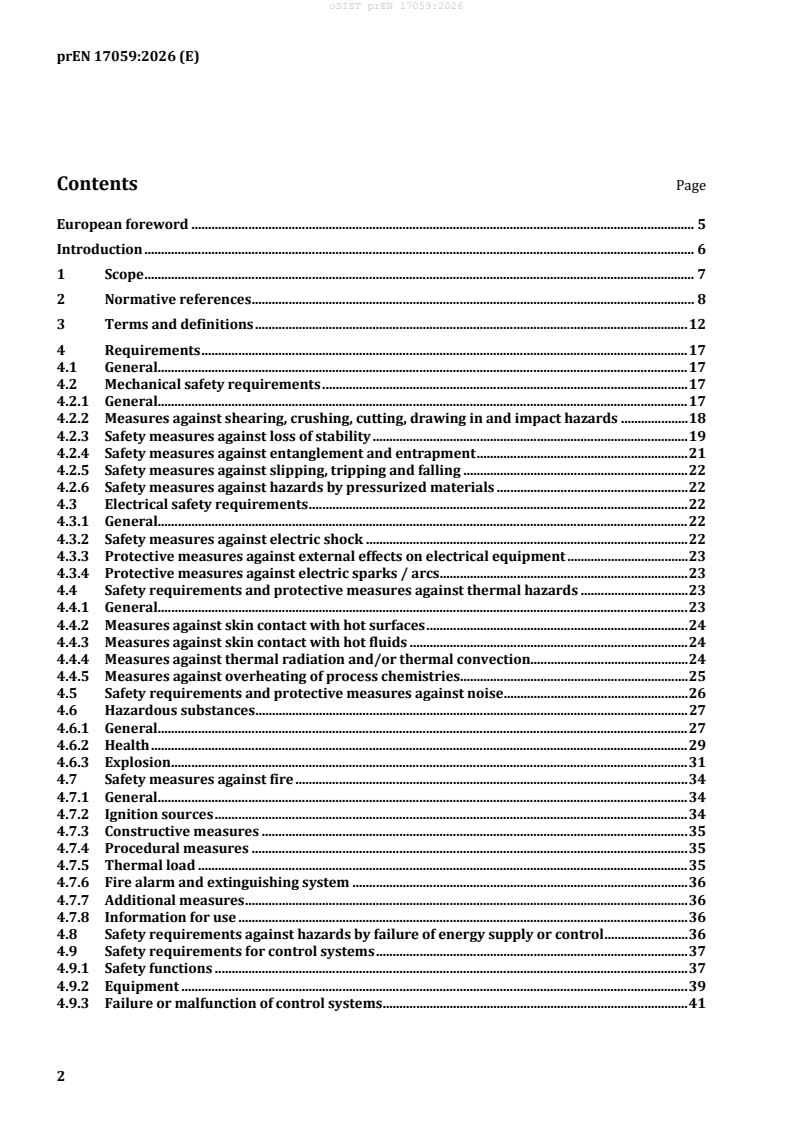
Contents Page
European foreword . 5
Introduction . 6
1 Scope . 7
2 Normative references . 8
3 Terms and definitions . 12
4 Requirements . 17
4.1 General. 17
4.2 Mechanical safety requirements . 17
4.2.1 General. 17
4.2.2 Measures against shearing, crushing, cutting, drawing in and impact hazards . 18
4.2.3 Safety measures against loss of stability . 19
4.2.4 Safety measures against entanglement and entrapment . 21
4.2.5 Safety measures against slipping, tripping and falling . 22
4.2.6 Safety measures against hazards by pressurized materials . 22
4.3 Electrical safety requirements . 22
4.3.1 General. 22
4.3.2 Safety measures against electric shock . 22
4.3.3 Protective measures against external effects on electrical equipment . 23
4.3.4 Protective measures against electric sparks / arcs . 23
4.4 Safety requirements and protective measures against thermal hazards . 23
4.4.1 General. 23
4.4.2 Measures against skin contact with hot surfaces . 24
4.4.3 Measures against skin contact with hot fluids . 24
4.4.4 Measures against thermal radiation and/or thermal convection. 24
4.4.5 Measures against overheating of process chemistries. 25
4.5 Safety requirements and protective measures against noise . 26
4.6 Hazardous substances . 27
4.6.1 General. 27
4.6.2 Health . 29
4.6.3 Explosion . 31
4.7 Safety measures against fire . 34
4.7.1 General. 34
4.7.2 Ignition sources . 34
4.7.3 Constructive measures . 35
4.7.4 Procedural measures . 35
4.7.5 Thermal load . 35
4.7.6 Fire alarm and extinguishing system . 36
4.7.7 Additional measures . 36
4.7.8 Information for use . 36
4.8 Safety requirements against hazards by failure of energy supply or control . 36
4.9 Safety requirements for control systems . 37
4.9.1 Safety functions . 37
4.9.2 Equipment . 39
4.9.3 Failure or malfunction of control systems . 41
4.10 Maintenance . 41
5 Determination of compliance with safety requirements and / or protective
measures . 41
5.1 General . 41
5.2 Mechanical hazards . 41
5.3 Electrical hazards . 42
5.4 Thermal hazards . 42
5.5 Noise . 42
5.6 Hazardous substances . 42
5.6.1 General . 42
5.6.2 Health . 43
5.6.3 Explosions . 43
5.7 Fire . 44
5.8 Failure of energy supply. 44
5.9 Safety requirements for control systems . 44
6 Information for use . 44
6.1 General . 44
6.2 Instruction handbook . 45
6.2.1 Minimum information of the instruction handbook. 45
6.2.2 Information relating to the use of plating lines . 48
6.2.3 Maintenance . 49
6.3 Marking . 50
Annex A (informative) Significant hazards . 51
A.1 General . 51
A.2 Mechanical hazards . 51
A.3 Electrical hazards . 53
A.4 Thermal hazards . 53
A.5 Hazards generated by noise. 53
A.6 Hazards resulting from dangerous substances . 54
A.7 Fire . 55
A.8 Hazards caused by failure of energy supply or control system . 55
Annex B (informative) Examples of transporter units . 56
Annex C (informative) Examples of working areas . 61
Annex D (normative) Calculation of required minimum air flow rates for tanks with lids,
open tanks, enclosing hoods, tunnels and transporter systems . 64
D.1 Introduction . 64
D.2 Calculation of the required minimum air flow rate . 64
Annex E (normative) Required minimum air capture velocities (mean speed) in the main
processes used in plating and anodizing industry . 77
E.1 Method for the determination of the required minimum air velocity . 77
Annex F (informative) Energy-efficiency and reduction of environmental impact . 97
F.1 General . 97
F.2 Machinery . 97
Annex ZA (informative) Relationship between this European Standard and the essential
requirements of Regulation (EU) 2023/1230 aimed to be covered . 99
Bibliography . 108
European foreword
This document (prEN 17059:2026) has been prepared by Technical Committee CEN/TC 271 “Surface
treatment equipment - Safety”, the secretariat of which is held by DIN.
This document is currently submitted to the CEN Enquiry.
This document will supersede EN 17059:2018.
a) requirements for the calculation of required minimum air flow rates for tanks with lids, open tanks,
enclosing hoods, tunnels and transporter systems have been modified (Annex D);
b) required minimum air capture velocities (mean speed) in the main processes used in plating and
anodizing industry have been modified (Annex E);
c) required category of explosion protection for equipment used in plating and anodizing lines with
open tanks and/or with tanks with lids has been added (subclause 4.6.3.3.4);
d) a new Annex F (informative) on Energy-efficiency and reduction of environmental impact has been
added;
e) the Annex ZA (informative) has been updated to include the relationship between this European
Standard and the essential requirements of Regulation (EU) 2023/1230 aimed to be covered.
This document has been prepared under a standardization request addressed to CEN by the European
Commission. The Standing Committee of the EFTA States subsequently approves these requests for its
Member States.
For the relationship with EU Legislation, see informative Annex ZA, which is an integral part of this
document.
Introduction
This document is a type-C standard as stated in EN ISO 12100:2010.
This document is of relevance, in particular, for the following stakeholder groups representing the
market players with regard to machinery safety:
— machine manufacturers (small, medium and large enterprises);
— health and safety bodies (regulators, accident prevention organizations, market surveillance,
etc.).
Others can be affected by the level of machinery safety achieved with the means of the document by the
above-mentioned stakeholder groups:
— machine users/employers (small, medium and large enterprises);
— machine users/employees (e.g. trade unions);
— service providers, e.g. for maintenance (small, medium and large enterprises);
The above-mentioned stakeholder groups have been given the possibility to participate at the drafting
process of this document.
The machinery concerned and the extent to which hazards, hazardous situations or hazardous events
are covered are indicated in the Scope of this document.
When requirements of this type-C standard are different from those which are stated in type-A or
type-B standards, the requirements of this type-C standard take precedence over the requirements of
the other standards for machines that have been designed and built according to the requirements of
this type-C standard.
1 Scope
This document describes all significant hazards, hazardous situations and events relating to plating and
anodizing lines, when used as intended and in compliance with the foreseeable conditions of the
manufacturer. In addition, procedures for testing and measuring safety requirements, marking of
equipment and minimum operation requirements are specified.
For reference to plating lines and anodizing lines, the term plating line is used in this document.
This document applies to the design and construction of plating lines and anodizing lines, including its
transporter systems, for surface treatment of industrial products by means of inorganic or organic
electrolytes or by means of other process chemistries.
Plating lines and anodizing lines in terms of this document are arrangements of process tanks for:
— electrolytic treatment of workpieces (e.g. electrocleaning, passivation, electroetching, burnishing,
electrolytic polishing and brightening);
— wet chemical treatment of workpieces (e.g. degreasing, passivation, chemical polishing, etching,
pickling, blackening);
— electrolytic and electro-less metal deposition, even on non-metallic workpieces made electrically
conductive by corresponding treatment;
— changing of substance composition on the surface of metallic workpieces, e.g. burnishing,
blackening, phosphating, chromating; and
— anodizing (anodic oxidation);
including rinsing tanks, the corresponding transporter equipment (e.g. transporter systems, handling
gantry, bean, etc.), where the products are lifted in and out of tanks, and drying equipment.
This document distinguishes between the following types of plating lines:
— Type 1: manual lines;
— Type 2: semi-automatic lines;
— Type 3: fully automatic lines.
Furthermore, it specifies equipment marking and requirements on user information.
This document does not deal with hazards resulting from plating lines parts above category 1 of PED
(Pressure Equipment Directive).
This document is not applicable to:
— transporter systems of carrousel lines (see EN 618:2002+A1:2010 and EN 15095:2007+A1:2008);
— equipment for the preparation and treatment of water and wastewater;
— machinery for dip coating and electro-deposition of organic liquid coating material (see
EN 12581:2005+A1:2010);
— horizontal plating lines (e.g. printed circuit board, etching, reel to reel, continuous plating lines);
— machinery for surface cleaning and surface pre-treatment of industrial items using liquids or
vapours (EN 12921-1:2005+A1:2010, EN 12921-2:2005+A1:2008, EN 12921-3:2005+A1:2008,
EN 12921-4:2005+A1:2008).
NOTE Machinery for surface cleaning and surface pre-treatment (see EN 12921 series) could be part of a
plating line.
2 Normative references
The following documents are referred to in the text in such a way that some or all of their content
constitutes requirements of this document. For dated references, only the edition cited applies. For
undated references, the latest edition of the referenced document (including any amendments) applies.
EN 179:2008, Building hardware — Emergency exit devices operated by a lever handle or push pad, for
use on escape routes — Requirements and test methods
EN 619:2022, Continuous handling equipment and systems — Safety requirements for equipment for
mechanical handling of unit loads
EN 809:1998+A1:2009, Pumps and pump units for liquids — Common safety requirements
EN 981:1996+A1:2008, Safety of machinery — System of auditory and visual danger and information
signals
EN 1570-1:2024, Safety requirements for lifting tables — Part 1: Lifting tables serving up to two fixed
landings
EN 1125:2008, Building hardware — Panic exit devices operated by a horizontal bar, for use on escape
routes — Requirements and test methods
EN 1127-1:2019, Explosive atmospheres — Explosion prevention and protection — Part 1: Basic concepts
and methodology
EN 1677-1:2000+A1:2008, Components for slings — Safety — Part 1: Forged steel components, Grade 8
EN 1677-2:2000+A1:2008, Components for slings — Safety — Part 2: Forged steel lifting hooks with
latch, Grade 8
EN 1677-3:2001+A1:2008, Components for slings — Safety — Part 3: Forged steel self-locking hooks,
Grade 8
EN 1677-4:2000+A1:2008, Components for slings — Safety — Part 4: Links, Grade 8
EN 12433-1:1999, Industrial, commercial and garage doors and gates — Terminology — Part 1: Types of
doors
EN 12433-2:1999, Industrial, commercial and garage doors and gates — Terminology — Part 2: Parts of
doors
EN 12453:2017+A1:2021, Industrial, commercial and garage doors and gates — Safety in use of power
operated doors — Requirements and test methods
EN 12921-1:2005+A1:2010, Machines for surface cleaning and pre-treatment of industrial items using
liquids or vapours — Part 1: Common safety requirements
EN 12921-2:2005+A1:2008, Machines for surface cleaning and pre-treatment of industrial items using
liquids or vapours — Part 2: Safety of machines using water based cleaning liquids
As impacted by EN 809:1998+A1:2009/AC:2010.
EN 12921-3:2005+A1:2008, Machines for surface cleaning and pre-treatment of industrial items using
liquids or vapours — Part 3: Safety of machines using flammable cleaning liquids
EN 12921-4:2005+A1:2008, Machines for surface cleaning and pretreatment of industrial items using
liquids and vapours — Part 4: Safety of machines using halogenated solvents
EN 12978:2024, Industrial, commercial and garage doors and gates and pedestrian doorsets — Protective
devices for power operated doors and gates — Requirements and test methods
EN 13445-1:2026, Unfired pressure vessels — Part 1: General
EN 13445-2:2026, Unfired pressure vessels — Part 2: Materials
EN 13445-3:2026, Unfired pressure vessels — Part 3: Design
EN 13445-4:2026, Unfired pressure vessels — Part 4: Fabrication
EN 13445-5:2026, Unfired pressure vessels — Part 5: Inspection and testing
EN 13445-8:2026, Unfired pressure vessels — Part 8: Additional requirements for pressure vessels of
aluminium and aluminium alloys
EN 13480-1:2024, Metallic industrial piping — Part 1: General
EN 13480-2:2024, Metallic industrial piping — Part 2: Materials
EN 13480-3:2024, Metallic industrial piping — Part 3: Design and calculation
EN 13480-4:2024, Metallic industrial piping — Part 4: Fabrication and installation
EN 13480-5:2024, Metallic industrial piping — Part 5: Inspection and testing
EN 13861:2011, Safety of machinery — Guidance for the application of ergonomics standards in the
design of machinery
EN 14462:2015, Surface treatment equipment — Noise test code for surface treatment equipment
including its ancillary handling equipment — Accuracy grades 2 and 3
EN 14597:2012, Temperature control devices and temperature limiters for heat generating systems
EN 50110-1:2023, Operation of electrical installations — Part 1: General requirements
EN 60204-1:2018, Safety of machinery — Electrical equipment of machines — Part 1: General
requirements (IEC 60204-1:2016)
EN 60825-1:2014, Safety of laser products — Part 1: Equipment classification and requirements (IEC
60825-1:2014)
EN 61310-1:2008, Safety of machinery — Indication, marking and actuation — Part 1: Requirements for
visual, acoustic and tactile signals (IEC 61310-1:2007)
As impacted by EN 60204-1:2018/A1:2025
As impacted by EN 60825-1:2014/A11:2021, EN 60825-1:2014/AC:2017-06 and EN 60825-
1:2014/A11:2021/AC:2022-03.
EN IEC 61340-5-1:2024, Electrostatics — Part 5-1: Protection of electronic devices from electrostatic
phenomena — General requirements (IEC 61340-5-1:2024)
EN IEC 61340-5-3:2022, Electrostatics — Part 5-3: Protection of electronic devices from electrostatic
phenomena — Properties and requirements classification for packaging intended for electrostatic
discharge sensitive devices (IEC 61340-5-3:2022)
EN IEC 60079-0:2018, Explosive atmospheres — Part 0: Equipment — General requirements (IEC 60079-
0:2017)
EN IEC 61000-6-1:2019, Electromagnetic compatibility (EMC) — Part 6-1: Generic standards —
Immunity standard for residential, commercial and light-industrial environments (IEC 61000-6-1:2016)
EN IEC 61000-6-3:2026, Electromagnetic compatibility (EMC) — Part 6-3: Generic standards — Emission
standard for equipment in residential environments (IEC 61000-6-3:2026)
EN IEC 61000-6-4:2019, Electromagnetic compatibility (EMC) — Part 6-4: Generic standards — Emission
standard for industrial environments (IEC 61000-6-4:2018)
EN IEC 61496-1:2020, Safety of machinery — Electro-sensitive protective equipment — Part 1: General
requirements and tests (IEC 61496-1:2020)
EN IEC 61496-2:2020, Safety of machinery — Electro-sensitive protective equipment — Part 2: Particular
requirements for equipment using active opto-electronic protective devices (AOPDs) (IEC 61496-2:2020)
EN IEC/IEEE 82079-1:2020, Preparation of instructions for use — Structuring, content and presentation
— Part 1: General principles and detailed requirements (IEC 82079-1:2020)
EN ISO 4413:2010, Hydraulic fluid power - General rules and safety requirements for systems and their
components (ISO 4413:2010)
EN ISO 4414:2010, Pneumatic fluid power - General rules and safety requirements for systems and their
components (ISO 4414:2010)
EN ISO 10218-2:2025, Robotics — Safety requirements — Part 2: Industrial robot applications and robot
cells (ISO 10218-2:2025)
EN ISO 11688-1:2009, Acoustics — Recommended practice for the design of low-noise machinery and
equipment — Part 1: Planning (ISO/TR 11688-1:1995)
EN ISO 12100:2010, Safety of machinery — General principles for design — Risk assessment and risk
reduction (ISO 12100:2010)
EN ISO 13732-1:2008, Ergonomics of the thermal environment — Methods for the assessment of human
responses to contact with surfaces — Part 1: Hot surfaces (ISO 13732-1:2006)
EN ISO 13849-1:2023, Safety of machinery — Safety-related parts of control systems — Part 1: General
principles for design (ISO 13849-1:2023)
EN ISO 13849-2:2012, Safety of machinery — Safety-related parts of control systems — Part 2: Validation
(ISO 13849-2:2012)
EN ISO 13850:2015, Safety of machinery — Emergency stop function — Principles for design
(ISO 13850:2015)
EN ISO 13854:2019, Safety of machinery — Minimum gaps to avoid crushing of parts of the human body
(ISO 13854:2017)
EN ISO 13856-1:2013, Safety of machinery — Pressure-sensitive protective devices — Part 1: General
principles for design and testing of pressure-sensitive mats and pressure-sensitive floors
(ISO 13856-1:2013)
EN ISO 13856-2:2013, Safety of machinery — Pressure-sensitive protective devices — Part 2: General
principles for design and testing of pressure-sensitive edges and pressure-sensitive bars
(ISO 13856-2:2013)
EN ISO 13856-3:2013, Safety of machinery — Pressure-sensitive protective devices — Part 3: General
principles for design and testing of pressure-sensitive bumpers, plates, wires and similar devices
(ISO 13856-3:2013)
EN ISO 13857:2019, Safety of machinery — Safety distances to prevent hazard zones being reached by
upper and lower limbs (ISO 13857:2019)
EN ISO 14118:2018, Safety of machinery — Prevention of unexpected start-up (ISO 14118:2017)
EN ISO 14119:2025, Safety of machinery — Interlocking devices associated with guards — Principles for
design and selection (ISO 14119:2024)
EN ISO 14120:2015, Safety of machinery — Guards — General requirements for the design and
construction of fixed and movable guards (ISO 14120:2015)
EN ISO 14122-1:2016, Safety of machinery — Permanent means of access to machinery — Part 1: Choice
of fixed means and general requirements of access (ISO 14122-1:2016)
EN ISO 14122-2:2016, Safety of machinery — Permanent means of access to machinery — Part 2:
Working platforms and walkways (ISO 14122-2:2016)
EN ISO 14122-3:2016, Safety of machinery — Permanent means of access to machinery — Part 3: Stairs,
stepladders and guard-rails (ISO 14122-3:2016)
EN ISO 14122-4:2016, Safety of machinery — Permanent means of access to machinery — Part 4: Fixed
ladders (ISO 14122-4:2016)
EN ISO 80079-36:2016, Explosive atmospheres — Part 36: Non-electrical equipment for explosive
atmospheres — Basic method and requirements (ISO 80079-36:2016)
HD 60364-4-41:2017, Low-voltage electrical installations — Part 4-41: Protection for safety —
Protection against electric shock (IEC 60364-4-41:2005, modified)
ISO 20560-1:2024, Safety information for the content of piping systems and tanks — Part 1: Piping
systems
As impacted by EN ISO 80079-36:2016/AC:2019.
As impacted by HD 60364-4-41:2017/A11:2017 and HD 60364-4-41:2017/A12:2019.
3 Terms and definitions
For the purposes of this document, the terms and definitions given in EN ISO 12100:2010 and the
following apply.
ISO and IEC maintain terminology databases for use in standardization at the following addresses:
— ISO Online browsing platform: available at https://www.iso.org/obp/
— IEC Electropedia: available at https://www.electropedia.org/
3.1
draining area
area (e.g. drip tray also as part of the transporter system) where runoff excess chemistry or rinsing
liquids from the work piece are collected outside treatment tanks
3.2
additive
admixture added to the coating chemistry at a specified volume ratio
Note 1 to entry: Additives influence the deposition and the coating characteristics of the deposited layers.
3.3
anode
metal in the form of plates, rods, balls (spheres), sections, pellets, billets dipping into the treatment tank
and which is suspended at an anode rod or which is filled in baskets attached to an anode hook and
suspended, hung or immersed in the tank
Note 1 to entry: In electroplating, the workpiece is the cathode (connected to the negative pole of the rectifier). In
anodizing, the workpiece is the anode (connected to the positive pole of the rectifier). In electrolytic cleaning, the
workpiece can either be the anode ("anodic cleaning") or the cathode ("cathodic cleaning").
Note 2 to entry: Non-dissolvable anodes are metals such as stainless steel, steel, titanium, etc. in form of rods,
plates, expanded metal plates serving as pure power-supplying electrodes (positive electrode) and are made of
graphite. They do not have the task of emitting metallic atoms to the treatment tank.
3.4
type of plating lines
are characterized by their different constructions and are distinguished by the following description:
— type 1: manual plating lines;
— type 2: semi-automatic lines;
— type 3: fully automatic lines
3.5
operating modes
intended operation of type 3 (fully automatic line) plating lines, and, if applicable, type 2 (semi-
automatic line) which can include the following operating modes:
— automatic mode: automatic, programmed and continuous mode of the plating lines providing the
possibility of manual and automatic loading by means of a transporter system until the program or
the operator stops the machine;
— setting mode: operating mode during which settings for the next working processes are performed;
this is an optional operating mode for manual work under restricted operating conditions;
— service mode: operating mode for service and maintenance works; this is an optional operating
mode for manual work under restricted operating conditions
Note 1 to entry: The setting mode is also referred to as TIP mode.
Note 2 to entry: The service mode is also referred to as MANUAL mode.
Note 3 to entry: Other operating modes are possible as long as they meet the safety objectives laid down in the
Regulation (EU) 2023/1230 (2023/1230, Annex III, B, chapter 1.2.5).
3.6
thermal load
sum of thermal energies capable of being released during combustion of all flammable substances
associated with machinery and their production including raw and auxiliary materials
3.7
flammable substance
gas, vapour, liquid, solid, or mixtures thereof able to undergo an exothermic reaction with air when
ignited
3.8
enclosure
equipment enclosed on all sides with the exception of closable access ports for loading and unloading of
workpieces and having access doors and openings for fire protection reasons, e.g. roof openings
3.9
exposure limits
concentration limits of hazardous substances in air required by worker health legislation
3.10
explosive atmosphere
mixture with air, under atmospheric conditions, of flammable substances in the form of gases, vapours,
mists or dusts in which, after ignition has occurred, combustion spreads to the entire unburned mixture
[SOURCE: EN 14034-1:2004+A1:2011, definition 3.4]
3.11
plating line
totality of machinery, i.e. complex installations, which together form the coating or treatment
equipment
Note 1 to entry: Metal deposition or surface treatment from inorganic and/or organic liquid electrolytes on the
work piece is performed here.
Note 2 to entry: Plating lines may consist of the following units:
— load and unload stations;
— transporter systems consisting of transport hoist with lifting and lowering devices;
— extraction hood at transporter system;
— flight bar including barrel, rack, jig, basket for product reception;
— control system with electrical control panels and switching devices;
— process tanks;
— rinsing baths;
— drying position;
— positions for storage of product carriers, unprocessed workpieces and finished products;
— forced ventilation (inlet and exhaust air system);
— auxiliary equipment such as e.g.: rectifier, filters, pumps and agitators, product motions, heaters, dosing
systems, recycling plants, automation systems including switching system.
Note 3 to entry: Plating lines can be installed with or without enclosure.
Note 4 to entry: Machinery for surface cleaning and surface pre-treatment (EN 12921 series) with its process
tanks could be part of a plating line. These process tanks are distinguished from process tanks from the other
plating processes.
3.12
plating process
process for metal deposition or surface treatment of work piece surfaces, e.g. for deposition of inorganic
or organic liquid electrolytes on the work piece or for surface treatment (cleaning, degreasing, etching)
Note 1 to entry: Treatment takes for example place in process tanks or containers, where different kinds of
process chemistries are used.
3.13
danger zone
area where dangers occur when the plating line is running.
Note 1 to entry: Guards or ESPEs are used to prevent, limit or supervise access.
3.14
hazardous area
area where hazards due to explosive atmosphere may exist.
Note 1 to entry: The probability of occurrence of explosive atmosphere is classified in zones. Limits of hazardous
zones are given in Annex A.
3.14.1
zone 0
place in which an explosive atmosphere consisting of a mixture with air of flammable substances in the
form of gas, vapour or mist is present continuously or for long periods or frequently
[SOURCE: EN IEC 60079-10-1:2021, 3.3.4]
3.14.2
zone 1
place in which an explosive atmosphere consisting of a mixture with air of flammable substances in the
form of gas, vapour or mist is likely to occur in normal operation occasionally
[SOURCE: EN IEC 60079-10-1:2021, 3.3.5]
3.14.3
zone 2
place in which an explosive atmosphere consisting of a mixture with air of flammable substances in the
form of gas, vapour or mist is not likely to occur in normal operation but, if it does occur, will persist for
a short period only
[SOURCE: EN IEC 60079-10-1:2021, 3.3.6]
3.15
danger points
certain points at machines and equipment giving free access, where persons may be injured
Note 1 to entry: See Annex A for detailed list of danger points.
3.16
normal operation
situation where the equipment, protective system, and components perform their intended function
within their design and construction parameters
[SOURCE: EN ISO 12100:2010, 5.4 b.]
3.17
process tank
tank containing an active treatment bath (e.g. an electrolyte) for performance of chemical or electrolytic
surface treatment processes
3.18
material safety data sheet
MSDS
document, drawn up in 16 chapters in compliance with the Directive 1907/2006/CE, reporting the
characteristics of a chemical product to evaluate the potential risks soaring from its use
3.19
forced ventilation
exchange of air by one or more fans across the installed inlet and exhaust system
Note 1 to entry: Air exhausted from the room (exhaust air) is replaced by fresh make-up air. Forced ventilation
may be mounted on the process tanks or in the area of the transporter system.
3.19.1
air adjustment
building ventilation to ensure the supply of sufficient quantity of fresh air to the operational space
3.19.2
make-up air
air which needs to be replenished for air lost through forced ventilation
3.20
transporter system
set-up for the transport of workpieces via jigs, racks and barrels, and anodes during the processing
cycle or during maintenance.
Note 1 to entry: The conveying movements may be horizontal or vertical and axes may be totally or partially
power-driven.
Note 2 to entry: A transporter system may consist of the following machines, components or equipment:
— hoist blank (pathway) and supports;
— transporter system frame;
— hoist drive (lift and traction drive);
— lifting equipment;
— load handling device (belts, chains, slings, hooks, loading traverses (product carrier));
— flight bar and work piece receptacles (jig, barrel, basket);
— positioning system;
— drip pan (collector);
— extraction hood;
— running board;
— safety equipment for persons.
Note 3 to entry: Transporter systems may be designed as:
— suspended hoist with crosspiece, central and lateral guiding of lifting equipment, running on lateral as well as
central running rail;
— portal hoist, with crosspiece lateral guiding of lifting equipment running on rails in the container area;
— lateral hoist with supporting structure, lateral guiding of lifting equipment running on one side running rail
with supporting rail;
— convertors with product carrier receptacles as dry converters or as wet converters, tanks with castors and
product carrier receptacles, running on rails in the container area;
— continuous conveyors;
— circular conveyors.
For transporter systems, see also Figures B.1 to B.9 in Annex B.
3.21
minimum level cutout
activation point at which the heaters shall be deactivated
3.22
lower explosion limit
LEL
lower limit of the explosion range
Note 1 to entry: See 3.19.1 and 3.20.1 of EN 13237:2024.
Note 2 to entry: “Explosion limit” and "ignition limit” are equivalent. In accordance with international usage, only
the term "explosion limit” is used in this document.
3.23
flight bar
used to suspend workpieces via rack or barrels and transport to the various process tanks
Note 1 to entry: Also acts as the cathode or anode bar during the plating process or anodizing process/anodic
cleaning process.
3.24
flight bar agitation
mechanical agitation of flight bar within the tank by electrical motor drive
3.25
working area
area where the operators access during all the steps of workpieces treatment (manual or automatic)
Note 1 to entry: See also Figures C.1 to C.3 in Annex C.
Note 2 to entry: This includes, for example, the preparation of bath (e.g. dissolution, transfer), preparation of
working piece, control of bath (pH adjustment) and operations of maintenance.
4 Requirements
4.1 General
Plating lines shall comply with the safety requirements and protective measures of this clause. In
addition, plating lines shall be designed according to the principles of for hazards relevant but not
significant which are not dealt with by this document.
In addition to EN ISO 12100:2010, plating lines shall al
...