


CEN/TS 16675:2014
(Main)Characterisation of waste - Test methods for the determination of the monolithic status of waste
General Information
- Abstract
This Technical Specification provides methods, which can be used to assess the monolithic character of a stabilised/solidified waste, with respect to landfilling. Information on the monolithic character is required to enable the choice of appropriate leaching tests for determination of the release of different substances from stabilised/solidified waste under specified (landfilling) conditions.
This document includes several physical and/or chemical test methods each addressing different aspects of monolithic character. The selection of methods required for an assessment of the monolithic character of a stabilised/solidified waste may vary, depending on the scenario to be addressed or it may be specified in regulation.
Rather than describing the procedures and methods in detail this document refers to existing standards and provides some guidance on their use on stabilised/solidified waste materials.
This Technical Specification does not address issues related to health and safety.
The following procedures and methods are included in this document:
- test to determine unconfined compressive strength;
- test to determine permeability;
- test to determine the loss of mass by dissolution or disintegration;
- test to determine expansion;
- test to determine the content of organic matter;
- test to determine freeze/thaw effects.
- Status
- Withdrawn
- Publication Date
- 09-Sep-2014
- Withdrawal Date
- 22-Sep-2026
- Technical Committee
- CEN/TC 444 - Environmental characterization
- Drafting Committee
- CEN/TC 444/WG 1 - Leaching tests
- Current Stage
- 9960 - Withdrawal effective - Withdrawal
- Start Date
- 22-Aug-2018
- Completion Date
- 23-Sep-2026

Relations
- Effective Date
- 29-Aug-2018
- Refers
CEN/TR 15177:2006 - Testing the freeze-thaw resistance of concrete - Internal structural damage - Effective Date
- 28-Jan-2026
- Effective Date
- 28-Jan-2026
- Effective Date
- 28-Jan-2026
- Effective Date
- 28-Jan-2026
- Effective Date
- 28-Jan-2026
- Effective Date
- 28-Jan-2026
- Refers
EN 15002:2015 - Characterization of waste - Preparation of test portions from the laboratory sample - Effective Date
- 28-Jan-2026
- Effective Date
- 28-Jan-2026
Get Certified
Connect with accredited certification bodies for this standard

CIS Institut d.o.o.
Personal Protective Equipment (PPE) certification body. Notified Body NB-2890 for EU Regulation 2016/425 PPE.

Kiwa BDA Testing
Building and construction product certification.
Kmetijski inštitut Slovenije
Agricultural Institute of Slovenia. Soil testing, plant health, agricultural product analysis.
Sponsored listings
Frequently Asked Questions
CEN/TS 16675:2014 is a technical specification published by the European Committee for Standardization (CEN). Its full title is "Characterisation of waste - Test methods for the determination of the monolithic status of waste". This standard covers: This Technical Specification provides methods, which can be used to assess the monolithic character of a stabilised/solidified waste, with respect to landfilling. Information on the monolithic character is required to enable the choice of appropriate leaching tests for determination of the release of different substances from stabilised/solidified waste under specified (landfilling) conditions. This document includes several physical and/or chemical test methods each addressing different aspects of monolithic character. The selection of methods required for an assessment of the monolithic character of a stabilised/solidified waste may vary, depending on the scenario to be addressed or it may be specified in regulation. Rather than describing the procedures and methods in detail this document refers to existing standards and provides some guidance on their use on stabilised/solidified waste materials. This Technical Specification does not address issues related to health and safety. The following procedures and methods are included in this document: - test to determine unconfined compressive strength; - test to determine permeability; - test to determine the loss of mass by dissolution or disintegration; - test to determine expansion; - test to determine the content of organic matter; - test to determine freeze/thaw effects.
This Technical Specification provides methods, which can be used to assess the monolithic character of a stabilised/solidified waste, with respect to landfilling. Information on the monolithic character is required to enable the choice of appropriate leaching tests for determination of the release of different substances from stabilised/solidified waste under specified (landfilling) conditions. This document includes several physical and/or chemical test methods each addressing different aspects of monolithic character. The selection of methods required for an assessment of the monolithic character of a stabilised/solidified waste may vary, depending on the scenario to be addressed or it may be specified in regulation. Rather than describing the procedures and methods in detail this document refers to existing standards and provides some guidance on their use on stabilised/solidified waste materials. This Technical Specification does not address issues related to health and safety. The following procedures and methods are included in this document: - test to determine unconfined compressive strength; - test to determine permeability; - test to determine the loss of mass by dissolution or disintegration; - test to determine expansion; - test to determine the content of organic matter; - test to determine freeze/thaw effects.
CEN/TS 16675:2014 is classified under the following ICS (International Classification for Standards) categories: 13.030.10 - Solid wastes. The ICS classification helps identify the subject area and facilitates finding related standards.
CEN/TS 16675:2014 has the following relationships with other standards: It is inter standard links to CEN/TS 16675:2018, CEN/TR 15177:2006, EN 15936:2022, CEN/TS 15864:2015, EN 15216:2021, EN ISO 17892-11:2019, EN 12390-3:2019, EN 15002:2015, EN 15863:2015. Understanding these relationships helps ensure you are using the most current and applicable version of the standard.
CEN/TS 16675:2014 is associated with the following European legislation: Standardization Mandates: M/326. When a standard is cited in the Official Journal of the European Union, products manufactured in conformity with it benefit from a presumption of conformity with the essential requirements of the corresponding EU directive or regulation.
CEN/TS 16675:2014 is available in PDF format for immediate download after purchase. The document can be added to your cart and obtained through the secure checkout process. Digital delivery ensures instant access to the complete standard document.
Standards Content (Sample)
SLOVENSKI STANDARD
01-november-2014
Karakterizacija odpadkov - Preverjanje statusa monolitnosti odpadkov
Characterization of waste - Verification of the monolithic status of waste
Charakterisierung von Abfällen - Nachweis des monolithischen Status von Abfällen
Caractérisation des déchets - Vérification du caractère monolithique d'un déchet
Ta slovenski standard je istoveten z: CEN/TS 16675:2014
ICS:
13.030.10 Trdni odpadki Solid wastes
2003-01.Slovenski inštitut za standardizacijo. Razmnoževanje celote ali delov tega standarda ni dovoljeno.
TECHNICAL SPECIFICATION
CEN/TS 16675
SPÉCIFICATION TECHNIQUE
TECHNISCHE SPEZIFIKATION
September 2014
ICS 13.030.10
English Version
Characterisation of waste - Test methods for the determination
of the monolithic status of waste
Caractérisation des déchets - Vérification du caractère Charakterisierung von Abfällen - Prüfverfahren für die
monolithique d'un déchet Bestimmung der monolithischen Eigenschaften von
Abfällen
This Technical Specification (CEN/TS) was approved by CEN on 18 February 2014 for provisional application.
The period of validity of this CEN/TS is limited initially to three years. After two years the members of CEN will be requested to submit their
comments, particularly on the question whether the CEN/TS can be converted into a European Standard.
CEN members are required to announce the existence of this CEN/TS in the same way as for an EN and to make the CEN/TS available
promptly at national level in an appropriate form. It is permissible to keep conflicting national standards in force (in parallel to the CEN/TS)
until the final decision about the possible conversion of the CEN/TS into an EN is reached.
CEN members are the national standards bodies of Austria, Belgium, Bulgaria, Croatia, Cyprus, Czech Republic, Denmark, Estonia,
Finland, Former Yugoslav Republic of Macedonia, France, Germany, Greece, Hungary, Iceland, Ireland, Italy, Latvia, Lithuania,
Luxembourg, Malta, Netherlands, Norway, Poland, Portugal, Romania, Slovakia, Slovenia, Spain, Sweden, Switzerland, Turkey and United
Kingdom.
EUROPEAN COMMITTEE FOR STANDARDIZATION
COMITÉ EUROPÉEN DE NORMALISATION
EUROPÄISCHES KOMITEE FÜR NORMUNG
CEN-CENELEC Management Centre: Avenue Marnix 17, B-1000 Brussels
© 2014 CEN All rights of exploitation in any form and by any means reserved Ref. No. CEN/TS 16675:2014 E
worldwide for CEN national Members.
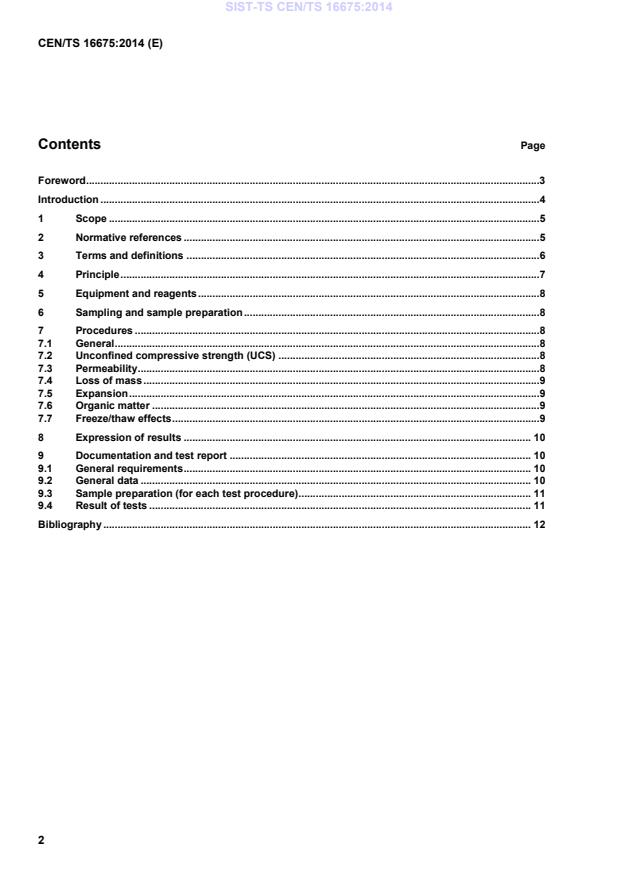
Contents Page
Foreword .3
Introduction .4
1 Scope .5
2 Normative references .5
3 Terms and definitions .6
4 Principle .7
5 Equipment and reagents .8
6 Sampling and sample preparation .8
7 Procedures .8
7.1 General .8
7.2 Unconfined compressive strength (UCS) .8
7.3 Permeability .8
7.4 Loss of mass .9
7.5 Expansion .9
7.6 Organic matter .9
7.7 Freeze/thaw effects .9
8 Expression of results . 10
9 Documentation and test report . 10
9.1 General requirements . 10
9.2 General data . 10
9.3 Sample preparation (for each test procedure) . 11
9.4 Result of tests . 11
Bibliography . 12
Foreword
This document (CEN/TS 16675:2014) has been prepared by Technical Committee CEN/TC 292
“Characterization of waste”, the secretariat of which is held by NEN.
Attention is drawn to the possibility that some of the elements of this document may be the subject of patent
rights. CEN [and/or CENELEC] shall not be held responsible for identifying any or all such patent rights.
According to the CEN/CENELEC Internal Regulations, the national standards organizations of the following
countries are bound to announce this Technical Specification: Austria, Belgium, Bulgaria, Croatia, Cyprus,
Czech Republic, Denmark, Estonia, Finland, Former Yugoslav Republic of Macedonia, France, Germany,
Greece, Hungary, Iceland, Ireland, Italy, Latvia, Lithuania, Luxembourg, Malta, Netherlands, Norway, Poland,
Portugal, Romania, Slovakia, Slovenia, Spain, Sweden, Switzerland, Turkey and the United Kingdom.
Introduction
Disposal of some types of waste requires stabilisation/solidification to reduce the impact and/or comply with
regulatory requirements. The characterisation of waste is an essential step for the assessment of a potential
final destination, especially in case of landfilling and associated potential hazards. Based on its properties, a
stabilised/solidified waste material may be allocated to a landfill for granular waste or a landfill for monolithic
waste. Information on certain physical properties of a given stabilised/solidified waste material is required to
determine if it can be classified as a monolithic material and to select appropriate leaching test method(s) and
landfilling options for that waste. This technical specification describes test methods applicable to assessment
of these physical properties.
WARNING – Anyone dealing with waste and sludge analysis should be aware of the typical risks of
that kind of material irrespective of the parameter to be determined. Waste and sludge samples may
contain hazardous (e.g. toxic, reactive, flammable, infectious) substances, which can be liable to
biological and/or chemical reaction. Consequently these samples should be handled with special
care. Gases which may be produced by microbiological or chemical activity are potentially flammable
and will pressurise sealed bottles. Bursting bottles are likely to result in hazardous shrapnel, dust
and/or aerosol. National regulations should be followed with respect to all hazards associated with
the methods in this technical specification.
1 Scope
This Technical Specification provides methods, which can be used to assess the monolithic character of a
stabilised/solidified waste, with respect to landfilling. Information on the monolithic character is required to
enable the choice of appropriate leaching tests for determination of the release of different substances from
stabilised/solidified waste under specified (landfilling) conditions.
This document includes several physical and/or chemical test methods each addressing different aspects of
monolithic character. The selection of methods required for an assessment of the monolithic character of a
stabilised/solidified waste may vary, depending on the scenario to be addressed or it may be specified in
regulation.
Rather than describing the procedures and methods in detail this document refers to existing standards and
provides some guidance on their use on stabilised/solidified waste materials.
This Technical Specification does not address issues related to health and safety.
The following procedures and methods are included in this document:
— test to determine unconfined compressive strength;
— test to determine permeability;
— test to determine the loss of mass by dissolution or disintegration;
— test to determine expansion;
— test to determine the content of organic matter;
— test to determine freeze/thaw effects.
2 Normative references
The following documents, in whole or in part, are normatively referenced in this document and are
indispensable for its application. For dated references, only the edition cited applies. For undated references,
the latest edition of the referenced document (including any amendments) applies.
EN 12390-3, Testing hardened concrete - Part 3: Compressive strength of test specimens
EN 13137, Characterization of waste - Determination of total organic carbon (TOC) in waste, sludges and
sediments
EN 15002, Characterization of waste - Preparation of test portions from the laboratory sample
CEN/TR 15177:2006, Testing the freeze-thaw resistance of concrete - Internal structural damage
EN 15216, Characterization of waste - Determination of total dissolved solids (TDS) in water and eluates
CEN/TS 15863, Characterisation of waste - Leaching behaviour test for basic characterisation - Dynamic
monolithic leaching test with periodic leachant renewal, under fixed test conditions
CEN/TS 15864, Characterisation of waste - Leaching behaviour test for basic characterisation - Dynamic
monolithic leaching test with continuous leachant renewal under conditions relevant for specified scenario(s)
CEN ISO/TS 17892-11, Geotechnical investigation and testing - Laboratory testing of soil - Part 11:
Determination of permeability by constant and falling head (ISO/TS 17892-11)
3 Terms and definitions
For the purposes of this document, the following terms and definitions apply.
3.1
dry matter
wdm
mass fraction of a sample excluding water expressed as a percentage by mass calculated by determination of
dry residue or water content
[SOURCE: EN 14346]
3.2
dry residue
wdr
remaining mass fraction of a sample after a drying process at 105 °C
[SOURCE: EN 14346]
3.3
eluate
solution recovered from a leaching test
3.4
laboratory sample
sample or subsample (s) sent to or received by the laboratory
[SOURCE: IUPAC:1997]
Note 1 to entry: When the laboratory sample is further prepared (reduced) by subdividing, mixing, grinding or by
combinations of these operations, the result is the test sample. When no preparation of the laboratory sample is required,
the laboratory sample is the test sample. A test portion is removed from the test sample for the performance of the test or
for analysis. The laboratory sample is the final sample from the point of view of sample collection but it is the initial sample
from the point of view of the laboratory.
Note 2 to entry: Several laboratory samples could be prepared and sent to different laboratories or to the same
laboratory for different purposes. When sent to the same laboratory, the set is generally considered as a single laboratory
sample and is documented as a single sample.
3.5
leachant
liquid used in a leaching test
[SOURCE: EN 1
...