


EN 15892:2011
(Main)Railway applications - Noise Emission - Measurement of noise inside driver's cabs
General Information
- Abstract
This European Standard specifies a type test method to measure noise levels inside the driver's cabs of railway vehicles for assessing compliance with the relevant European legislation.
NOTE The relevant European legislation includes Directive 2003/10/EC of 6 February 2003 and the Commission Decisions of 23 December 2005 (Technical specification for interoperability relating to the subsystem ‘rolling stock - noise’ of the trans-European conventional rail system) and of 21 February 2008 (Technical specification for interoperability relating to the ‘rolling stock’ sub-system of the trans-European high-speed rail system).
This method is applicable to:
- the measurement of noise inside driver's cab resulting from the sounding of external warning horns when the vehicle is stationary;
- the measurement of noise inside the driver cab while the vehicle is running.
The method is not applicable to:
- complementary measurements that can be requested for acceptance tests, but which are not required by the TSIs referred to in this standard;
- the measurement of the noise from internal and external audible devices other than external warning horns;
- routine monitoring of the noise exposure of train crew.
The test procedures specified in this European Standard are of engineering grade (grade 2) with a precision of ± 2 dB, which is the preferred method for noise declaration purposes, as defined in EN ISO 12001.
- Status
- Withdrawn
- Publication Date
- 08-Feb-2011
- Withdrawal Date
- 22-Sep-2026
- Technical Committee
- CEN/TC 256 - Railway applications
- Drafting Committee
- CEN/TC 256/WG 3 - Noise emission
- Current Stage
- 9960 - Withdrawal effective - Withdrawal
- Start Date
- 22-Sep-2021
- Completion Date
- 23-Sep-2026
- Directive
- Not Harmonized2001/16/EC - Directive 2001/16/EC of the European Parliament and of the Council of 19 March 2001 on the interoperability of the trans-European conventional rail system
Not Harmonized2008/57/EC - DIRECTIVE 2008/57/EC OF THE EUROPEAN PARLIAMENT AND OF THE COUNCIL of 17 June 2008 on the interoperability of the rail system within the Community (Recast)OJ Ref: C, C 214 OJ Date: 20-Jul-2011

Relations
- Effective Date
- 30-Dec-2020
- Effective Date
- 09-Feb-2026
- Effective Date
- 09-Feb-2026
- Effective Date
- 09-Feb-2026
- Effective Date
- 28-Jan-2026
Get Certified
Connect with accredited certification bodies for this standard

IRIS Certification (UNIFE)
International Railway Industry Standard certification.

TÜV SÜD Rail GmbH
TÜV SÜD railway certification services.
BSMI (Bureau of Standards, Metrology and Inspection)
Taiwan's standards and inspection authority.
Sponsored listings
Frequently Asked Questions
EN 15892:2011 is a standard published by the European Committee for Standardization (CEN). Its full title is "Railway applications - Noise Emission - Measurement of noise inside driver's cabs". This standard covers: This European Standard specifies a type test method to measure noise levels inside the driver's cabs of railway vehicles for assessing compliance with the relevant European legislation. NOTE The relevant European legislation includes Directive 2003/10/EC of 6 February 2003 and the Commission Decisions of 23 December 2005 (Technical specification for interoperability relating to the subsystem ‘rolling stock - noise’ of the trans-European conventional rail system) and of 21 February 2008 (Technical specification for interoperability relating to the ‘rolling stock’ sub-system of the trans-European high-speed rail system). This method is applicable to: - the measurement of noise inside driver's cab resulting from the sounding of external warning horns when the vehicle is stationary; - the measurement of noise inside the driver cab while the vehicle is running. The method is not applicable to: - complementary measurements that can be requested for acceptance tests, but which are not required by the TSIs referred to in this standard; - the measurement of the noise from internal and external audible devices other than external warning horns; - routine monitoring of the noise exposure of train crew. The test procedures specified in this European Standard are of engineering grade (grade 2) with a precision of ± 2 dB, which is the preferred method for noise declaration purposes, as defined in EN ISO 12001.
This European Standard specifies a type test method to measure noise levels inside the driver's cabs of railway vehicles for assessing compliance with the relevant European legislation. NOTE The relevant European legislation includes Directive 2003/10/EC of 6 February 2003 and the Commission Decisions of 23 December 2005 (Technical specification for interoperability relating to the subsystem ‘rolling stock - noise’ of the trans-European conventional rail system) and of 21 February 2008 (Technical specification for interoperability relating to the ‘rolling stock’ sub-system of the trans-European high-speed rail system). This method is applicable to: - the measurement of noise inside driver's cab resulting from the sounding of external warning horns when the vehicle is stationary; - the measurement of noise inside the driver cab while the vehicle is running. The method is not applicable to: - complementary measurements that can be requested for acceptance tests, but which are not required by the TSIs referred to in this standard; - the measurement of the noise from internal and external audible devices other than external warning horns; - routine monitoring of the noise exposure of train crew. The test procedures specified in this European Standard are of engineering grade (grade 2) with a precision of ± 2 dB, which is the preferred method for noise declaration purposes, as defined in EN ISO 12001.
EN 15892:2011 is classified under the following ICS (International Classification for Standards) categories: 17.140.30 - Noise emitted by means of transport; 45.060.10 - Tractive stock. The ICS classification helps identify the subject area and facilitates finding related standards.
EN 15892:2011 has the following relationships with other standards: It is inter standard links to EN ISO 3381:2021, EN 61672-2:2013, EN 61672-1:2003, EN 60942:2003, EN 15153-2:2020. Understanding these relationships helps ensure you are using the most current and applicable version of the standard.
EN 15892:2011 is associated with the following European legislation: EU Directives/Regulations: 2001/16/EC, 2008/57/EC, 96/48/EC; Standardization Mandates: M/275, M/334. When a standard is cited in the Official Journal of the European Union, products manufactured in conformity with it benefit from a presumption of conformity with the essential requirements of the corresponding EU directive or regulation.
EN 15892:2011 is available in PDF format for immediate download after purchase. The document can be added to your cart and obtained through the secure checkout process. Digital delivery ensures instant access to the complete standard document.
Standards Content (Sample)
2003-01.Slovenski inštitut za standardizacijo. Razmnoževanje celote ali delov tega standarda ni dovoljeno.Železniške naprave - Hrup - Meritev hrupa v voznikovi kabiniBahnanwendungen - Geräuchemission - Geräuchmessung im FührerraumApplications ferroviaires - Emission de bruit - Mesurage du bruit dans la cabine de conduiteRailway applications - Noise Emission - Measurement of noise inside driver's cabs45.060.10Tractive stock17.140.30Emisija hrupa transportnih sredstevNoise emitted by means of transportICS:Ta slovenski standard je istoveten z:EN 15892:2011SIST EN 15892:2011en,fr,de01-oktober-2011SIST EN 15892:2011SLOVENSKI
STANDARD
EUROPEAN STANDARD NORME EUROPÉENNE EUROPÄISCHE NORM
EN 15892
February 2011 ICS 17.140.30; 45.060.10 English Version
Railway applications - Noise Emission - Measurement of noise inside driver's cabs
Applications ferroviaires - Emission de bruit - Mesurage du bruit dans la cabine de conduite
Bahnanwendungen - Geräuschemission - Geräuschmessung im Führerraum This European Standard was approved by CEN on 24 December 2010.
CEN members are bound to comply with the CEN/CENELEC Internal Regulations which stipulate the conditions for giving this European Standard the status of a national standard without any alteration. Up-to-date lists and bibliographical references concerning such national standards may be obtained on application to the CEN-CENELEC Management Centre or to any CEN member.
This European Standard exists in three official versions (English, French, German). A version in any other language made by translation under the responsibility of a CEN member into its own language and notified to the CEN-CENELEC Management Centre has the same status as the official versions.
CEN members are the national standards bodies of Austria, Belgium, Bulgaria, Croatia, Cyprus, Czech Republic, Denmark, Estonia, Finland, France, Germany, Greece, Hungary, Iceland, Ireland, Italy, Latvia, Lithuania, Luxembourg, Malta, Netherlands, Norway, Poland, Portugal, Romania, Slovakia, Slovenia, Spain, Sweden, Switzerland and United Kingdom.
EUROPEAN COMMITTEE FOR STANDARDIZATION
COMITÉ EUROPÉEN DE NORMALISATION EUROPÄISCHES KOMITEE FÜR NORMUNG
Management Centre:
Avenue Marnix 17,
B-1000 Brussels © 2011 CEN All rights of exploitation in any form and by any means reserved worldwide for CEN national Members. Ref. No. EN 15892:2011: ESIST EN 15892:2011
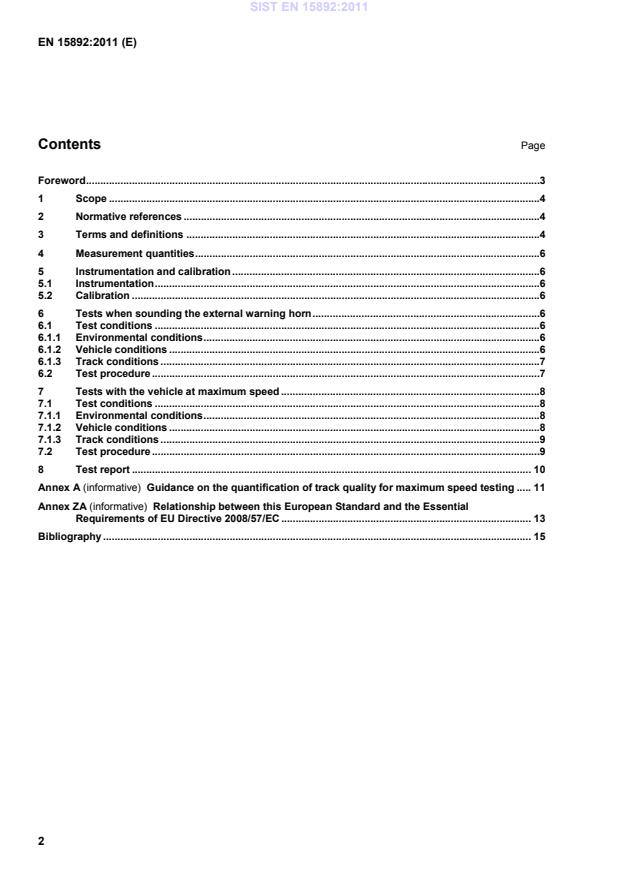
Guidance on the quantification of track quality for maximum speed testing . 11Annex ZA (informative)
Relationship between this European Standard and the Essential Requirements of EU Directive 2008/57/EC . 13Bibliography . 15 SIST EN 15892:2011
(1) where Lr
is the acoustic roughness level in dB; rRMS
is the root mean square roughness in µm; r0
is the reference roughness; r0 = 1,0 µm. NOTE 1 Adapted from EN 15610:2009. NOTE 2 For information, see EN 15610. NOTE 3 This definition applies to values measured either as a wavelength spectrum or in a particular wavelength band. 3.3 acoustic roughness spectrum
amplitude of the acoustic roughness level expressed as a function of the wavelength NOTE Adapted from EN 15610:2009. 3.4 A-weighted equivalent continuous sound pressure level LpAeq,T A-weighted sound pressure level given by the following equation:
(2) where LpAeq,T is the A-weighted equivalent continuous sound pressure level, in dB; pA(t) is the A-weighted instantaneous sound pressure; )( r ~ λ ( ) d 1lg
10 0 2 0 2 A TpAeq, =∫ T t p t p T LSIST EN 15892:2011
6.1 Test conditions 6.1.1 Environmental conditions The train shall be positioned in an open environment, and therefore not in a building or in a tunnel. Except for the ground, there shall not be any acoustically reflective (hard) surfaces comprising such materials as steel or concrete, including other trains and fixed structures, within 10 m of the external surfaces of the sides of the cab within which tests are being undertaken. Similarly, there shall not be any acoustically reflective surfaces within 25 m of the external surface of the front end of the cab.
6.1.2 Vehicle conditions The vehicle shall be stationary. SIST EN 15892:2011
The horns shall be inspected for debris, which shall be removed if found to be present.
NOTE The sound source that is to be measured, the external warning horn, is inherently of high sound level, and therefore typical internal background noise levels in the cab when stationary are unlikely to interfere with the measured results. Nevertheless, it is advisable to run only those systems on the train that are essential to allow the external warning horn to sound, and to avoid positioning the vehicle at locations where other high noise level sources are present.
6.1.3 Track conditions No track condition. 6.2 Test procedure The stationary measurements require the noise level in the vicinity of the driver’s ears to be quantified when the external warning horn is sounded.
When the cab contains more than one set of complete driving controls, the test shall be carried out at each of these positions. This is not necessary at auxiliary driving positions where a full set of controls is not present. When the external warning horn has more than one operating control, the test shall be carried out using each of these controls. If the vehicle or multiple unit has two cabs and is symmetrical about its longitudinal centre, it is only necessary to carry out the full test within one cab provided the horn configuration and installation is identical for both cabs. If this is not the case, the tests shall be carried out in both cabs and the higher resultant level shall be recorded. Sound pressure levels shall be measured at the normal operational energy level available on the vehicle. When the external warning horn has two or more tones or chords the following tests shall be carried out for both or all of these. When the acoustic warning has an option for a loud or quiet setting, the loud setting shall be used. Measurement conditions shall comply with EN 15153-2 for the measurement of horn performances. If the value of LpAeq,T measured under these conditions is outside the range specified for this test within EN 15153-2, or if these measured levels before and after the stationary cab noise measurements differ by more than 3 dB, the cab noise results are invalid.
The background noise level within the cab shall be measured and recorded at the beginning and end of the stationary measurement, in terms of LpAeq,T over a measurement time interval, T, of 20 s. This measurement shall be obtained at the same position on both occasions, and that position is to be chosen from one of the available eight locations as defined below. The measurement shall be carried out at eight evenly spaced microphone positions in a horizontal plane at the height of a seated driver’s ears, at a radius of 25 cm, while the external warning horn is sounding. The position of the seated driver's ears, if not defined elsewhere, shall be taken at 0,80 m ± 0,05 m vertically above the centroid of the unloaded seat surface. If the seat height is adjustable, this adjustment shall be set at midrange. The height of this nominal positi
...