

October 2026 Standards Update: Optical Amplifier Testing and eHMI Systems for Automated Vehicles
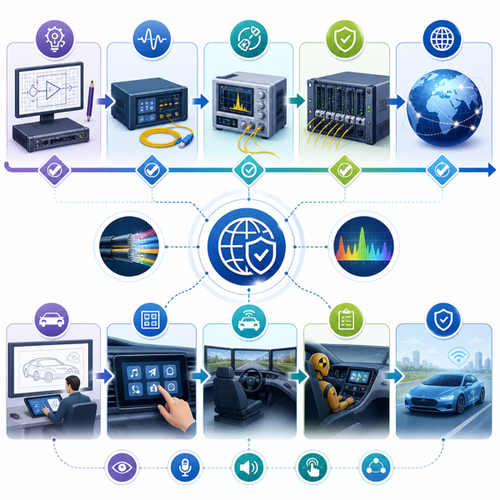
In October 2026, two pivotal international standards were released for the telecommunications, audio, and video engineering sector. These standards address crucial aspects of optical amplifier testing and the integration of advanced external human-machine interface (eHMI) visual systems for automated vehicles. For professionals navigating evolving technologies and regulatory environments, understanding these updates is essential for ensuring compliance, optimizing operations, and fostering innovation.
Overview / Introduction
The telecommunications, audio, and video engineering field is transforming rapidly, driven by demands for higher bandwidth, intelligent automation, and safer connectivity. Standards play a foundational role in this landscape, harmonizing best practices, establishing interoperability, and assuring safety and quality. This article delves into newly published standards that will shape future deployments—from testing the precision of optical hardware in core networks to integrating safe, clear visual communication between automated vehicles and road users. Readers can expect to:
- Understand the latest test methodologies for optical amplifier noise figures
- Gain insight into external visual systems for automated vehicle eHMI
- Learn about compliance needs and technical best practices
Detailed Standards Coverage
IEC 61290-3-2:2026 - Test Methods for Optical Amplifier Noise Figure Using ESA
Optical amplifiers – Test methods – Part 3-2: Noise figure parameters – Electrical spectrum analyzer method
This standard defines precise and reliable test methods for measuring the noise figure parameters of all commercially available optical amplifiers (OAs), including optical fibre amplifiers (OFAs— based on rare-earth doped fibres or the Raman effect), semiconductor optical amplifiers (SOAs), and planar waveguide optical amplifiers (PWOAs). Developed by IEC Subcommittee 86C, it replaces the previous 2008 edition, introducing key technical revisions for contemporary optical networks.
Scope and Key Requirements
- Applicable to OA designs used in telecommunications backbone, data centre interconnects, and advanced optical networking systems.
- Specifies the use of the Electrical Spectrum Analyzer (ESA) method, providing systematic requirements for accurate measurement of noise figure parameters, a critical specification for optical amplifier performance.
- Incorporates rigorous terminology from IEC 61291-1, including definitions for noise figure, gain, shot noise, RIN (Relative Intensity Noise), and ASE (Amplified Spontaneous Emission).
Main Changes from Previous Edition
- Shortened, clarified scope for practicality
- Updated normative references for up-to-date compliance
- Eliminated duplicate test commands, streamlining the testing process
- Revised symbol definitions and added new ones for accuracy
Practical Implementation Implications
Organizations manufacturing or integrating OAs must now ensure calibration and measurement are performed with up-to-date apparatus, such as:
- Single-line laser sources (DFB preferred) with strictly controlled linewidth (20–100 MHz recommended)
- Low RIN performance (<-150 dB/Hz), high optical isolation (>60 dB), and precise optical power accuracy
- Input/output Variable Optical Attenuators (VOA) with high attenuation range and linearity
- Accurate measurement equipment for bandwidth calibration and noise quantification within ±20% accuracy
This method directly addresses the full noise figure—including sources like spontaneous emission, MPI (Multiple Path Interference), and relative intensity noise—providing a much clearer assessment of real-world OA performance than techniques focused only on signal-spontaneous noise.
Key highlights:
- Covers all amplifier types used in modern optical networking (OFAs, SOAs, PWOAs)
- Achieves measurement accuracy within ±1 dB
- Streamlines test setups, minimizes redundancies, and improves symbol clarity
Access the full standard:View IEC 61290-3-2:2026 on iTeh Standards
IEC TR 63676-1:2026 - External Visual Systems for eHMI in Automated Vehicles
Multimedia systems and equipment for vehicles – External visual systems of external human-machine interfaces (eHMI) for automated vehicles – Part 1: General
IEC TR 63676-1:2026 provides a comprehensive overview of design concepts, architecture, and system components of external visual human-machine interface (eHMI) systems for automated vehicles. As roads increasingly feature connected and autonomous vehicles, clear communication between vehicles and other road users—pedestrians, cyclists, and drivers—becomes a top safety priority. This technical report lays the groundwork for future prescriptive standards by introducing foundational concepts and defining system boundaries.
Scope and Core Elements
- Focuses on multimedia-enabled eHMI: display panels (LED/OLED/LCD), dynamic segment lights, projection and transparent displays, and integrated lighting systems on automated vehicles.
- Addresses the importance of intuitive visual signals in communicating vehicle intent (yielding, turning, stopping) where a human driver is absent.
- Details system architecture, typical external display types, and the relationship between physical position, color, brightness, contrast ratio, viewing angle, and anticipated effectiveness in diverse environments.
- Excludes usage scenarios, UX/UI specifics, hardware performance metrics, regulatory specifics, and applications for specialty vehicles (e.g., emergency trucks, buses).
Key Requirements and System Features
- Defines critical components for eHMI: display/control modules, LED lighting, color selection, positioning
- Discusses evaluation criteria: brightness/contrast, color gamut, grey scale, off-angle visibility
- Highlights integration of eHMI into broader multimedia and control networks in the automated vehicle
- Provides real-world use cases and formative system architectures for industry adaptation
Practical Implications for Organizations
Automotive and system integrators working on AVs should anticipate future regulatory trends towards prescriptive eHMI requirements, using this TR as a baseline for R&D, interface prototyping, and safety validation. Close coordination among manufacturing, HMI design, and compliance teams will be essential as the field matures from concept to mandated practice.
Key highlights:
- Establishes a foundational framework for external visual communications for automated vehicles
- Outlines performance criteria vital for safe V2X (vehicle-to-everyone) communications
- Orients industry towards harmonized architectures for next-generation AV deployments
Access the full standard:View IEC TR 63676-1:2026 on iTeh Standards
Industry Impact & Compliance
Both standards represent significant shifts for stakeholders across optical and automotive sectors. Businesses that produce, deploy, or procure optical amplifiers must upgrade their test procedures and documentation to reflect the latest ESA-based measurement methods. Adherence ensures not only compliance but also enhanced reliability and customer trust in product performance claims.
In the automated vehicle domain, the new eHMI overview is likely to shape legislative requirements and industry terminology. Early adopters of the TR’s recommendations will be better positioned to address regulatory convergence and to engineer solutions that support seamless, intuitive communication—accelerating overall acceptance of AVs in mixed traffic.
Compliance Considerations
- For OA manufacturers: Validate that all product lines have been characterized according to IEC 61290-3-2:2026 methods. Update documentation, lab SOPs, and customer datasheets to reflect revised accuracy and reporting requirements.
- For automotive OEMs/suppliers: Use IEC TR 63676-1:2026 as a guide for new eHMI module development, usability trials, and integration into in-vehicle control systems. Monitor emerging regulatory proposals referencing this TR.
- Anticipate phased implementation and market requirements in procurement, bidding, and certification contracts.
Benefits of Adoption
- Improved measurement accuracy and interoperability in optical communications
- Safer, more predictable interactions between AVs and vulnerable road users via standardized visual cues
- Competitive advantage by demonstrating proactive standards compliance
Risks of Non-Compliance
- Outdated product testing may result in non-acceptance in regulated markets
- Liability exposure if AVs or communication equipment fail to meet evolving safety expectations
- Lost opportunities in procurement or project tenders mandating current standards
Technical Insights
Across both standards, several technical trends are evident:
- Precision Measurement: Both the optical amplifier and eHMI standards emphasize quantifiable, reproducible performance. For OAs, this means reducing uncertainty in noise figure readings. For eHMIs, it’s about defining and measuring parameters like brightness and viewing angle.
- Integration and Modularity: Systems must be designed for integration with existing platforms—whether in laboratory measurement setups or in-vehicle control architectures.
- Validation and Testing: Adopting well-specified, repeatable test setups is critical. For OA testing, use calibrated ESAs, low-RIN sources, and certified VOAs. For eHMI, set up evaluation panels and simulation environments to optimize visual communication under real-world lighting and traffic conditions.
Best Practices
- Maintain up-to-date traces to referenced standards (e.g., IEC 61291-1 for amplifier terminology)
- Institute robust calibration protocols with independent lab cross-verification
- Document system/component behavior under worst-case and typical scenarios
Testing & Certification
- Train technical teams in new measurement SOPs and reporting formats
- Seek third-party assessment/certification as recognized by procurement authorities
- For AVs, develop user studies and simulation testbeds for eHMI display configurations
Conclusion / Next Steps
The October 2026 standards update in telecommunications, audio, and video engineering marks a leap forward in quality assurance—from laboratory measurement precision in optical networks to the visible communication revolution in automated vehicle design. Organizations should:
- Audit internal processes for alignment with IEC 61290-3-2:2026 and IEC TR 63676-1:2026
- Integrate new test methods and design frameworks into ongoing development activities
- Monitor iTeh Standards and regulatory bulletins for additional parts and related requirements
Explore the newly published standards now on iTeh Standards to stay ahead of compliance, procurement, and technology developments in this dynamic sector.
Categories
- Latest News
- New Arrivals
- Generalities
- Services and Management
- Natural Sciences
- Health Care
- Environment
- Metrology and Measurement
- Testing
- Mechanical Systems
- Fluid Systems
- Manufacturing
- Energy and Heat
- Electrical Engineering
- Electronics
- Telecommunications
- Information Technology
- Image Technology
- Precision Mechanics
- Road Vehicles
- Railway Engineering
- Shipbuilding
- Aircraft and Space
- Materials Handling
- Packaging
- Textile and Leather
- Clothing
- Agriculture
- Food technology
- Chemical Technology
- Mining and Minerals
- Petroleum
- Metallurgy
- Wood technology
- Glass and Ceramics
- Rubber and Plastics
- Paper Technology
- Paint Industries
- Construction
- Civil Engineering
- Military Engineering
- Entertainment