

October 2026: New Welding Standard Enhances Rail Crossing Construction
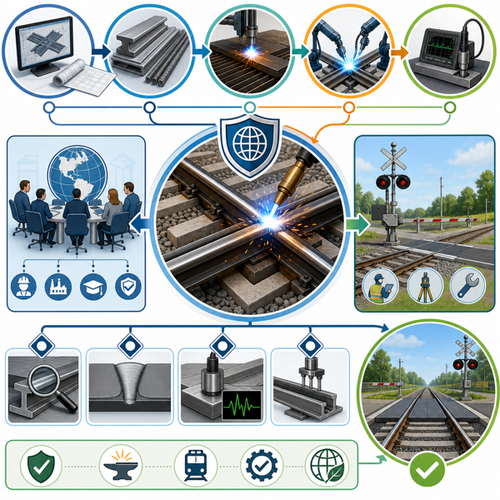
Staying at the forefront of rail infrastructure reliability and safety, the manufacturing engineering sector welcomes a significant update this October 2026: the publication of EN 14587-3:2026. This European standard targets the flash butt welding of rails in association with crossing construction—an area critical to both track performance and long-term safety. As the industry grows, stringent and detailed welding standards like this become vital for quality assurance, operational efficiency, and minimizing lifecycle costs. This article unpacks the new requirements, technical advancements, and practical impacts introduced in this revision, providing actionable insights for professionals across railway manufacturing and infrastructure maintenance.
Overview
The manufacturing engineering field underpins critical infrastructure worldwide, including railway networks that form the backbone of national economies and international logistics. In such high-demand environments, the integration of updated standards ensures durable, safe, and consistently high-quality results at every stage.
Welding in railway crossings presents unique challenges: precise material compatibility, fatigue resistance, and conformance to geometric requirements are non-negotiable. The new EN 14587-3:2026 builds on these imperatives with enhanced specifications, stricter quality measures, and a focus on both procedural approval and ongoing weld production.
In this article, you’ll discover:
- The main scope and functional coverage of EN 14587-3:2026
- Key requirements and specifications affecting manufacturers and railway authorities
- Industry-wide implications for implementation, testing, and compliance
- Expert insights into best practices for adopting the updated standard
Detailed Standards Coverage
EN 14587-3:2026 - Welding in Association with Crossing Construction
Railway applications - Infrastructure - Flash butt welding of rails - Part 3: Welding in association with crossing construction
EN 14587-3:2026 provides the most up-to-date framework for the approval and production of flash butt welded Vignole rails to crossing components—essential junctions and branches in railway track infrastructure. The standard is designed for fixed plant welding facilities responsible for joining:
- Vignole rails manufactured according to EN 13674-1
- Crossing components, including:
- Cast manganese crossings (EN 15689 compliant)
- Fabricated crossings from rail
- Crossings from forged/rolled premium steels
Scope and Applicability
This standard supersedes the previous EN 14587-3:2012 edition, tightening procedural controls and introducing clearer guidance on material compatibility and weld quality for manufacturers, suppliers, and railway authorities. The requirements facilitate the production of crossings meeting stringent performance, traceability, and safety criteria. The document also addresses special rail profiles, providing for case-by-case test requirements in collaboration with railway authorities.
Key Requirements and Specifications
- Comprehensive weld approval process: Established through detailed procedural trials in fixed welding plants—including requirements for welding machines, operator competencies, and supervisory systems.
- Welding process control: All flash butt welding operations must utilize RA (Railway Authority)-approved procedures and programmed automatic welding sequences.
- Workpiece preparation: Surfaces to be welded must be precisely machined, cleaned, and verified for dimensional conformity prior to welding. Tolerance for total mismatch is limited to a maximum of 2 mm.
- Clamping, burn-off, preheating, and post-weld treatment: Defined steps to minimize thermal and mechanical stress, ensuring weld integrity and consistent quality.
- Geometric and surface finishing requirements: Strict profile finishing guidelines to avoid localized stress concentrations and guarantee surface roughness within specified limits (e.g., ≤ 6.3 µm Ra in wheel contact area).
- Quality assurance system: Mandatory implementation of a quality management system with full documentation, traceability, and adherence to EN ISO 9001 guidance.
- Approval and production testing: Approval is based on a multifaceted testing protocol, with rigorous visual, geometric, and non-destructive evaluation—including:
- Visual and dimensional inspection (EN 13018)
- Liquid penetrant and magnetic particle tests
- Macro and micro-examination
- Bend and fatigue testing (with procedures for both austenitic and non-austenitic materials)
- Hardness and ultrasonic testing
- Weld identification and traceability: Unique identification for each weld, paramount for traceability and conformance checks.
- Expanded and clarified acceptance criteria: More detailed and transparent inspection protocols for foot dimensions, flat spots, lack of bond, alignment, and defect tolerances—with a new annex on geometric inspection.
Major Revisions from Previous Editions
- Clearer guidance on measuring foot dimension, with the introduction of gauges and reference tables
- Enhanced sequence and specificity for visual inspections
- More detailed criteria for flat spots and microstructure analysis
- Criteria for cross-acceptance of different rail materials
- Bend test requirements for new high-strength steel grades
- New annex for guidance on geometric inspection
Who Needs to Comply
- Fixed plant welding manufacturers involved in crossing and rail production
- Railway infrastructure contractors and project managers
- Quality managers, production supervisors, and compliance personnel in the rail sector
- Rail product procurement specialists and specifiers
- Railway authorities and regulatory bodies overseeing infrastructure works
Practical Implications for Implementation
Adoption of EN 14587-3:2026 streamlines rail crossing manufacturing, providing transparency and reliability from approval through production. The outcome—safer, higher-performing railway track infrastructure built with improved process consistency and greater traceability.
Key highlights:
- Enhanced procedural approval and testing regime for manufacturers
- Greater transparency and harmonization in defect and tolerance criteria
- Traceability and documentation required at every stage of weld production
Access the full standard:View EN 14587-3:2026 on iTeh Standards
Industry Impact & Compliance
The adoption of EN 14587-3:2026 brings substantial benefits and challenges for companies across the manufacturing engineering and railway sectors:
Effects on Businesses
- Competitive advantage: Early adopters of the standard can demonstrate superior compliance to clients and regulatory bodies, increasing marketability for public and private rail contracts.
- Improved safety and reliability: By adhering to rigorous testing, inspection, and documentation, businesses reduce the long-term risk of weld failures and costly maintenance disruptions.
- Streamlined QA/QC workflows: Uniform and transparent procedures facilitate both internal audits and external assessments, making the compliance process more predictable and manageable.
Compliance Considerations & Timelines
- Implementation required by April 2027: All national standards bodies within CEN must adopt the text or endorse it, with conflicting standards to be withdrawn by this deadline.
- Mandatory operator training and assessment: Staff must be certified for the relevant welding operations and verification techniques (following EN ISO 9712 and related standards).
- Audit and documentation: Seamless traceability and procedural records are non-negotiable for ongoing compliance; the quality management systems referenced must align with EN ISO 9001 and sector-specific best practices.
Benefits of Adoption
- Reduced rework and downtime
- Enhanced product/service reputation
- Immediate alignment with cross-border procurement and interoperability needs
Risks of Non-Compliance
- Potential barriers to participating in international contracts and tenders
- Increased risk of structural failure or service disruption—a significant safety hazard
- Liability and insurance complications should incidents arise
Technical Insights
Common Technical Requirements
- Automatic welding process control: All welding must be executed via programmable sequences with approved, fixed parameters.
- Inspection and testing rigor: Every weld must undergo rigorous, multi-tiered testing and verification—including non-destructive evaluation, dimensional checks, and fatigue testing where specified.
- Geometric precision: Maximum grinding lengths, flatness, and alignment tolerances are set not just for performance but for long-term durability under dynamic rail loads.
- Profile finishing discipline: Ensuring a smooth transition and correct shaping at welding interfaces minimizes stress concentration, reducing the risk of in-service failure.
Implementation Best Practices
- Integrate operator certification: Regularly verify and maintain current certifications for all welding operators, in accordance with EN ISO 9712 and related standards.
- Monitor, record, and audit all process parameters: Use digital management systems to log critical data (current, pressure, displacement, time, treatment cycles), linking them directly to weld identification numbers.
- Streamline defect detection and response: Adopt state-of-the-art visual, magnetic, and ultrasonic testing techniques for fast, accurate inspection.
- Plan for procedural audits and regular process validation: Institute periodic review points and clause-by-clause conformance assessments, particularly when introducing new materials or profiles.
- Document special cases jointly: For unusual profiles not covered in EN 13674, establish clear collaboration between the manufacturer and railway authority to document test requirements and acceptance criteria.
Testing & Certification Considerations
- Non-destructive testing (NDT): Personnel active in NDT must be trained and certified. Magnetic particle and liquid penetrant methods are applied based on the materials involved.
- Sample preparation and approval sequence: Manufacturers must prepare specimen welds reflecting actual production methods and undergo rigorous approval tests—including multiple macro/micro examinations, bend and fatigue testing, hardness checks, and ultrasonic scans.
- Continuous improvement and data-driven adjustment: Outcome data from testing routines should inform process adjustments and drive quality improvements over time.
Conclusion & Next Steps
EN 14587-3:2026 signals a significant step forward in manufacturing engineering, delivering clearer, stricter, and more actionable requirements for the flash butt welding of rails in railway crossing construction. Its enhanced focus on approval, testing, defect criteria, and documentation is set to reshape QA/QC workflows across the European railway sector and beyond.
Key takeaways:
- The standard delivers transparency, repeatability, and safety improvements for all parties in rail infrastructure manufacturing and maintenance.
- Early adoption is essential for businesses seeking to remain compliant, compete for international contracts, and ensure the highest levels of operational safety.
Recommendations for organizations:
- Review and update operational protocols against the new requirements
- Invest in operator training and process documentation
- Engage quality and compliance teams in preemptive process audits
- Collaborate with railway authorities for profile-specific testing needs
Stay ahead: Explore the full details and official specifications of this critical new standard directly on iTeh Standards. Ensuring compliance with EN 14587-3:2026 not only future-proofs your operations but also ingrains safety, quality, and client trust into every weld.
Access the full standard:View EN 14587-3:2026 on iTeh Standards
Categories
- Latest News
- New Arrivals
- Generalities
- Services and Management
- Natural Sciences
- Health Care
- Environment
- Metrology and Measurement
- Testing
- Mechanical Systems
- Fluid Systems
- Manufacturing
- Energy and Heat
- Electrical Engineering
- Electronics
- Telecommunications
- Information Technology
- Image Technology
- Precision Mechanics
- Road Vehicles
- Railway Engineering
- Shipbuilding
- Aircraft and Space
- Materials Handling
- Packaging
- Textile and Leather
- Clothing
- Agriculture
- Food technology
- Chemical Technology
- Mining and Minerals
- Petroleum
- Metallurgy
- Wood technology
- Glass and Ceramics
- Rubber and Plastics
- Paper Technology
- Paint Industries
- Construction
- Civil Engineering
- Military Engineering
- Entertainment